
What to Do When Your Flight Is Cancelled (AU Rights Guide)
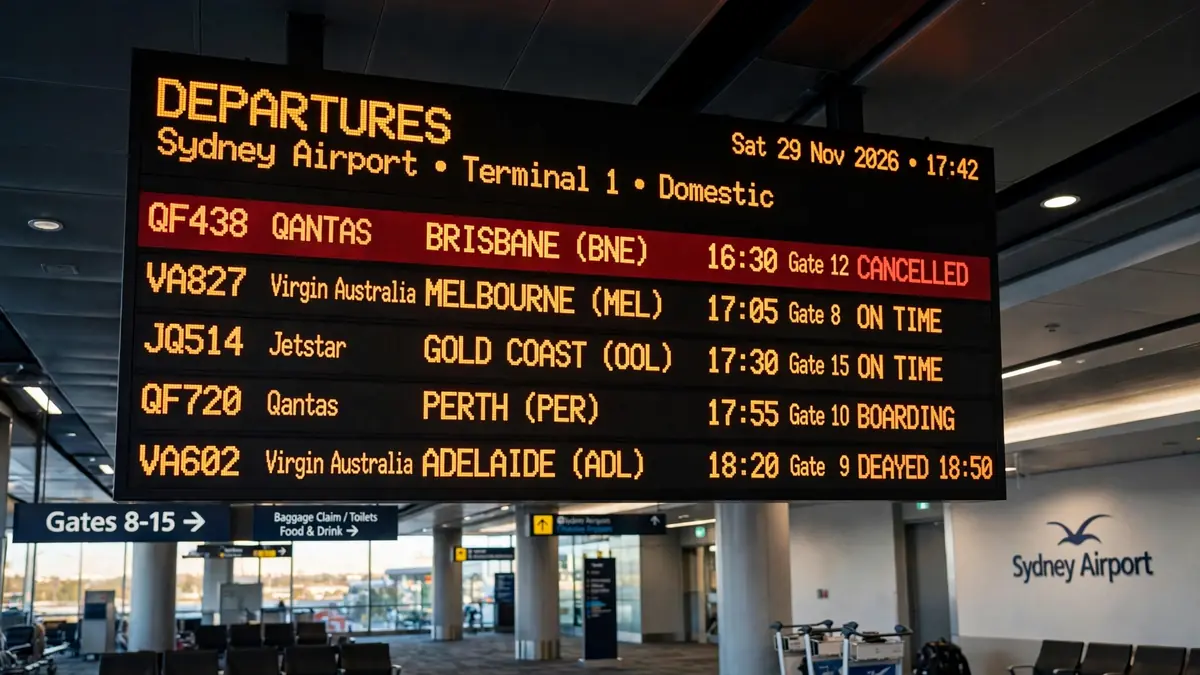
Your flight is cancelled. The departure board is red, the queue at the service desk is 40 deep, and nobody is telling you anything useful. What you do in the next 30 minutes determines whether you get home tonight or sleep on terminal chairs — and what you are owed afterwards. This guide covers your flight cancelled Australia rights: immediate steps, refunds vs rebooking, what Australian Consumer Law actually entitles you to, and how to escalate when the airline stonewalls.
The First 30 Minutes: Act Fast
1. Do not join the queue (yet)
While everyone queues at the desk, open the airline’s app and website. Rebooking options often appear there first, and phone lines sometimes move faster than the physical queue. Do all three in parallel if you can: app, phone, queue.
2. Check what you have been offered
Airlines typically auto-rebook you on the next available flight. Check whether the new flight works — if it does not (wrong day, wrong city, misses your connection), you are entitled to alternatives. Do not accept a useless rebooking by default.
3. Screenshot everything
The cancellation notice, the original booking, the rebooking offer, any airline messages. If this becomes a dispute, contemporaneous evidence wins.
4. Keep receipts for everything you spend
Meals, accommodation, transport, phone calls — every dollar. You will need them for reimbursement claims.
Your Rights Under Australian Consumer Law
Here is what most travellers do not know: flights are services covered by automatic consumer guarantees under Australian Consumer Law — and these rights cannot be excluded by the airline’s terms and conditions, no matter what the fine print says. The ACCC has taken enforcement action against Qantas, Virgin, Jetstar and Tigerair over misleading refund representations, resulting in court-enforceable undertakings and (for Jetstar) a $1.95 million penalty.
The key guarantee: services must be provided within a reasonable time. If your flight is cancelled or significantly delayed for a reason within the airline’s control (crew issues, mechanical faults, scheduling — not weather or air traffic control), and the airline cannot get you there within a reasonable time, you are entitled to a remedy. That means your choice of a replacement flight or a refund — not just a credit note, and not just whatever the airline prefers.
Important nuances:
- It applies to: flights within Australia, international flights departing Australia, and international flights to Australia booked through the airline’s Australian website — regardless of whether you booked direct, through an agent or via a third party.
- “Within the airline’s control” matters: weather, air traffic control and security events are generally outside the airline’s control; mechanical and crewing issues are inside it.
- No EU-style automatic cash compensation: unlike Europe’s EC261, Australia has no fixed compensation amounts for delays. Your remedy is rebooking or refund, plus reasonable expenses in some cases — not a set payout per hour delayed.
- Airlines cannot say “no refunds”: blanket “non-refundable” statements about fares are misleading under the ACL when consumer guarantees apply.
Read the ACCC’s consumer guidance at accc.gov.au — it is the authoritative reference.
Refund vs Rebooking vs Credit: Choose Wisely
- Rebooking: usually the best option if you still need to travel. Push for the earliest workable flight — including on partner airlines if yours has none. Be firm but polite; agents have more discretion than they admit.
- Refund: choose this if the trip is ruined or you will make your own arrangements. You are entitled to a refund to your original payment method — not a credit voucher — when the airline cancels and cannot offer a reasonable alternative.
- Credit/voucher: only accept if it genuinely suits you. Credits expire, and you lose the leverage of a refund. Never accept a credit when you are entitled to a refund unless you prefer it.
Expenses: What You Can Claim
If the cancellation strands you overnight away from home, airlines’ own policies often cover reasonable accommodation and meals — Virgin, for example, provides for accommodation and meals for passengers delayed overnight away from their home port (with caps). Keep every receipt and claim through the airline first. If the airline refuses reasonable expenses for a cancellation within its control, that refusal can form part of a consumer guarantee complaint.
Your travel insurance is the second layer: most policies cover additional accommodation, meals and rebooking costs after a delay threshold (often 6 hours). File with the airline first, then the insurer for the remainder — our guide to what travel insurance covers explains the interaction.
Step-by-Step: The Cancellation Playbook
- At the airport: rebook via app/phone/desk in parallel; screenshot everything; keep all receipts.
- Within 24 hours: confirm the rebooking in writing; if you want a refund instead, request it explicitly and in writing.
- Within a week: submit expense claims to the airline with receipts; file travel insurance claims for anything the airline does not cover.
- If the airline refuses: lodge a formal written complaint quoting the consumer guarantees. Give them a reasonable time to respond (2-4 weeks).
- Still stuck: escalate to the Airline Customer Advocate — a free service for eligible complaints against participating Australian airlines.
- Last resort: your state/territory fair trading or consumer protection agency, or the small claims tribunal. The amounts involved usually fit tribunal limits.
Special Cases
Cancelled by you vs cancelled by them
These are completely different. If you cancel, the fare rules apply — and most cheap fares are non-refundable by choice. Consumer guarantees do not help when you simply change your mind. (This is why flexible fares and insurance exist.) If they cancel, the guarantees above apply.
Missed connections on separate tickets
If you booked two separate tickets and the first is cancelled, the second airline owes you nothing — your contract is per ticket. This is the risk of split-ticket savings (see our cheap flight strategies). Travel insurance is your only backstop here.
Weather cancellations
When weather cancels flights, the airline still must get you rebooked or refunded — but “within the airline’s control” arguments around expenses get murkier. You will get home; claiming the hotel bill is harder. Insurance fills this gap.
Australia vs the EU: Why the Difference?
Travellers often ask why Europe mandates fixed cash compensation (EC261: €250-€600 depending on distance and delay) while Australia relies on consumer guarantees. The short answer is regulatory history: the EU legislated specific airline passenger rights; Australia has relied on general consumer law plus airline policies. The federal government has been developing an Aviation Consumer Ombuds Scheme — expected to clarify rights around refunds, minimum assistance and complaint handling from 2026. Until it is operational, the consumer guarantee framework plus the Airline Customer Advocate is what you have. Know it, use it, document everything.
Claiming on Travel Insurance After a Cancellation
Your insurer and the airline owe you different things, and claiming in the right order matters. First, the airline: rebooking or refund, plus any expenses their policy covers. Then, insurance: additional accommodation, meals and transport costs beyond what the airline paid, after your policy’s delay threshold (commonly 6 hours). Insurers will ask what the airline already provided — claiming the same expense twice is fraud, so keep the airline’s settlement letter. File promptly: most policies require claims within 30 days, and receipts are mandatory.
Writing a Complaint That Gets Results
Vague complaints get vague responses. An effective complaint includes: booking reference, flight numbers and dates, a timeline of what happened, what you are seeking (refund amount, specific expenses with receipts attached), and a reference to the consumer guarantee (“services were not provided within a reasonable time”). Set a deadline for response (14-21 days) and state your next step (Airline Customer Advocate, fair trading agency). Send it in writing — email creates a paper trail that phone calls do not. One well-documented complaint beats ten angry tweets.
Delays (Not Cancellations): What Are You Owed?
Long delays without cancellation sit in a greyer area. The consumer guarantee of services “within a reasonable time” still applies — a 6-hour delay on a 1-hour flight is harder to defend as reasonable than a 1-hour delay on a 14-hour one. In practice: ask the airline for meal vouchers after 2-3 hours, and for accommodation if the delay runs overnight. Document the delay’s cause if the airline states it (mechanical vs weather matters for later claims). Your travel insurance’s delay benefit (often $100-$200/day after 6 hours) is the reliable backstop — file with receipts. And if a delay causes you to miss a prepaid tour, cruise or event, both the airline claim and the insurance claim should reflect those consequential losses.
Codeshare Cancellations: Who Owes You?
When your Qantas-coded flight operated by another airline is cancelled (or vice versa), both airlines may point at each other. The rule: your contract is with the airline you booked with (the marketing carrier on your ticket) — they owe you the rebooking or refund. The operating carrier owes you the duty of care on the day. In practice, deal with whoever is at the airport first for immediate rebooking, then pursue the refund/expense claim with the airline named on your booking confirmation. Screenshot both airlines’ communications — finger-pointing is common, and evidence ends it.
The Evidence Folder: What to Keep
Create a folder (physical or digital) for every disrupted trip containing: the original booking confirmation, the cancellation/delay notification, screenshots of rebooking offers, all receipts (meals, hotels, transport, phone), correspondence with the airline (reference numbers, names, dates), your insurance policy and claim number, and a one-page timeline of events. This folder is what turns a vague complaint into a winning one — at the Airline Customer Advocate, at AFCA for insurance disputes, or at a tribunal. Most passengers who “get nowhere” simply have no evidence. Be the passenger with the folder.
When the Airline Offers Nothing: Escalation That Works
Some airlines simply refuse — no rebooking help, no refund, no response. The escalation ladder that actually works: 1. Social media (public): a factual, unemotional public post with your booking reference often gets a faster response than any queue — airlines staff social teams to protect their reputation. 2. The Airline Customer Advocate: free, independent, and airlines take it seriously because outcomes are tracked. 3. Your bank: if you paid by credit card and the service was not provided, a chargeback is a legitimate remedy — your bank reverses the payment and the airline must dispute it. 4. Fair trading / tribunal: for amounts under the tribunal limit (which covers most fares), filing is cheap and airlines usually settle rather than attend. The common thread: every step requires your evidence folder. Start building it at the airport, not months later.
Frequently Asked Questions
What are my rights if my flight is cancelled in Australia?
Under Australian Consumer Law, flights carry automatic consumer guarantees — including that services be provided within a reasonable time. If your flight is cancelled for a reason within the airline’s control and no reasonable alternative is offered, you’re entitled to your choice of a replacement flight or a refund to your original payment method. Airlines cannot exclude these rights in their terms.
Can I get compensation for a cancelled flight in Australia?
Australia has no EU-style automatic cash compensation scheme. Your core rights are rebooking or refund, plus reasonable expenses (meals, accommodation) in some cases — particularly for overnight delays away from home. Travel insurance covers additional costs after delay thresholds.
Should I accept a credit voucher for a cancelled flight?
Only if it genuinely suits you. When the airline cancels and can’t offer a reasonable alternative, you’re entitled to a refund to your original payment method — not just a credit. Credits expire and remove your leverage. Never accept one under pressure.
What is the Airline Customer Advocate?
A free dispute-resolution service for eligible complaints against participating Australian airlines. If the airline’s formal complaints process hasn’t resolved your issue, the Advocate can review it independently at no cost to you.
What if I miss a connection on separate tickets?
The second airline owes you nothing — your contract is per ticket when you book separately. This is the key risk of split-ticket savings. Travel insurance is your only backstop, so check your policy covers missed connections on separate bookings.