
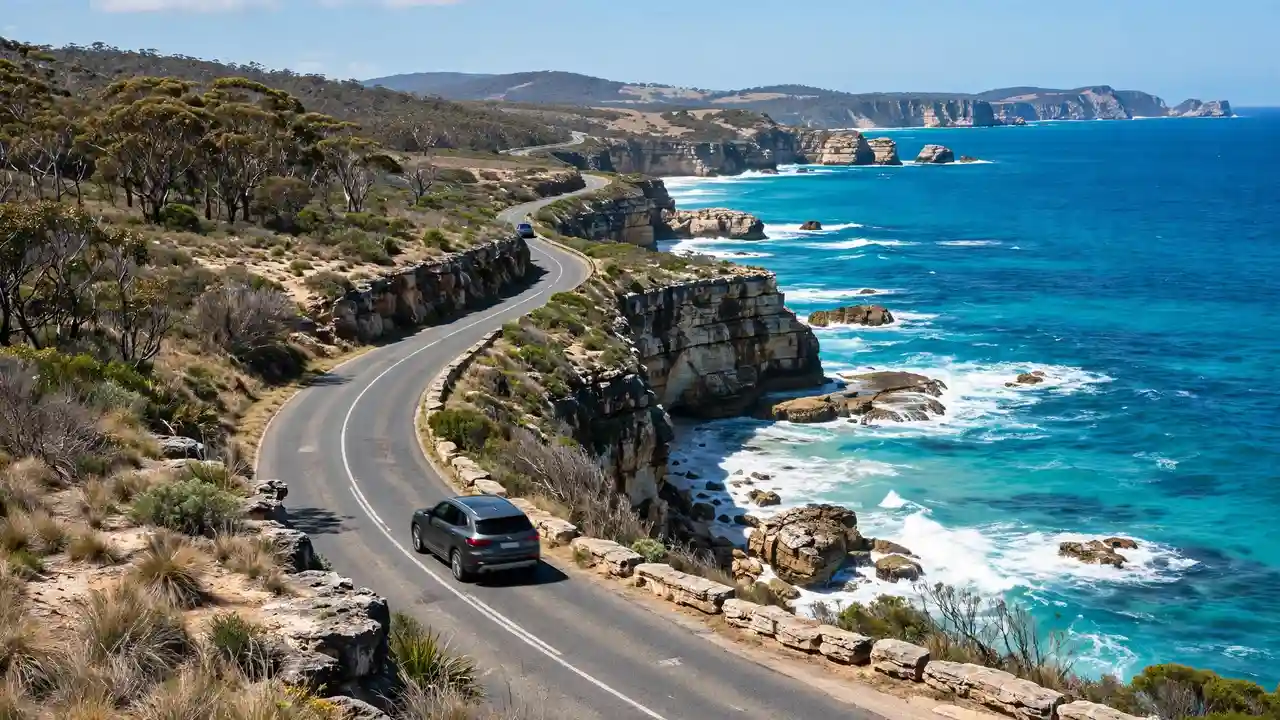
Best Road Trips in Australia: 15 Epic Routes You Have to Drive
Australia is made for road trips. With its enormous distances, empty highways and jaw-dropping variety of landscapes — from tropical coastline to red desert — there is no better way to see this country than behind the wheel. These are the best road trips in Australia, ranked and mapped for your next great adventure.
Whether you have a long weekend or a full month, there’s a route on this list for you. We’ve focused on drives with real variety, good infrastructure, and the kind of scenery that makes you stop the car every ten minutes. Australians grow up on road trip mythology — the big lap, the Nullarbor crossing, the surf-coast pilgrimage — and these 15 routes are where that mythology lives. Buckle up.
1. Great Ocean Road, Victoria (Melbourne to Warrnambool)
Great Ocean Road is Australia’s most famous drive, and it earns the reputation. Stretching roughly 240 kilometres from Torquay to Warrnambool, this cliff-hugging highway delivers the Twelve Apostles, Loch Ard Gorge, the Otways rainforest and endless surf beaches. Three days is ideal — one day just isn’t enough to do it justice.
Highlights include Bells Beach, the seaside towns of Lorne and Apollo Bay, and the Shipwreck Coast near Port Campbell. Drive east to west so the ocean is on your side of the road, and start early to beat the tour buses at the Apostles.
2. Pacific Coast Drive, NSW (Sydney to Brisbane)
The roughly 900-kilometre stretch of the Pacific Highway between Sydney and Brisbane is one of the country’s great coastal journeys. You’ll pass through the Central Coast, Byron Bay, Coffs Harbour and the Gold Coast, with detours to national parks and surf towns the whole way. Allow at least five days — a week if you can. See our full Pacific Coast Drive Sydney to Brisbane itinerary for the day-by-day plan.
3. Eyre Highway and the Nullarbor Crossing, WA/SA
Perth to Adelaide across the Nullarbor Plain is the quintessential Australian road trip — around 2,700 kilometres of it, with the famous 1,200-kilometre Nullarbor stretch in the middle. It’s a rite of passage: the longest straight road in the country (146 kilometres of dead-straight bitumen), whale watching at the Head of the Bight, and some of the most remote coastline on Earth. Our complete Nullarbor Crossing guide covers fuel stops, distances and planning essentials.
4. Savannah Way, Queensland/NT/WA (Cairns to Broome)
The Savannah Way runs 3,700 kilometres from Cairns to Broome, crossing the Gulf Savannah, the Northern Territory outback and into the Kimberley. This is a proper adventure drive — river crossings, gorge country, remote communities and fishing that will ruin every other fishing trip for you. Two to three weeks minimum, and a high-clearance 4WD is strongly recommended in the dry season (May to October). Full route details in our Savannah Way road trip guide.
5. The Red Centre Way, Northern Territory
Alice Springs to Uluru to Kings Canyon and back via the West MacDonnell Ranges is the classic outback loop. Roughly 1,200 kilometres return, this trip packs Uluru-Kata Tjuta National Park, Kings Canyon’s rim walk and the waterholes of the MacDonnells into five or six days. Winter (June to August) is the sweet spot — mild days, cold nights, crystal-clear light.
6. Great Alpine Road, Victoria
Australia’s highest sealed road runs from Wangaratta to Bairnsdale through the Victorian Alps, climbing to 1,750 metres at Mount Hotham. The 340-kilometre route winds through snow gums, alpine villages and the old gold town of Bright. Spectacular in autumn (April is magic in Bright) and a snow-dusted wonderland in winter, though you’ll need to carry chains.
7. Tasmania’s East Coast (Hobart to the Bay of Fires)
Hobart to the Bay of Fires via the Great Eastern Drive is one of the prettiest short road trips in the country — about 300 kilometres each way. Wineglass Bay in Freycinet National Park, the orange-lichen-covered boulders of the Bay of Fires, fresh oysters in Swansea and the convict history of Port Arthur. Five days lets you linger.
8. South Coast, NSW (Sydney to Eden)
South of Sydney, the Princes Highway rolls through the Royal National Park, Wollongong’s Sea Cliff Bridge, the dairy country of Kiama and the fishing towns of Bermagui and Eden. The roughly 480-kilometre run to Eden takes you through some of the best-preserved coastline in NSW, with whale watching (May to November) as a bonus.
9. Gibb River Road, Western Australia
The 660-kilometre Gibb River Road through the Kimberley is the 4WD adventure of legend. Windjana Gorge, Tunnel Creek, Bell Gorge, Manning Gorge and El Questro — all in the dry season, roughly April/May to October. It’s corrugated, remote and utterly unforgettable. Do not attempt it without preparation, recovery gear and plenty of water.
10. Kangaroo Island and the Fleurieu Peninsula, South Australia
From Adelaide, the Fleurieu Peninsula leads to Victor Harbor and the ferry to Kangaroo Island, where Remarkable Rocks, Admirals Arch, wild koalas and pristine beaches await. Four or five days for the whole loop. The island’s wildlife alone — kangaroos, echidnas, sea lions — justifies the ferry fare.
11. The Grand Pacific Drive, NSW
Only 140 kilometres from Sydney to Wollongong, but packed: the Royal National Park, Stanwell Tops, and the Sea Cliff Bridge that arcs over the ocean. It pairs perfectly with a South Coast trip or works as a brilliant one-day drive from Sydney.
12. Matilda Highway, Queensland
The inland route from the Sunshine Coast to Charleville and the outback beyond, following the highway named for “Waltzing Matilda”. Cunnamulla, Charleville’s Cosmos Centre (dark skies), and the start of true outback Queensland. Best in winter; summer is brutal out here.
13. Cairns to Cape Tribulation, Queensland
Seventy-five kilometres of rainforest road from Cairns to Cape Tribulation, where the Daintree meets the reef. Mossman Gorge, the Daintree Ferry and Cape Tribulation’s beaches — where two World Heritage areas collide. Two or three days, and the drive along the Captain Cook Highway is a destination in itself.
14. The Waterfall Way, NSW
From Coffs Harbour to Armidale, the Waterfall Way lives up to its name: Dangar Falls, Ebor Falls and Wollomombi Falls, plus the World Heritage rainforests of Dorrigo National Park. Around 185 kilometres of winding mountain road — short, sweet and waterfall-packed.
15. The Silo Art Trail, Victoria
Across the Wimmera-Mallee region of northwest Victoria, giant painted silos turn grain towns into an open-air gallery. The roughly 200-kilometre loop from Rupanyup to Patchewollock is best as a long weekend from Melbourne, with stops at Grampians National Park on the way.
How to Plan an Australian Road Trip
Distances and driving times
Australian distances catch out first-timers. Sydney to Melbourne is nearly 900 kilometres; Perth to Adelaide is about 2,700. Plan rest stops every two hours — fatigue is a genuine killer on long, straight outback roads, and kangaroos are most active at dawn and dusk, so avoid driving then in rural areas.
Fuel and supplies
On remote routes like the Nullarbor, Gibb River Road and Savannah Way, fuel stops can be 200+ kilometres apart and fuel is expensive. Top up at every opportunity, carry extra water (at least 5–10 litres per person in the outback), and download offline maps — phone coverage vanishes for long stretches.
Best time of year
There is no single best season; it depends on the route. The Top End and Kimberley are dry-season only (roughly May to October). The Red Centre is best in winter (June to August). The south coast and Tasmania shine in summer and autumn. Always check road conditions before remote trips via state road authority sites.
Renting vs buying a camper
Campervans and 4WD campers are the classic way to do these routes, with rentals from major companies in every capital city. For a trip longer than a month, backpackers often buy a cheap van and resell it — just get a proper roadworthy inspection first. And if you’re planning to camp free along the way, read our guide to free camping in Australia before you go.
Choosing the Right Vehicle
Most of the routes on this list are fully sealed and fine in a standard car — the Great Ocean Road, Pacific Coast, South Coast and Tasmania’s east coast need nothing special. The outback routes are a different story. The Nullarbor is sealed and doable in any roadworthy car, but the Savannah Way, Gibb River Road and the Bungles turnoff demand a high-clearance 4WD with good tyres and recovery gear.
Campervans are the classic Australian road trip vehicle for good reason: they solve accommodation and transport in one, and the country is set up for them with caravan parks, dump points and free camps everywhere. For trips over three weeks, compare rental costs against buying a used van — the backpacker buy-drive-sell market is well established, but get an independent roadworthy inspection before handing over cash. Whatever you drive, a full-size spare tyre (not a space-saver), a tyre compressor and a basic tool kit are non-negotiable outside the cities.
Outback Driving Safety Essentials
Road trains are the defining feature of outback highways — up to 53 metres long, and they cannot swerve or stop quickly. When one approaches from behind, slow down, move left and let it pass; when overtaking, allow enormous distance and don’t cut back in early. Never drive at dawn, dusk or night in kangaroo country — the risk of a serious animal strike is real, and it peaks in the low-light hours.
Fatigue kills more outback drivers than anything else. The monotony of the Nullarbor or the Stuart Highway is genuinely hypnotic: take a break every two hours, share driving, and never push through drowsiness. Carry 5–10 litres of water per person, keep your fuel above half a tank in remote areas, and make sure someone knows your route and expected check-ins. A satellite communicator is cheap insurance where there’s no phone signal — and on the remote routes, there’s no phone signal for hundreds of kilometres at a time.
Road Trip Apps and Planning Tools
A few apps make Australian road trips dramatically easier. WikiCamps Australia is essential for finding campsites (free and paid) with reviews and offline access. Fuel Map or similar fuel-price apps help you plan cheap fill-ups before remote stretches. The state road authority apps (Live Traffic NSW, VicTraffic, Main Roads WA) give real-time closures and roadworks. And download offline maps in Google Maps or Maps.me before any remote route — you will lose signal, guaranteed. A paper road atlas as backup is old-school wisdom that still applies in the outback.
Frequently Asked Questions
What is the best road trip in Australia for first-timers?
The Great Ocean Road is the best first-timer road trip in Australia. It’s close to Melbourne, takes just two to three days, has excellent infrastructure, and packs iconic scenery — the Twelve Apostles, rainforest, surf towns — into a single manageable drive.
How long does it take to drive across Australia?
Driving across Australia from Sydney to Perth takes about 4 days of solid driving (around 4,000 kilometres via the Nullarbor), but most travellers take 7–10 days to enjoy the stops. North to south (Darwin to Adelaide) is around 3,000 kilometres and takes 3–5 days of driving.
What is the best time of year for an Australian road trip?
It depends on the route. Southern routes (Great Ocean Road, Tasmania, South Coast) are best in the warmer months from October to April. Northern and outback routes (Kimberley, Savannah Way, Red Centre) are best in the dry season from May to October.
Is it safe to drive in the Australian outback?
Yes, with preparation. Carry plenty of water, fuel up at every opportunity, tell someone your plans, download offline maps, and never leave the main road without a 4WD and recovery gear. Check road conditions with state authorities before remote travel.
Learn more about driving conditions and road safety across the country at the Australian Government’s Bureau of Infrastructure, Transport and Regional Economics, which publishes road safety data and travel statistics.