
Great Ocean Road Itinerary: 3 Days
This Great Ocean Road itinerary covers one of the world’s great coastal drives — 243 km of winding cliff road from Torquay to Allansford, built by returned WWI soldiers as a memorial to the fallen. In three days you’ll see the Twelve Apostles at sunset, the shipwreck story of Loch Ard Gorge, the rainforest of the Otways, koalas in the wild at Kennett River, and beach towns from Lorne to Port Campbell. This is the drive every Australia visitor should do once.
The key decision: self-drive vs tour. Self-driving gives you sunrise/sunset at the Apostles (the day-tour buses arrive midday) and the freedom to stop where you like. Day tours from Melbourne are efficient but rushed — the 12-hour round trip spends half the day on the bus. This 3-day itinerary assumes a hire car; variations for tours and 2-day trips are covered below.
Before You Go: Driving the Great Ocean Road
- Drive direction: Melbourne → west means you drive on the ocean side (left side of the road) — the views are better and the lookouts are easier to pull into. The road officially starts at Torquay (the surf capital) and ends at Allansford near Warrnambool.
- The road is winding: 243 km takes 5+ hours of pure driving; with stops, each leg is a full day. Take motion-sickness precautions if prone.
- Book accommodation ahead — Lorne, Apollo Bay and Port Campbell have limited beds and sell out in summer.
- Fuel: fill up in Torquay/Lorne and Apollo Bay; stations are sparse between.
- Wildlife: kangaroos and koalas near the road at dawn/dusk — drive carefully.
Day 1: Melbourne → Apollo Bay (via Lorne)
Driving: ~185 km, 3.5–4 hours driving, full day with stops.
Leave Melbourne by 8 am via the M1 and Anglesea Road to Torquay — the official start, home of Bells Beach (the famous surf break, 10 minutes south — the lookout is worth the detour even if you don’t surf). The road gets spectacular after Aireys Inlet: the Split Point Lighthouse (tours available), Fairhaven Beach, and the cliff-hugging bends.
Lorne (1.5 hours from Melbourne) is the classic lunch stop: the Lorne Pier, the Great Ocean Road Heritage Centre, and Teddy’s Lookout for the coastal panorama. Behind Lorne, the Erskine Falls (30-m waterfall, 10 minutes inland) is worth the detour.
Continue through Wye River and Kennett River — stop at Kennett River for wild koalas (look up in the manna gums along Grey River Road; the Kafe Koala will point you). The Otway Fly Treetop Adventures (near Beech Forest, 45 minutes inland) offers a treetop walk and zipline through mountain ash forest.
Overnight in Apollo Bay — the road’s prettiest town: a sweeping beach, the Mariners Lookout at sunset, and excellent seafood on the foreshore. Driving: Torquay → Apollo Bay ~120 km of the best coastal road in Australia.
Day 2: Apollo Bay → Port Campbell (via the Otways and the Apostles)
Driving: ~170 km, 3–4 hours driving, full day with stops.
Morning: drive the inland detour to the Otways rainforest — Maits Rest Rainforest Walk (30-minute boardwalk through ancient myrtle beech and tree ferns) and the Triplet Falls (1-hour loop). Then rejoin the coast at Princetown.
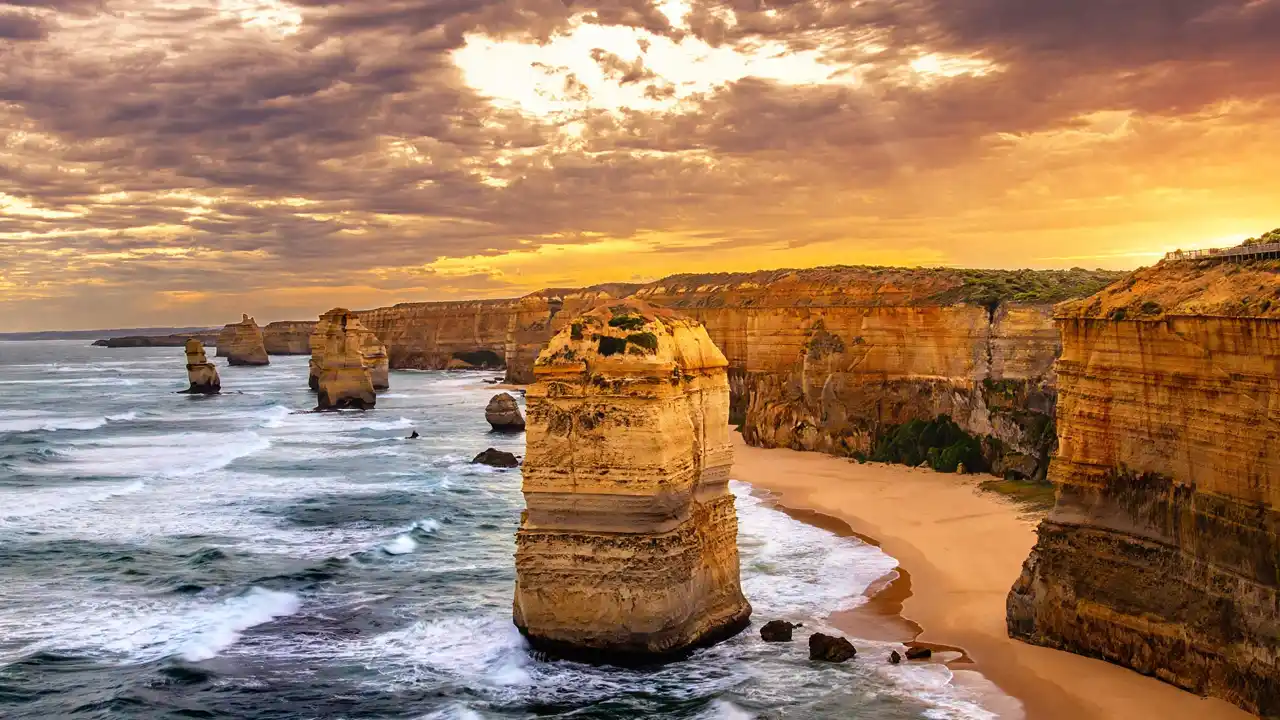
Afternoon: the Shipwreck Coast — the itinerary’s climax. Twelve Apostles (the viewing platforms face west — sunset is the time; arrive 1 hour before for a good spot at the main platform). Despite the name, fewer than twelve stacks remain standing — the sea keeps taking them. Then Loch Ard Gorge (the 1878 shipwreck story, the beach, Thunder Cave, the Arch), The Razorback, and the Gibsons Steps (descend to the beach for the worm’s-eye view of the Apostles).
Overnight in Port Campbell — the tiny town 10 minutes from the Apostles. Book dinner ahead; options are limited. Tip: staying here lets you revisit the Apostles at sunrise (empty platforms, soft light) before the crowds.
Day 3: Port Campbell → Melbourne (via the Inland Route)
Driving: ~230 km, 3–3.5 hours.
Morning: sunrise at the Twelve Apostles (optional but recommended), then the remaining Shipwreck Coast sights: London Bridge (the collapsed arch — the 1990 collapse stranded two tourists on the new island), The Grotto (a sinkhole with ocean views), and Bay of Martyrs / Bay of Islands near Peterborough.
Return to Melbourne via the inland route (Princes Highway through Camperdown and Colac) — faster (3 hours) and different scenery: volcanic plains, crater lakes (Lake Corangamite), and the Red Rock Lookout. Alternatively, re-drive the coast eastbound for a second look — slower but spectacular.
Back in Melbourne by late afternoon. See our Melbourne neighbourhoods guide for where to stay.
2-Day and Tour Variations
2 days: Day 1 as above to Apollo Bay; Day 2 Apollo Bay → Apostles → return to Melbourne via inland route (long day, 6+ hours driving). Rushed but doable.
Day tour from Melbourne: 12–14 hour tours (around A$150–200 per person, approximately) visit the Apostles, Loch Ard Gorge, Otways rainforest and Kennett River koalas. Efficient, but you see the Apostles at midday with the crowds and spend 6+ hours on the bus. Small-group tours (max 20) are far better than the big coaches.
Helicopter: 15-minute flights over the Apostles from the heliport near Port Campbell (from around A$150 per person) — the scale is only fully visible from the air.
Where to Stay
- Lorne: the upmarket option — best dining on the road, beautiful beach. A$220–350/night.
- Apollo Bay: the sweet spot — pretty town, good food, reasonable prices. A$180–280/night.
- Port Campbell: the practical Apostles base — limited but adequate. A$170–260/night. Book early.
- Otways hinterland: rainforest B&Bs and cottages around Beech Forest and Forrest — quiet and magical.
Where to Eat
- Lorne: the best restaurants on the road — MoVida Lorne, the Bottle of Milk (the famous burger joint).
- Apollo Bay: Chris’s Beacon Point (clifftop fine dining), the Apollo Bay Fishermen’s Co-op (the freshest fish and chips on the road).
- Port Campbell: 12 Rocks Beach Bar, the Port Campbell Hotel — book ahead.
- Roadside: the Wye River General Store and Kennett River Kafe Koala for lunch stops.
What It Costs (Self-Drive, 3 Days)
Approximate per-person (two sharing): hire car A$250–400 for 3 days; fuel ~A$120; accommodation A$180–300/night; food A$80–120/day; activities (Otway Fly, helicopter optional) A$50–200. Budget roughly A$900–1,400 per person for 3 days — the road itself and all the lookouts are free.
Practical Tips
- Sunset at the Apostles is non-negotiable — plan Day 2 around it.
- Sunrise at the Apostles (Day 3) has empty platforms — worth the early alarm if you overnight at Port Campbell.
- Motion sickness: the road twists constantly — sit up front, look at the horizon, consider tablets.
- Phone coverage: patchy between towns — download the route offline.
- Weather: the Shipwreck Coast is wild — bring a windproof jacket even in summer; the mist and drama are part of it.
- Penguins: London Bridge has a small penguin colony visible at dusk (free, quiet, magical).
The Great Ocean Road is Victoria’s signature drive — pair it with Phillip Island for the full Melbourne touring loop, or contrast it with our Tasmania road trip. For official trip ideas, see visitvictoria.com.
The Otways Deep Dive: Waterfalls and Treetops
The Great Otway National Park — the rainforest behind the coast — deserves more than a drive-by. The inland loop (Apollo Bay → Beech Forest → Lavers Hill → Princetown) adds 2 hours but delivers the road trip’s green heart:
- Maits Rest Rainforest Walk: the 30-minute boardwalk — myrtle beech, tree ferns, fungi. The easiest rainforest immersion on the road.
- Triplet Falls: the 1-hour loop — three cascades in mountain ash forest. The best waterfall on the Otways loop.
- Hopetoun Falls: the 30-m plunge — the viewing platform is a short walk from the carpark. Photographers’ favourite (the long-exposure shot).
- Beauchamp Falls: the 3-km return walk — quieter, wilder, glow worms at night.
- Otway Fly Treetop Adventures: the 600-m elevated walkway (25 m high) through the mountain ash canopy, plus the Zipline Tour (the “cloud station” — flying through the treetops). Around A$30–130 per person (approximately) depending on the experience.
- Cape Otway Lightstation: the 1848 lighthouse — Australia’s oldest surviving lighthouse, 90 m above the Southern Ocean. The tour (around A$20, approximately) includes the keepers’ quarters and WWII radar bunker.
Great Ocean Road Photography Tips
- Twelve Apostles at sunset: the main platform faces west — arrive 1 hour before sunset for the front-row spot. The light on the stacks peaks in the last 30 minutes.
- Gibsons Steps at low tide: the beach-level view — the Apostles towering above. Check tides (the beach disappears at high tide).
- Loch Ard Gorge at sunrise: the eastern light fills the gorge — empty before the tour buses.
- The Razorback: the long-exposure shot — the waves wrapping the rock spine.
- London Bridge at dusk: the penguin colony — little penguins coming ashore (no flash, quiet).
- Gear: a tripod for the sunset long-exposures, a wide-angle for the stacks, lens cloths for the sea spray.
Port Campbell and Peterborough: The Shipwreck Coast Towns
- Port Campbell: the Apostles base — the 12 Rocks Beach Bar (the sunset drinks spot), the Port Campbell Hotel (the pub), Sow and Piglets (the café). The Port Campbell Discovery Walk (the foreshore trail) is the evening stroll.
- Peterborough: 15 minutes west — quieter, cheaper, the Bay of Islands and Bay of Martyrs on the doorstep. The Peterborough general store does the local lunch.
- Timboon: 20 minutes inland — the Timboon Railway Shed Distillery (the whisky and gin in the old railway shed), Timboon Fine Ice Cream, and the Curdies River platypus spotting (dawn/dusk).
Great Ocean Road’s Best Short Walks
The road is the star, but the short walks are the secret:
- Maits Rest Rainforest Walk: 30 minutes — the boardwalk (the Otways).
- Triplet Falls: 1 hour — the loop (the cascades).
- Erskine Falls: 30 minutes — the lookout (the 30-m falls, Lorne hinterland).
- Sheoak Falls: 1 hour return — the Swallow Caves (the Lorne hinterland).
- Teddy’s Lookout: 20 minutes — the panorama (the Lorne coastline).
- Cape Otway Lightstation: 1 hour — the grounds (the lighthouse, the WWII bunker).
- Gibsons Steps: 30 minutes — the beach (the Apostles from below).
- Loch Ard Gorge: 1 hour — the loop (the gorge, Thunder Cave, the Arch).
- The Grotto: 20 minutes — the sinkhole (the ocean view).
- Tower Hill: 1 hour — the volcanic crater (the Warrnambool extension — wildlife, koalas).
Great Ocean Road FAQs
How many days do you need for the Great Ocean Road?
Three days is ideal: Day 1 Melbourne to Apollo Bay, Day 2 Apollo Bay to Port Campbell via the Otways and Twelve Apostles at sunset, Day 3 the Shipwreck Coast and return via the inland route. Two days is rushed but doable.
Should I self-drive or take a tour of the Great Ocean Road?
Self-driving is far better — you see the Twelve Apostles at sunset/sunrise (tours arrive midday), stop where you like, and stay overnight at Port Campbell. Day tours from Melbourne are efficient but spend 6+ hours on the bus.
What is the best time of day to see the Twelve Apostles?
Sunset — the west-facing platforms glow as the sun drops, and the light on the stacks is spectacular. Sunrise is the quiet alternative with empty platforms. Midday (when tour buses arrive) is the worst time.
Where should I stay on the Great Ocean Road?
Apollo Bay (night 1) is the prettiest town and best all-round base; Port Campbell (night 2) is the practical Twelve Apostles base for sunset and sunrise. Lorne is the upmarket option. Book all three well ahead in summer.
Can you do the Great Ocean Road in one day from Melbourne?
Day tours do it in 12–14 hours, but it is exhausting — 6+ hours on the bus, the Apostles at midday with crowds, and no sunset. If you only have one day, a small-group tour is the least-bad option; two to three days self-driving is vastly better.