
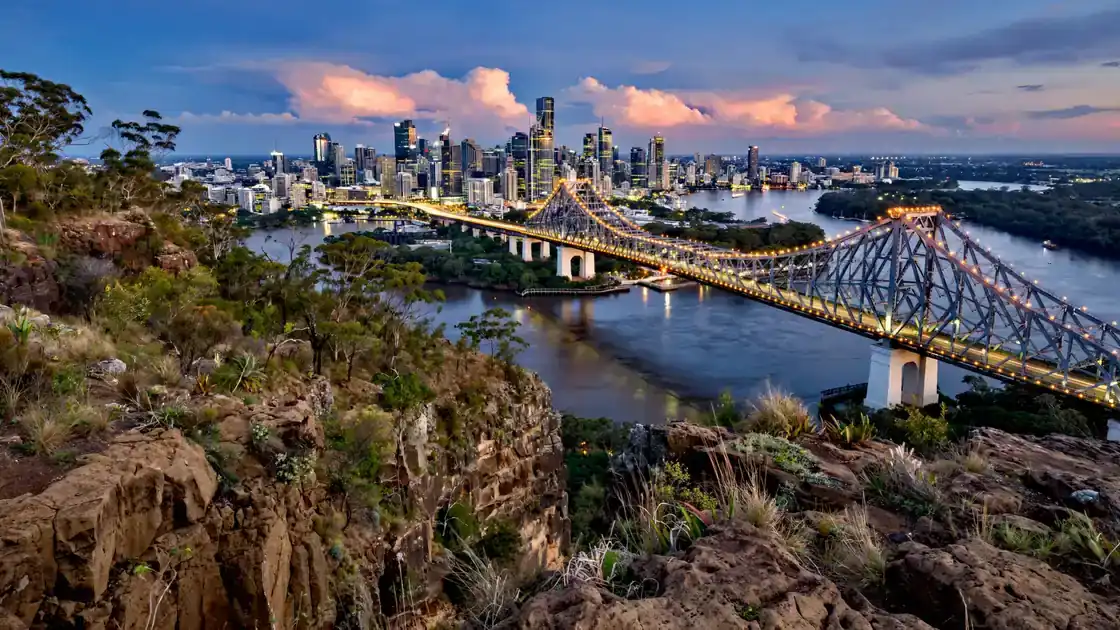
This Brisbane travel guide proves that two days is enough to fall for Queensland’s capital — if you spend them well. Brisbane is Australia’s most underrated big city: a subtropical river town with 300 days of sunshine a year, a legitimately great food scene, and a pace that feels like a deep breath after Sydney or Melbourne. Forty-eight hours here buys you the river, the rooftops, the koalas and a proper taste of the city’s easygoing character.
What surprises first-time visitors is how much Brisbane packs into a compact centre. South Bank’s parklands, the Story Bridge, the City Botanic Gardens, the Queen Street Mall and Fortitude Valley’s nightlife all sit within a few kilometres of each other. The CityCat ferries glide up and down the Brisbane River for the price of a bus fare, doubling as a sightseeing cruise. And when the city day is done, the Gold Coast, Noosa and Moreton Island are all within day-trip range.
Best Time to Visit Brisbane
Brisbane’s subtropical climate means there is no bad month, only trade-offs. April to October is the sweet spot: warm, dry days (20–26°C), cool evenings and almost no rain. Summer (November to March) is hot, humid and stormy — afternoon downpours are a daily event — but it is also jacaranda season in October and the city is at its greenest.
Winter in Brisbane (June to August) is genuinely delightful: sunny days around 22°C while the southern capitals shiver. This is peak season for good reason, so book accommodation ahead. Major events like the Brisbane Festival (September) and the Ekka (August) also push prices up.
Getting Around Brisbane
Brisbane runs on the TransLink go card (or contactless bank card) across trains, buses and ferries. The star of the network is the CityCat — the high-speed catamaran ferries that run the length of the river from the University of Queensland to Northshore Hamilton. A full river journey costs a few dollars and is one of the best-value harbour cruises in Australia.
The city centre is compact and walkable, and the free CityHopper ferry loops between North Quay, South Bank and New Farm. For day trips you will want a car or a tour: Lone Pine Koala Sanctuary, Mount Coot-tha and the bayside are all awkward without one.
Day 1: The River City Classics
Morning: South Bank and the CityCat
Start at South Bank Parklands, the 17 hectares of riverfront parkland built for World Expo 88. Swim at Streets Beach — Australia’s only inner-city man-made beach, a lagoon with sand and lifeguards, completely free. Walk the bougainvillea-covered Grand Arbour, browse the weekend Collective Markets, and ride the Wheel of Brisbane for a 60-metre-high view over the river and city (around A$25 per adult, approximately).
Then board a CityCat at South Bank and ride it upriver. Sit on the open rear deck as the ferry threads under the Story Bridge and past the riverside mansions of New Farm. Hop off at New Farm Park for a wander under the jacarandas (spectacular in October) and a coffee at the rotunda end of the park.
Afternoon: Story Bridge and Kangaroo Point
Back in the city, walk across the Story Bridge — the pedestrian path is free and the views up and down the river are superb. Adrenaline seekers can book the Story Bridge Adventure Climb (around A$130–160 per person, approximately), one of only a handful of bridge climbs in the world.
Descend into Kangaroo Point, where the heritage-listed cliffs offer Brisbane’s best sunset viewpoint. The cliffs are floodlit at night and the city panorama from the top is the photo every visitor takes home. Locals rock-climb and abseil here; visitors mostly bring a picnic and watch the light change.
Evening: Eat Street and Rooftops
For dinner, head to Eat Street Northshore (Friday to Sunday evenings) — a shipping-container night market with 70+ food stalls and live music, entry around A$5. Alternatively, explore Fortitude Valley, Brisbane’s nightlife engine: craft beer bars, live music venues and late-night eateries along Brunswick and Ann Streets.
Finish the night at a rooftop bar. Brisbane’s rooftop scene is one of the best in the country — the subtropical evenings were made for it. Try the bars along Eagle Street Pier or in Fortitude Valley for skyline views with your drink.
Day 2: Koalas, Culture and Mount Coot-tha
Morning: Lone Pine Koala Sanctuary
No 48 hours in Brisbane is complete without Lone Pine Koala Sanctuary, the world’s oldest and largest koala sanctuary, on the river at Fig Tree Pocket. You can hand-feed kangaroos, watch the platypus, and — the famous one — hold a koala for a photo (around A$35 extra, approximately; entry itself is around A$50 per adult). Arrive at opening time to see the animals at their most active, and allow 3–4 hours.
Getting there is half the fun: the Koala Express boat departs from South Bank and cruises 75 minutes up the river to the sanctuary. Book the combined cruise-and-entry ticket to save money and skip the bus.
Afternoon: Culture at South Bank
Back at South Bank, spend the afternoon in Brisbane’s cultural precinct — all free to enter. The Queensland Art Gallery | Gallery of Modern Art (QAGOMA) is one of Australia’s best modern art museums, the Queensland Museum covers the state’s natural history, and the State Library of Queensland has a superb riverfront reading room. The precinct sits right on the river, so the walk between buildings is a pleasure in itself.
Sunset: Mount Coot-tha Lookout
End your 48 hours at the Mount Coot-tha Lookout, 7 km west of the city. The panoramic view stretches from the CBD skyscrapers across the suburbs to Moreton Bay and the Glass House Mountains on a clear day. Time your visit for sunset, then have dinner at the Summit Restaurant or grab a coffee from the kiosk. The drive up through the Brisbane Botanic Gardens Mount Coot-tha (free entry) is worth an hour on its own.
Where to Eat in Brisbane
- Howard Smith Wharves: the riverfront dining precinct under the Story Bridge — restaurants, a brewery and riverside bars with bridge views.
- Fortitude Valley: the city’s dining heart — from cheap ramen to hatted restaurants on James Street.
- South Bank: riverside restaurants and the Friday night Young Designers Market food stalls.
- West End: Brisbane’s bohemian quarter — multicultural eateries, bookshops and boundary-street markets.
- The Fish Markets at Hamilton: for the freshest Moreton Bay bugs and prawns in the city.
Budget roughly A$20–30 for a good casual lunch and A$35–60 per person for dinner at a mid-range restaurant. Brisbane’s café breakfast culture is strong — the smashed avo and flat white will run you about A$25.
Where to Stay in Brisbane
For 48 hours, stay central. The CBD and South Bank put you within walking distance of most day-one sights; Fortitude Valley suits nightlife lovers; New Farm and West End offer character and café culture a short ferry or bus ride out. Expect around A$170–260 per night for a mid-range hotel in 2026, less in the outer suburbs.
Day-Trip Options from Brisbane
With a third day, Brisbane’s location shines. Moreton Island (Mulgumpin) offers sand tobogganing, snorkelling the Tangalooma Wrecks and wild dolphin feeding — day tours run from around A$200 per person. The Gold Coast is an hour south by train (see our Gold Coast travel guide), Noosa is 90 minutes north (see our Noosa travel guide), and the Scenic Rim delivers rainforest walks and wineries inland.
Practical Tips
- Sun and storms: Brisbane’s UV is extreme — slip, slop, slap applies year-round. In summer, plan outdoor activities for the morning; afternoon storms are near-daily.
- go card: buy one at the airport or use contactless. Fares are capped daily.
- Swimming: Streets Beach at South Bank is patrolled and free — the easiest safe swim in the city.
- Weekend markets: South Bank, New Farm and West End all run weekend markets worth building a morning around.
Brisbane is also the gateway to Queensland’s big-ticket nature. If you are heading further north, our Cairns and Port Douglas guide covers the reef and rainforest. For official events and trip ideas, see queensland.com, the official site of Tourism and Events Queensland.
Brisbane’s Hidden Gems
Beyond the headline sights, Brisbane rewards explorers:
- New Farm Park and the Powerhouse: the riverside park is Brisbane’s prettiest picnic spot; the Brisbane Powerhouse (a converted 1920s power station) hosts comedy, theatre and live music with river views.
- West End’s Boundary Street: the city’s bohemian quarter — bookshops, Vietnamese bakeries, the Boundary Street Markets (weekends), and Avid Reader bookshop.
- Mount Gravatt Lookout: the locals’ alternative to Mount Coot-tha — 360° views, walking tracks, and a fraction of the crowds.
- Paddington and Latrobe Terrace: heritage shopping village with antique shops, the Kookaburra Café (a Brisbane institution), and the Suncorp Stadium precinct on game days.
- Brisbane’s laneway bars: Burnett Lane, Bakery Lane (Fortitude Valley) and Winn Lane hide the city’s best small bars.
- Shorncliffe Pier: the bayside suburb of Sandgate/Shorncliffe — the historic pier, calm bay swimming at Suttons Beach, and fish and chips with the sea breeze.
Brisbane After Dark
Brisbane’s nightlife punches above its weight. Fortitude Valley is the engine — The Zoo and The Tivoli for live music, Cloudland for the spectacular venue, and Black Bear Lodge for indie gigs. Howard Smith Wharves under the Story Bridge offers riverside bars with the bridge lit up above you — the Felons Brewing Co taproom is the local favourite. West End does the late-night multicultural thing (the Boundary Hotel‘s rooftop), and New Farm’s Brunswick Street has the wine bars. The Story Bridge light shows — the bridge lights up for events and causes most nights — are best viewed from Kangaroo Point or the CityCat after dark.
Brisbane with Kids
Brisbane is an excellent family city. Beyond Lone Pine: the Queensland Museum’s dinosaur and discovery zones (free), Roma Street Parkland’s playgrounds and water features, Streets Beach at South Bank (free, patrolled), the Sir Thomas Brisbane Planetarium (Mount Coot-tha), and WhiteWater World-adjacent Dreamworld on the Gold Coast (1 hour). The CityCat ferry ride itself is a kid-pleaser — sit up front on the open deck.
Brisbane’s Best Day Trips Under an Hour
- Mt Coot-tha Botanic Gardens: 15 minutes west — the free gardens (the tropical dome, the Japanese garden), the lookout, and the Sir Thomas Brisbane Planetarium (the Cosmic Skydome shows). The JC Slaughter Falls walk (2 km return) is the easy bushwalk.
- Shorncliffe and Sandgate: 30 minutes north — the bayside villages: the historic pier, Suttons Beach (the netted swim area), fish and chips on the foreshore, and the secondhand bookshops on Bowser Parade.
- Tamborine Mountain: 45 minutes south — the Gallery Walk (the craft shops), Curtis Falls (the rainforest walk), the SkyWalk (the elevated rainforest walk), and the wineries and distilleries (the Tamborine Mountain Distillery‘s liquors are famous).
- Bribie Island: 1 hour north — the Pumicestone Passage (the calm waterway — kayaking, birdwatching, dugongs), Woorim Beach (the surf beach), and the Bribie Island National Park (the 4WD beaches).
- Samford Valley: 30 minutes north-west — the rural valley: the Samford Village markets (the farmers’ market), John Scott Park (the swimming hole), and the D’Aguilar National Park walks.
Brisbane FAQs
Is 2 days enough for Brisbane?
Yes — 48 hours covers Brisbane’s highlights: South Bank, the CityCat ferry, the Story Bridge, Lone Pine Koala Sanctuary, the cultural precinct and Mount Coot-tha lookout. Add a third day for a Moreton Island or Gold Coast day trip.
What is Brisbane famous for?
Brisbane is famous for its subtropical climate, the Brisbane River and CityCat ferries, South Bank Parklands with its inner-city beach, the Story Bridge climb, Lone Pine Koala Sanctuary, and a thriving food and rooftop-bar scene.
What is the best month to visit Brisbane?
April to October is ideal — warm, dry days with low humidity. Winter (June to August) brings sunny 22-degree days. Summer (November to March) is hot, humid and stormy but lush and green.
Do you need a car in Brisbane?
Not for the city centre — trains, buses, CityCat ferries and the free CityHopper cover the main sights. You will want a car or a guided tour for Lone Pine, Mount Coot-tha and any day trips outside the city.
Is Brisbane worth visiting compared to Sydney and Melbourne?
Absolutely, for different reasons: Brisbane offers subtropical weather, a relaxed pace, excellent value, and easy access to the Gold Coast, Noosa and Moreton Island. It is less about big-ticket icons and more about lifestyle — river, rooftops and sunshine.