
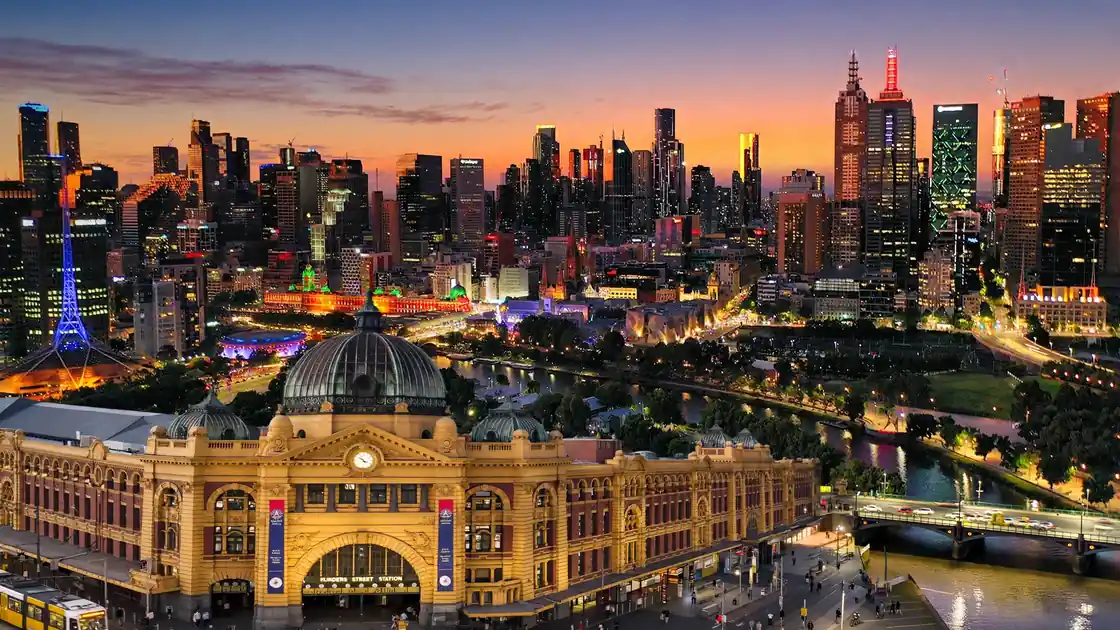
This Melbourne travel guide answers the question every visitor asks first: where should I stay? Melbourne is a city of villages — the CBD grid, the laneway bars, the terrace streets of Fitzroy, the beach promenades of St Kilda — and your choice of neighbourhood shapes the whole trip. Get it right and Melbourne feels effortless; get it wrong and you will spend your holiday on trams.
Melbourne consistently ranks among the world’s most liveable cities, and it shows in the details: a free tram zone across the city centre, a coffee culture that borders on religion, a calendar packed with sport and festivals, and neighbourhoods with genuinely distinct personalities. This guide breaks down the eight best areas to base yourself, with honest pros, cons and price guidance for 2026.
How to Choose Your Melbourne Neighbourhood
Start with your travel style, not a hotel listing. First-timers who want maximum convenience should stay in or near the CBD — the free tram zone covers the main sights and you can walk to dinner everywhere. Nightlife and arts lovers belong in Fitzroy or Collingwood. Beach people should look at St Kilda. Shoppers and foodies will love South Yarra and Prahran. Families often do best in Southbank or Docklands, with bigger rooms and river views.
Melbourne’s public transport runs on the myki card (or contactless payment). The free tram zone covers the CBD and Docklands, and a full day of travel anywhere in the metro area costs about A$11 for an adult — roughly the price of two coffees. You genuinely do not need a car in the inner city.
CBD (Central Business District)
Best for: first-time visitors, business travellers, anyone who wants everything walkable.
The CBD is Melbourne’s beating heart: the Hoddle Grid of streets, the famous laneways (Hosier Lane, Degraves Street, Centre Place), Federation Square, the shopping arcades and the Yarra riverfront. Staying here puts Flinders Street Station — the hub of the whole train and tram network — on your doorstep, plus the free tram zone makes getting around the centre completely free.
The trade-off is price and atmosphere: CBD hotels are the most expensive in the city, and the area empties out after office hours compared to the inner north. Expect around A$200–320 per night for a mid-range CBD hotel in 2026, more during the Australian Open (January) and the Grand Prix (March).
Fitzroy
Best for: nightlife, live music, vintage shopping, travellers under 40.
Fitzroy is Melbourne’s bohemian soul — Brunswick Street’s bars and bookshops, Rose Street’s weekend artists’ market, live music venues on nearly every corner. It is the neighbourhood visitors fall in love with: terrace houses, street art, and a pub or wine bar that feels like a local secret every hundred metres. Accommodation is mostly boutique hotels, apartments and Airbnbs rather than big chains.
It is about 15–20 minutes by tram from the CBD. It can be noisy on weekend nights, and parking is painful — but you will not need a car. Budget roughly A$160–260 per night for a good boutique stay.
Collingwood
Best for: food lovers, craft beer fans, creative-industry travellers.
Collingwood sits just east of Fitzroy and has matured into Melbourne’s serious food-and-drink neighbourhood — Smith Street’s restaurants, the craft breweries, the Collingwood Yards arts precinct. It is slightly less chaotic than Fitzroy, slightly more grown-up, and the accommodation (boutique hotels and serviced apartments) is often better value. The 86 tram runs straight into the CBD in about 15 minutes.
St Kilda
Best for: beach lovers, backpackers, families who want sand with their city.
St Kilda is Melbourne’s seaside suburb: the esplanade, Luna Park’s famous smiling entrance, the Sunday markets, and the penguin colony on the breakwater at dusk. It has the city’s best backpacker and budget accommodation, plus some grand old seaside hotels. The beach itself is calm and swimmable in summer, though locals will tell you the water is at its best from December to March.
The catch: St Kilda is 20–30 minutes from the CBD by tram, and the main drag (Acland Street and Fitzroy Street) can feel rough late at night. For a beach base in Melbourne, though, nothing else comes close. Budget stays from around A$100–150 per night; mid-range A$170–250.
South Yarra and Prahran
Best for: shopping, restaurants, a polished inner-city stay.
South Yarra and Prahran are Melbourne at its most stylish — Chapel Street’s fashion strip, the Prahran Market (a food hall institution since the 1890s), leafy residential streets and a strong restaurant scene. Accommodation skews toward serviced apartments and boutique hotels, which suits longer stays. The train from South Yarra station reaches Flinders Street in under 10 minutes.
Southbank
Best for: families, arts lovers, river views.
Southbank sits across the Yarra from the CBD, home to the Arts Centre, the National Gallery of Victoria and the Crown entertainment complex. The promenade restaurants have river views, the apartments are spacious, and you are a short bridge-walk from the city centre. It lacks the character of the inner north, but for a comfortable, convenient family base it is hard to beat. Expect A$180–300 per night for a one-bedroom apartment.
Docklands
Best for: budget-conscious travellers who want to stay central.
Docklands is Melbourne’s waterfront redevelopment — modern apartment towers, harbour views and the cheapest central accommodation in the city. It is inside the free tram zone, so the CBD is minutes away. The downside is atmosphere: it can feel quiet and corporate in the evenings. If your priority is a cheap, clean, central base and you plan to spend your days elsewhere, Docklands delivers.
Carlton
Best for: Italian food, university vibe, families visiting the museum.
Carlton’s Lygon Street is Melbourne’s historic Italian precinct — the restaurants, the gelaterias, the old-school espresso bars. It is also home to the Melbourne Museum, the Royal Exhibition Building and Carlton Gardens (a UNESCO World Heritage site). Accommodation is mostly apartments and mid-range hotels, and the university area keeps prices a touch lower than the CBD.
What Melbourne Accommodation Costs in 2026
Rough nightly ranges for 2026 (shoulder season, approximately): hostel dorm A$40–60; budget hotel or Airbnb private room A$120–170; mid-range hotel A$180–300; upscale A$320+. Prices spike 30–50% during the Australian Open (mid-January), the Formula 1 Grand Prix (March) and major concert weekends — if you are visiting then, book months ahead. Melbourne’s hotel supply is large, so outside events you can usually find good last-minute deals.
Getting Around from Your Base
Wherever you stay in the inner city, the system is the same: myki or contactless on trams, trains and buses. The free tram zone covers the CBD, Docklands and the Queen Victoria Market area — hop on and off without tapping. Trams run frequently until midnight (later on weekends), and the Night Network runs all night on Friday and Saturday.
From any of these neighbourhoods, the classic Melbourne day trips are easy: the Great Ocean Road (book a tour or hire a car), Phillip Island’s Penguin Parade (evening tours depart the city daily), and the Yarra Valley wine region (about an hour by train and bus, or a guided tour).
Practical Tips
- Weather: Melbourne’s “four seasons in one day” is real. Always carry a layer and check the forecast — a 35°C scorcher can follow a 16°C morning.
- Coffee: order a flat white or magic (a Melbourne invention — double ristretto with milk). Chain coffee is considered a last resort.
- Laneways: the best bars and cafés hide in laneways with no signage. Hosier Lane, AC/DC Lane, Duckboard Place and Meyers Place are good starting points.
- Sport: an AFL match at the MCG (March–September) is a bucket-list Melbourne experience even if you have never watched the game.
- Safety: the inner city is generally safe, but stay alert around Flinders Street and Southern Cross stations late at night.
Beyond Melbourne
Melbourne is also the gateway to Victoria’s best road trips. Our 3-day Great Ocean Road itinerary starts right at the city limits, and the Phillip Island day trip guide covers the famous Penguin Parade. If you are deciding between Australia’s two big cities, compare with our Sydney travel guide.
For official events, accommodation deals and trip ideas, see visitvictoria.com, the official visitor site for Visit Victoria.
Melbourne’s Laneways: A Self-Guided Walking Route
Melbourne’s laneway culture deserves half a day on foot. Start at Flinders Street Station, duck into Degraves Street for coffee, then wind through Centre Place (the city’s most atmospheric laneway — bars, dumpling houses, live buskers). Cross to Hosier Lane for the ever-changing street art (the walls are repainted constantly — no two visits look alike), then ACDC Lane (named for the band) and Duckboard Place. Finish at the Block Arcade and Royal Arcade — 1890s shopping arcades with mosaic floors and the famous Hopetoun Tea Rooms. The whole loop is under 2 km and free.
Melbourne’s Best Day Trips
Melbourne’s location makes it one of Australia’s great day-trip cities:
- Mornington Peninsula: 90 minutes south — hot springs (the Peninsula Hot Springs’ hilltop pool at sunset is magical), Arthurs Seat Eagle chairlift, Point Nepean National Park (military history + wild coastline), and the Main Street Mornington dining strip. Wine lovers: the Red Hill wineries.
- Yarra Valley: 1 hour east — 80+ wineries, the Healesville Sanctuary (the platypus and bird-of-prey shows are superb), and the Yarra Ranges National Park (mountain ash forest, the Black Spur Drive).
- Daylesford: 90 minutes north-west — Australia’s spa capital: mineral springs, the Hepburn Bathhouse, and a village of galleries and bookshops.
- Ballarat and Sovereign Hill: 90 minutes west — the gold-rush open-air museum is one of Victoria’s best family attractions; the Blood on the Southern Cross sound-and-light show runs summer evenings.
Melbourne’s Festival Calendar
Time your visit for one of the city’s great events: the Australian Open (January — the “Happy Slam”), the Formula 1 Australian Grand Prix (March, Albert Park), the Melbourne International Comedy Festival (March–April), Rising (June — the winter arts festival), the Melbourne International Film Festival (August), and the Melbourne Cup Carnival (November). Each transforms the city — and each pushes accommodation prices up 30–50%, so book early.
Melbourne’s Coffee Culture: How to Order Like a Local
Melbourne takes coffee more seriously than almost any city on earth — and ordering wrong marks you as a tourist instantly. The essentials: a flat white is the default (espresso with velvety steamed milk); a magic is the Melbourne invention (double ristretto with steamed milk, served in a smaller cup — stronger, sweeter); a long black is the black-coffee order; a piccolo is the small-but-strong option. Never order a “regular” (meaningless here), and don’t ask for decaf without expecting a raised eyebrow.
The rules: the best coffee is in the independent cafés (the laneways, Fitzroy, Collingwood, Carlton); the big chains are for emergencies only. Oat milk is ubiquitous; single-origin beans are the connoisseur’s choice. Breakfast is the main event — the smashed avo (invented here, arguably), the corn fritters, the bircher muesli. Expect A$5–6 for a coffee, A$24–30 for the full breakfast. The Melbourne International Coffee Expo (March) is the industry’s big event — the cupping sessions are open to the public.
Melbourne Neighbourhood FAQs
What is the best area to stay in Melbourne for first-time visitors?
The CBD is the best base for first-time visitors — it is walkable, inside the free tram zone, and close to Flinders Street Station for day trips. Fitzroy suits nightlife lovers, St Kilda suits beach lovers, and South Yarra suits shoppers and foodies.
Is it better to stay in St Kilda or Melbourne CBD?
Stay in the CBD for sightseeing convenience and the free tram zone; stay in St Kilda for the beach, cheaper accommodation and a laid-back vibe. St Kilda is 20–30 minutes from the city by tram, so it suits longer stays where the commute matters less.
Do I need a car in Melbourne?
No. Melbourne’s trams, trains and buses cover the inner city well, the CBD has a free tram zone, and a myki daily fare cap of about A$11 covers unlimited metro travel. You only need a car for self-driven day trips like the Great Ocean Road.
What is the best month to visit Melbourne?
March to May and October to November offer mild weather and fewer crowds. Summer (December to February) is warmest but busiest and priciest; winter (June to August) is cool and cheapest, with great theatre and arts programming.
Is Fitzroy safe at night?
Fitzroy is generally safe and its bar and live-music streets are busy late into the night, which adds to the sense of security. As in any nightlife district, stay aware of your surroundings, keep valuables out of sight, and use well-lit main streets after midnight.