
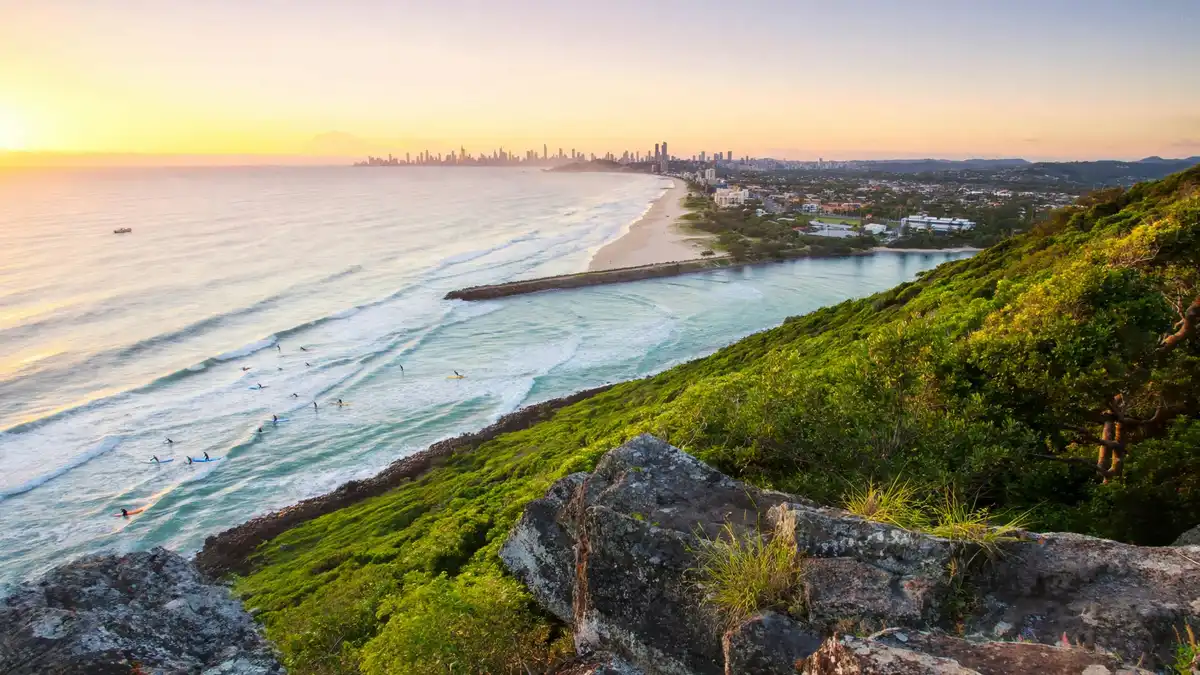
This Gold Coast travel guide is for travellers who think they know the GC — theme parks, Surfers Paradise, done — and are ready to be corrected. Yes, the theme parks exist (and they’re fun). But the Gold Coast of 2026 is also 70 km of surf beaches, a World Heritage-listed hinterland of waterfalls and rainforest, a genuinely good food scene, and beach towns like Burleigh and Coolangatta that locals fiercely prefer to the Surfers strip. This guide skips the obvious and shows you the Gold Coast worth travelling for.
The Gold Coast sits in Queensland‘s south-east corner, an hour south of Brisbane, with 300 days of sunshine a year and water temperatures that invite swimming nearly year-round. The skyline at Surfers Paradise is the postcard, but the soul of the coast is in the southern beaches, the Currumbin Valley, and the mountain villages of the hinterland. Whether you’re here for surf, nature, food or family fun, the GC delivers — you just need to know where to look.
Best Time to Visit the Gold Coast
March to May and September to November are ideal: warm days (24–28°C), warm water, thinner crowds and lower prices. Summer (December–February) is hot, humid and busy — school holidays push accommodation prices to their peak. Winter (June–August) is the secret season: sunny 21°C days, empty beaches, whale watching (June–November), and the cheapest rates of the year. The water stays swimmable year-round, rarely dropping below 21°C.
The Beaches, South to North
Burleigh Heads
The Gold Coast’s best suburb: a national park headland with an ocean-view rainforest walk, one of the world’s great right-hand point breaks, and James Street’s cafés and restaurants at its base. Swim at Burleigh Beach (patrolled), walk the Oceanview Track around the headland (1.2 km, easy), and eat on James Street. This is where locals take visitors.
Currumbin
Just south of Burleigh: the calm, family-friendly Currumbin Creek (stand-up paddleboarding, kayaking), Currumbin Wildlife Sanctuary (feed lorikeets, see koalas — around A$60 per adult, approximately), and Elephant Rock. The beachside cafés on Pacific Parade do excellent breakfasts.
Coolangatta and Kirra
The southernmost beaches, on the NSW border: Coolangatta Beach (patrolled, family-friendly), Kirra (a world-famous surf break), and Snapper Rocks (home of the Quiksilver Pro). The town has a retro beach-holiday feel — fish and chips, surf shops, ocean pools. Point Danger lookout straddles the state border with views up the whole coast.
Surfers Paradise
The famous one: the skyline, the beachfront markets (Wednesday, Friday, Sunday nights), and the buzz. The beach itself is excellent — wide, patrolled, great surf. Stay for the location and the nightlife; spend your days elsewhere. The SkyPoint Observation Deck (Q1 building, 77 floors up) gives the coast’s best panorama.
Main Beach and The Spit
North of Surfers: quieter, more upmarket — the Sherwood Road dining strip, the Southport Yacht Club, and The Spit with its parklands, the Gold Coast Seaway (great for diving and fishing), and Doug Jennings Park.
The Hinterland: Waterfalls and Rainforest
The Gold Coast’s secret weapon is 30 minutes inland: the McPherson Range and its Gondwana Rainforests World Heritage areas.
- Springbrook National Park: the Natural Bridge (a waterfall cascading through a cave — visit at night for glow worms), Purling Brook Falls (a 100-m waterfall with a 4-km circuit walk), and the Best of All Lookout with views into NSW.
- Tamborine Mountain: the SkyWalk (a 1.5-km elevated rainforest walk), Curtis Falls, the Tamborine Rainforest Skywalk, plus wineries, distilleries, fudge shops and the Gallery Walk craft strip in the villages of North Tamborine and Eagle Heights.
- Lamington National Park: O’Reilly’s and Binna Burra offer the coast’s best bushwalking — the Box Falls track, the Tree Top Walk at O’Reilly’s, and multi-day trails. Feed the crimson rosellas at O’Reilly’s, then walk it off in the ancient Antarctic beech forest.
Allow a full day for Springbrook or Tamborine, and a full day (or overnight) for Lamington. The roads are winding — drive carefully, especially after rain.
Theme Parks (The Honest Take)
The theme parks — Warner Bros. Movie World, Sea World, Wet’n’Wild and Dreamworld (plus WhiteWater World) — are genuinely good by world standards, and families with kids will want at least one park day. Multi-park passes (around A$130–180 for multi-day multi-park access, approximately) are far better value than single-day tickets. Go on weekdays outside school holidays to avoid the queues. Book online in advance — gate prices are higher.
Where to Eat on the Gold Coast
- Burleigh (James Street): the coast’s best dining strip — from fine dining to fish and chips.
- Miami Marketta (Saturday nights): the street-food market — 30+ stalls, live music, huge crowds.
- Broadbeach: the Gold Coast’s restaurant precinct — the Oracle Boulevard and Victoria Avenue strips.
- Coolangatta: retro beach-town eating — clubs, pubs and ocean-view cafés.
- Craft breweries: the GC’s brewery scene (Burleigh Brewing, Balter, Black Hops) is among Australia’s best.
Budget A$20–30 for a casual lunch, A$35–60 per person for dinner. The Village Markets (Burleigh, 1st and 3rd Sundays) are great for local design and food stalls.
Whale Watching and Water Activities
The Gold Coast is one of Australia’s best whale-watching spots — humpbacks migrate past from June to November, often close to shore. Tours from Surfers Paradise and Coolangatta run from around A$80–120 per adult. Beyond whales: surf lessons at every patrolled beach (from around A$70 for a group lesson), kayak tours in Currumbin Creek, jet boating in the Broadwater, and hot air ballooning over the hinterland at dawn.
Where to Stay
Burleigh Heads is the pick for most travellers — beach, national park, dining, village feel. Surfers Paradise suits nightlife and theme-park proximity (and has the cheapest high-rise apartments). Broadbeach is the polished middle ground — restaurants, the casino, the beach. Coolangatta suits a quieter beach holiday near the border. Expect A$160–280 per night for a mid-range hotel or apartment in 2026; school holidays push prices sharply higher.
Getting Around
The G:link light rail runs from Broadbeach through Surfers to Helensvale (connecting with Brisbane trains) — it covers the coastal strip well. Buses fill the gaps. For the hinterland (Springbrook, Tamborine, Lamington) you need a car or a tour — there is no public transport into the national parks. The Gold Coast Airport at Coolangatta serves domestic and some international flights; Brisbane Airport (an hour north) has far more options.
Practical Tips
- Swim safe: swim between the red and yellow flags on patrolled beaches; the surf can be powerful, especially at Kirra and Snapper.
- Sun: Queensland UV is extreme — the beach breeze hides the burn.
- School holidays: avoid NSW/QLD school holidays if you can — prices double and the theme parks queue out.
- Border: Coolangatta sits on the QLD/NSW border — the time zone changes in daylight saving (NSW observes it, QLD doesn’t). Check times for tours crossing the border.
- Rainforest: carry a rain jacket in the hinterland — Springbrook gets 3,000 mm of rain a year.
The Gold Coast is the start of a classic coastal run: Brisbane is an hour north, Byron Bay is an hour south, and Noosa is two hours north. For official events and trip ideas, see destinationgoldcoast.com, the official visitor site.
Currumbin Valley and Natural Bridge: The Hinterland Deep Dive
The Currumbin Valley — 20 minutes inland from Currumbin Beach — is the Gold Coast’s green heart: a valley of rainforest, rock pools and waterfalls that most visitors never see. Currumbin Rock Pools (free, at the valley’s end) are the local swimming hole — natural pools in the creek, rope swings, picnic areas. The Mount Cougal section of Springbrook National Park (the eastern end) offers the Cougal Cascades walk and historic sawmill ruins.
The Natural Bridge (Springbrook’s western section, 1 hour from the coast) deserves its own trip: a waterfall cascading through a basalt cave, home to glow worms and microbats. Visit at night (guided glow worm tours run from around A$90–120 per person, approximately) for the full magic — the cave ceiling glitters like a starfield. The daytime circuit (1 km, easy) is free and spectacular. Springbrook’s waterfalls — Purling Brook Falls (the 4-km circuit), Twin Falls, Stinson’s Stomp — are at their best after rain.
Gold Coast’s Best Free Experiences
The GC is generous with free experiences: every beach (all 70 km), the Burleigh Head National Park walks, Currumbin Rock Pools, Tamborine Mountain’s Curtis Falls and Gallery Walk (window shopping), the Surfers Paradise beachfront markets (Wednesday, Friday, Sunday nights), the Village Markets (Burleigh, 1st/3rd Sundays), Federation Walk (The Spit), and sunset at Point Danger. The HOTA (Home of the Arts) gallery in Surfers Paradise is free and excellent.
Gold Coast with Kids: Beyond the Theme Parks
Families have options beyond the big parks: Currumbin Wildlife Sanctuary (the lorikeet feeding at 8 am and 4 pm is magical — hundreds of rainbow lorikeets landing on you), the Sea World marine park, Topgolf (Oxenford), Australian Outback Spectacular (the dinner show), Infinity Attraction (Surfers — the illusion maze), and treetop ziplining at Thunderbird Park (Tamborine Mountain). The Gold Coast Aqua Park (inflatable water park at Southport) is the summer hit.
Surfers Paradise: The Honest Guide
Surfers Paradise — the name is the brand, and the reality is complicated. The good: the beach is genuinely excellent (wide, patrolled, great surf), the skyline is iconic, the nightlife is the coast’s liveliest, and the accommodation is the cheapest high-rise on the coast. The bad: Cavill Avenue is tacky (the souvenir shops, the hustlers), the nightclub strip gets rough late, and the traffic is terrible.
How to do Surfers right: stay for the location and value (the high-rise apartments with ocean views from around A$150/night in shoulder season), swim at the beach (the patrolled flags between Clifford Street and Hanlan Street), eat at the beachfront (the Surfers Paradise Beach Café, the new precinct restaurants), visit the SkyPoint Observation Deck (the Q1 — 77 floors, the coast’s best panorama, around A$30 per adult, approximately), and spend your days elsewhere (Burleigh, Currumbin, the hinterland). The beachfront markets (Wednesday, Friday, Sunday nights) are worth an evening. Avoid the Cavill Avenue nightclubs after midnight unless that’s your scene.
Gold Coast’s Best Breakfast Spots
- Barefoot Barista (Burleigh): the James Street institution — the specialty coffee, the acaí bowls.
- Communion (Burleigh): the all-day breakfast — the corn fritters, the cold brew.
- Paddock Bakery (Burleigh): the bakery — the pastries, the garden setting.
- Elk Espresso (Broadbeach): the Oracle café — the ricotta hotcakes.
- Daydream Island: the resort breakfast — the lagoon views.
- Café Dbar (Surfers): the beachfront — the ocean views, the big breakfast.
Expect A$24–30 for the full breakfast — the GC does brunch as well as anywhere in Australia.
Gold Coast FAQs
Is the Gold Coast worth visiting beyond the theme parks?
Yes — the Gold Coast offers 70 km of surf beaches, World Heritage hinterland rainforest with waterfalls (Springbrook, Lamington), beach towns like Burleigh and Coolangatta, whale watching, and a strong food and brewery scene.
How many days do you need on the Gold Coast?
Four to five days is ideal: two for beaches (Burleigh, Coolangatta, Surfers), one for the hinterland (Springbrook or Tamborine), and one to two for theme parks if travelling with kids. Three days covers the highlights.
What is the best month to visit the Gold Coast?
March to May and September to November offer warm weather, warm water and fewer crowds. Winter (June to August) is sunny, mild and cheapest, with whale watching. Summer is hot, humid and busiest.
Where should I stay on the Gold Coast?
Burleigh Heads is the best all-round base — beach, national park, dining and village atmosphere. Surfers Paradise suits nightlife and theme parks; Broadbeach is the polished middle ground; Coolangatta is quieter near the NSW border.
Do I need a car on the Gold Coast?
Not for the coastal strip — the G:link light rail and buses cover Broadbeach to Helensvale. You need a car or tour for the hinterland national parks (Springbrook, Tamborine, Lamington), which have no public transport.