
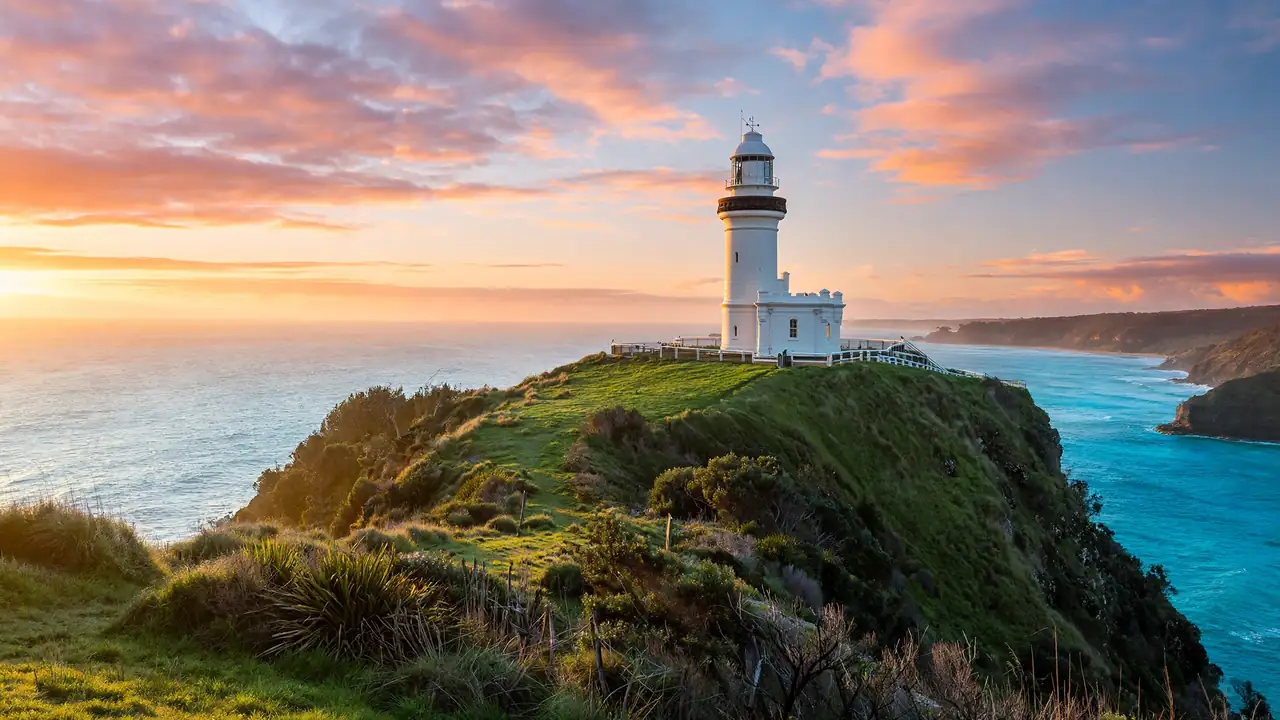
This Byron Bay travel guide comes with honest framing: Byron is Australia’s most famous beach town, and fame has changed it. The main street is busier, the prices are higher, and the parking is worse than the legend suggests. But the underlying magic — the lighthouse headland, the beaches, the sunsets, the hinterland — is completely real. Come with the right expectations and the right timing, and Byron still delivers one of the great Australian coastal experiences.
Byron Bay sits on the far north coast of New South Wales, at the easternmost point of mainland Australia. Cape Byron’s lighthouse watches over a sweep of beaches — Main Beach, Clarkes, The Pass, Wategos, Tallows — each with its own character. Behind the town, the Byron hinterland rises into the Nightcap Range: waterfalls, rainforest, and villages like Bangalow and Mullumbimby. This guide covers the beaches, the eats, the sunsets, and how to do Byron without the headaches.
Best Time to Visit Byron Bay
March to May and September to November are the sweet spots: warm water, warm days, thinner crowds and lower prices. Summer (December–February) is peak — hot, humid, packed, and expensive, with school holidays and the Falls Festival period pushing accommodation to extreme prices. Winter (June–August) is mild (20°C days), the water is still swimmable for the brave, and whale watching from the headland is superb.
The honest advice: avoid Byron during NSW/QLD school holidays and public-holiday long weekends if you possibly can. The town’s infrastructure groans under peak crowds, and the experience is a different (lesser) thing.
The Beaches
Main Beach
The town beach: patrolled, gentle, lined with cafés. Great for families and learners. It gets crowded — walk 10 minutes either way for space.
The Pass
Byron’s famous surf break: a long right-hander peeling off the headland. One of the best longboard waves in Australia. The beach below the headland is sheltered and beautiful; the surf crowd is serious.
Wategos Beach
The locals’ favourite: a small, sheltered cove under the lighthouse with calm water, reached by a winding road past multi-million-dollar houses. Limited parking — walk from town or arrive early.
Tallows Beach
The long, wild ocean beach west of the headland — 7 km of surf, dunes and space. The far end (toward Broken Head) is clothing-optional. Powerful surf; swim at the patrolled section near the surf club.
Clarkes Beach
Between Main Beach and The Pass: calm, patrolled, and the launch point for kayak tours with dolphins — bottlenose dolphins surf the waves at The Pass year-round, and the guided kayak tours (around A$80–100 per person, approximately) get you among them.
The Lighthouse Walk
The Cape Byron Walking Track (3.7 km loop) is the essential Byron experience: from town up through littoral rainforest to the Cape Byron Lighthouse (built 1901), the easternmost point of mainland Australia, then down past Wategos and The Pass. Allow 2 hours with stops.
Go for sunrise — you will be among the first people on mainland Australia to see the sun — or late afternoon for the golden light. The headland is the best land-based whale watching in NSW (June–November); bring binoculars. The Lighthouse Café at the top does a fine coffee with a million-dollar view. Parking at the lighthouse is limited and paid; walking up from town avoids it entirely.
Where to Eat in Byron Bay
Byron’s food scene is excellent and expensive — the town’s wellness-and-wealth mix shows up on menus:
- Breakfast: Byron invented the Australian café breakfast arms race. Try the institutions on Bay Street and Fletcher Street — expect A$24–30 for the full breakfast plate.
- Fish and chips: the Balcony Bar or the takeaway shops near Main Beach — eat on the sand at sunset.
- Fine dining: Byron’s hinterland restaurants (Bangalow, Newrybar) are destination dining — book ahead.
- Markets: the Byron Farmers’ Market (Thursday mornings) and the Byron Community Market (first Sunday of the month) are superb for produce and street food.
- Breweries: Stone & Wood (the Byron-born brewery, now national) has its spiritual home here; the Byron Bay Brewery and distilleries in the industrial estate are worth an afternoon.
Budget A$25–35 for a café lunch, A$45–80 per person for dinner. Byron is one of Australia’s priciest regional towns for dining — the quality is high, but so are the bills.
The Hinterland
Byron’s hinterland is the antidote to the town’s crowds:
- Bangalow: 15 minutes inland — a gorgeous heritage village with the famous Bangalow Market (fourth Sunday of the month), excellent cafés and boutiques.
- Minyon Falls: a 100-m waterfall in Nightcap National Park (World Heritage Gondwana rainforest) — the 8-km return walk from Minyon Grass is the classic; swim in the pools at the base in summer.
- Killen Falls: a hidden waterfall and swimming hole near Tintenbar — the local secret (keep it that way: take your rubbish).
- Crystal Castle: the Byron hinterland’s new-age landmark — giant crystals, rainforest walks, and the Buddha walk.
- Mullumbimby: “Mullum” — the alternative heart of the shire, with the famous Mullumbimby Farmers’ Market (Friday mornings).
Sunsets: Where to Watch
Byron faces east, so the famous sunsets are over the hinterland, not the ocean — and they are spectacular. The best spots: Fisherman’s Lookout at The Pass (watch the sun drop behind the lighthouse headland), Tallows Beach (the sun sets over the beach itself — the only west-facing ocean sunset on the east coast), and the Balcony Bar or any rooftop on Jonson Street. For sunrise, the lighthouse is non-negotiable.
Where to Stay
Town centre: walk to everything — noisiest and priciest. Wategos and the headland: luxury and views. Belongil: north of town — quieter, beachfront, local feel. The hinterland (Bangalow, Federal, Mullumbimby): B&Bs and cottages, 15–25 minutes from the beach. Budget: the hostels on the town’s edge and caravan parks at Clarkes Beach and Suffolk Park.
Expect A$200–350 per night for a mid-range hotel in shoulder season; peak summer and holidays can double that. Book 3–6 months ahead for summer.
Getting Around
Central Byron is walkable and bike-friendly — hire a bike to reach Tallows, the lighthouse base and Belongil. For the hinterland (Bangalow, Minyon Falls, Mullumbimby) you need a car. The Solar Train — the world’s first solar-powered train — runs from town to the North Beach station. Parking in town is difficult and expensive in peak times; the paid car parks fill by mid-morning.
Practical Tips
- Timing: avoid school holidays and long weekends — Byron at its best is a mid-week shoulder-season town.
- Parking: use the paid car parks or walk/cycle; street parking near the beach is a contact sport.
- Surf: The Pass is for experienced surfers; learners should take a lesson at Main Beach or Clarkes (group lessons from around A$70).
- Respect: Byron is on Bundjalung Country — the Arakwal National Park around the headland is jointly managed with the Arakwal people. Stay on tracks.
- Nightlife: Byron’s late-night scene has been curtailed in recent years — expect bars to wind down earlier than the legend suggests.
Byron sits on a classic coastal touring route: the Gold Coast is an hour north, Brisbane two hours north, and Noosa is the Sunshine Coast counterpart three hours north. For official trip ideas, see visitnsw.com, the official visitor site of Destination NSW.
Byron Bay on a Budget: The Honest Guide
Byron has a reputation for being expensive — and it can be. But the Byron experience is mostly free: the lighthouse walk (free), the beaches (free), the sunsets (free), the hinterland waterfalls (free). The money goes on accommodation and food. Budget strategies that work:
- Stay in Suffolk Park, Byron Bay’s south: the caravan parks and hostels here are half the price of town-centre beds, and Tallows Beach is on your doorstep.
- Self-cater: the Woolworths on Jonson Street and the Byron Farmers’ Market (Thursday) cover groceries; the Main Beach BBQs are free.
- Happy hours: the Beach Hotel and Balcony Bar do sunset happy hours; the Bowlo (Byron Bay Bowling Club) is the cheapest feed in town.
- Free activities: the Arakwal National Park walks, Belongil Beach (the quiet northern beach), Lennox Head (20 minutes south — the headland walk and Lake Ainsworth‘s tea-tree-stained swimming).
- Timing: mid-week, shoulder season — accommodation can be 40–50% cheaper than summer weekends.
Day Trip: Nimbin and Nightcap National Park
Nimbin — 1 hour west of Byron — is Australia’s alternative capital: the 1973 Aquarius Festival town, famous for its hemp activism, colourful main street, and the Nimbin Markets. It’s a curiosity — go for the people-watching and the Nimbin Candle Factory, stay for the surrounding rainforest. Behind Nimbin, Nightcap National Park (World Heritage Gondwana rainforest) offers the Minyon Falls walk (8 km return, 100-m waterfall) and the Protesters Falls walk (1.4 km return, the 40-m waterfall with the famous fig tree — no swimming, it’s a sacred site). The Channon Markets (2nd Sunday of the month) are the region’s best country markets.
Byron’s Best Kept Secrets
- Broken Head Nature Reserve: 10 minutes south — the Three Sisters Walking Track (1.6 km return) through littoral rainforest to a secluded headland with whale watching (June–November). Quieter than Cape Byron.
- Lennox Head: 20 minutes south — the Pat Morton Lookout (the headland panorama), Seven Mile Beach, and Lake Ainsworth (the tea-tree lake — the tannin-stained water is reputed to have healing properties).
- Killen Falls: the hidden waterfall near Tintenbar (20 minutes south-west) — the local swimming hole. Unsignposted; ask a local. Take your rubbish.
- The Pass at dawn: the dolphins surf the waves at first light — bring a coffee and watch from Fisherman’s Lookout.
- Suffolk Park: the southern suburb — Tallows Beach, the Beach Café, and none of the town’s crowds.
Byron Bay’s Wellness Scene: The Honest Take
Byron is Australia’s wellness capital — and the scene is real, if pricey. The yoga: Bodhi J (the Byron institution — vinyasa, yin, meditation), The Yoga Shala (the Ashtanga shala), Byron Yoga Centre (the teacher training hub — drop-in classes from around A$25, approximately). The retreats: Gaia Retreat & Spa (the Olivia Newton-John retreat — luxury wellness, from around A$500+/night), Crystalbrook Byron (the Eléme Spa), the hinterland retreats (yoga, meditation, surf retreats from around A$200–400/day).
The alternative therapies: sound healing (the Crystal Castle‘s sound dome), float tanks (the industrial estate float centres), ice baths (the beach breathwork groups at dawn), kinesiology, reiki — Byron has all of it. The honest take: the wellness is genuine (the practitioners are excellent), the prices are high (the Byron premium applies), and the best wellness is free — the lighthouse walk at dawn, the ocean swim, the hinterland silence.
Byron Bay FAQs
Is Byron Bay worth visiting?
Yes — the lighthouse headland walk, the beaches, dolphin kayaking, hinterland waterfalls and sunsets are genuinely special. Visit in shoulder season (March–May, September–November) and mid-week to avoid the worst crowds and prices.
How many days do you need in Byron Bay?
Three to four days is ideal: one for the lighthouse walk and town beaches, one for the hinterland (Bangalow, Minyon Falls), one for a surf lesson or kayak tour, and a spare beach day. Two days covers the essentials.
What is the best month to visit Byron Bay?
March to May and September to November offer warm weather, warm water and fewer crowds. Summer is hot, humid, packed and expensive. Winter is mild with excellent whale watching from the headland.
Can you see whales from Byron Bay?
Yes — Cape Byron is one of Australia’s best land-based whale watching spots. Humpback whales migrate past from June to November, often visible from the lighthouse and headland walking track with the naked eye.
Do I need a car in Byron Bay?
Not for the town and beaches — Byron is walkable and bike-friendly. You need a car for the hinterland (Bangalow, Minyon Falls, Mullumbimby, Crystal Castle), which has no public transport.