
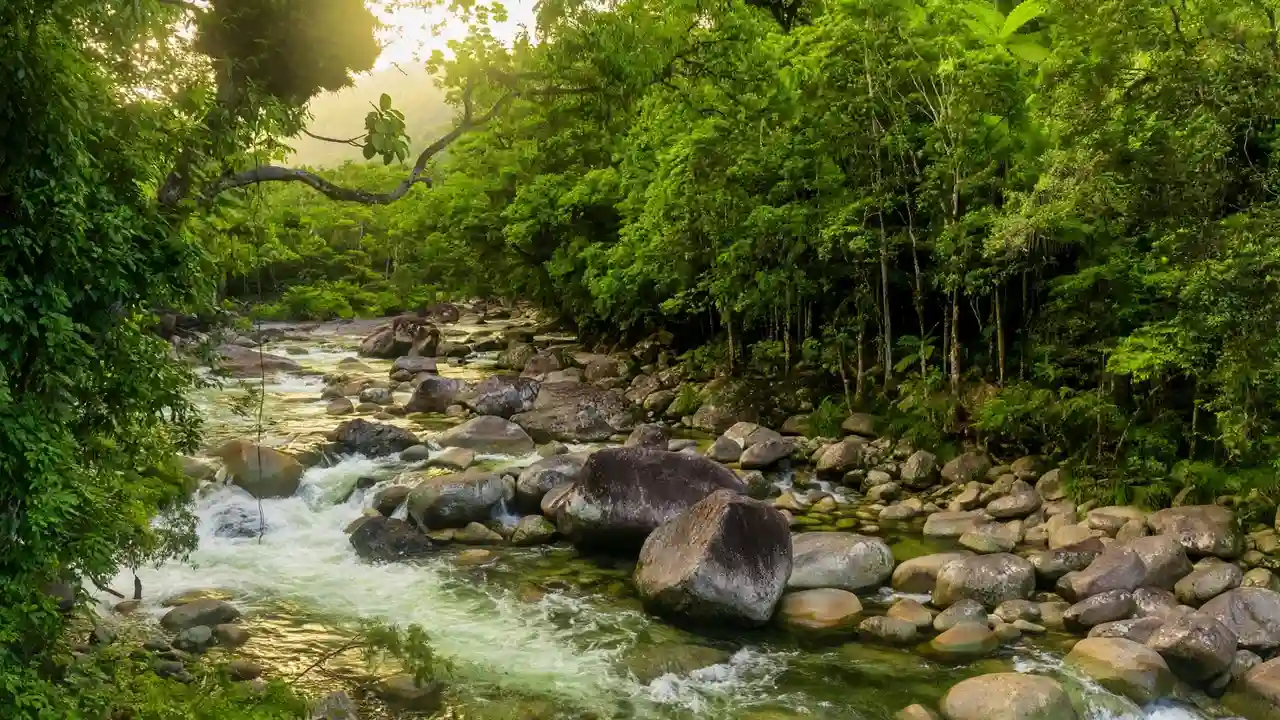
Daintree Rainforest Travel Guide
This Daintree Rainforest travel guide covers the oldest tropical rainforest on earth — 135 million years of continuous growth, a living museum of ancient plants and animals found nowhere else. The Daintree, in Far North Queensland, is where the Wet Tropics World Heritage Area meets the Great Barrier Reef World Heritage Area: the only place on the planet where two World Heritage areas sit side by side. Cape Tribulation — “where the rainforest meets the reef” — is the headline, but the Mossman Gorge, the Daintree River crocodile cruises, and the night walks are equally essential. This guide covers how to visit, what to do, where to stay, costs and safety for 2026.
The Daintree divides into two sections: the southern Daintree (Mossman Gorge, 20 minutes from Port Douglas) and the northern Daintree (beyond the Daintree River ferry — Cape Tribulation, Thornton Beach, Cow Bay). The river is the boundary: cross it and you’re in the deep Daintree. Allow 1–2 days: one for Mossman Gorge and the river, one (with an overnight) for Cape Tribulation and the northern beaches.
Best Time to Visit the Daintree
May to October (dry season) is ideal: lower humidity, sunny days, the river cruises at their best, and the Daintree River ferry running smoothly. June–August is peak — book accommodation ahead. Wet season (November–April): the rainforest is at its most alive — waterfalls thundering, the canopy dripping, fewer visitors — but heavy rain can flood roads, the Bloomfield Track closes, and stingers affect the beaches. The shoulder months (April–May, October–November) offer warm weather and good value.
Mossman Gorge: The Southern Gateway
Mossman Gorge, in the southern Daintree, is the most accessible rainforest experience — 20 minutes from Port Douglas, 1.5 hours from Cairns. The Mossman Gorge Centre (run by the Kuku Yalanji traditional owners) is the starting point: shuttle buses run to the gorge (around A$15 per adult, approximately), and the centre’s café and gallery are worth time.
The Dreamtime Walk (1.5 hours, around A$80 per adult, approximately) — a guided walk with Kuku Yalanji guides covering bush foods, medicines, Dreaming stories and a smoking ceremony — is the Daintree’s best cultural experience. The self-guided Baral Marrjanga and Rex Creek tracks (2–3 km) lead to the gorge’s swimming holes — crystal-clear granite pools (check conditions; flash flooding is the risk in the wet). The Lower River Track is the easy rainforest immersion.
Crossing the Daintree River
The Daintree River ferry (cable ferry, 5 am–midnight) is the gateway to the northern Daintree — around A$45 return per car (approximately; motorcycles and pedestrians cheaper). Queues build 10 am–2 pm in peak season — cross early or late. The ferry itself is a 5-minute ride; the crocodile-spotting starts immediately (watch the banks).
Daintree River crocodile cruises (1 hour, around A$40–60 per adult, approximately) depart from both banks — dawn cruises are best for wildlife (crocs, tree snakes, azure kingfishers, white-bellied sea eagles). The river is prime estuarine crocodile habitat — big ones. Never swim in the river.
Cape Tribulation: Where the Rainforest Meets the Reef
Cape Tribulation — named by Captain Cook in 1770 after his ship ran aground on the reef (“here began all our troubles”) — is the Daintree’s legendary headland: rainforest-clad slopes dropping straight to Myall Beach and the Coral Sea. The Kulki Lookout (10-minute boardwalk from the beach) gives the classic view — rainforest, beach, reef on the horizon.
Things to do at the Cape:
- Myall Beach and Thornton Beach: beautiful, wild, crocodile and stinger risk — admire, don’t swim (except in stinger season with suits on patrolled sections, and never where croc signs are posted).
- Daintree Discovery Centre: the canopy tower (23 m high) and aerial walkway — the best rainforest overview in Queensland. Around A$35 per adult (approximately). The audio guide is excellent.
- Jindalba and Marrdja boardwalks: free national park boardwalks through lowland rainforest — cassowary territory (see below).
- Night walks: guided nocturnal walks (around A$70–90 per person, approximately) — Boyd’s forest dragons, striped possums, tree frogs, papuan frogmouths. The Daintree at night is a different world.
- Horse riding: Cape Tribulation horse rides along Myall Beach at sunset — the romantic option.
- Great Barrier Reef from the Daintree: Ocean Safari and Cape Tribulation reef tours visit the mackay reef sites — smaller boats, fewer crowds than the Cairns pontoons.
Cassowaries: The Dinosaur Birds
The southern cassowary — 2 m tall, 70 kg, with a dagger claw — is the Daintree’s most famous resident and one of the world’s most dangerous birds. They are also endangered (fewer than 4,000 remain) and the reason the rainforest exists (they disperse the seeds of 70+ plant species).
- Where: the Jindalba/Marrdja boardwalks, Cow Bay, and the Cape Tribulation road (dawn/dusk).
- Safety: never feed them (fines apply), never approach — give them 50 m+. If confronted, back away slowly, put a tree between you, don’t run. Drive slowly — vehicle strikes are the biggest killer.
- Etiquette: keep dogs leashed/away; report sightings to the Daintree cassowary hotlines.
Where to Stay
Stay overnight in the Daintree if you can — the dawn chorus, the night walks and the empty beaches are worth it. Options: Cape Tribulation — rainforest lodges (Ferntree Rainforest Lodge, Cape Trib Beach House), eco-resorts (Daintree Eco Lodge, from around A$300+/night). Cow Bay/Daintree Village: B&Bs and cottages. Port Douglas (1 hour south): the comfortable base for day trips. Expect A$150–350 per night in the Daintree; Port Douglas A$250–450.
What It Costs
Approximate per-person for 2 days (2026): Daintree River ferry ~A$45/car; Mossman Gorge shuttle ~A$15; Dreamtime Walk ~A$80; river cruise ~A$50; Discovery Centre ~A$35; night walk ~A$80; accommodation A$150–350/night; food A$60–100/day (limited options — the Daintree Tea House and Mason’s Café are the local favourites). Budget roughly A$600–900 per person for 2 days.
Practical Tips: Safety
- Crocodiles: assume every river, creek and beach has them. Never swim unless a sign explicitly says it’s safe. Obey all warning signs — they mark real incidents.
- Stingers: box jellyfish and Irukandji November–May — don’t swim at ocean beaches without a stinger suit; the netted swimming enclosure at Cow Bay is the safe option.
- Cassowaries: as above — observe from distance, never feed.
- Driving: the Cape Tribulation road is narrow and winding; the Bloomfield Track (to Cooktown) is 4WD-only and closes in the wet. Drive slowly — cassowaries and wallabies on the road.
- Leeches: in the wet season, wear long socks and check yourself after walks.
- Respect: the Daintree is Kuku Yalanji Country — much of it is Aboriginal land. Stay on tracks, don’t remove anything, consider an Indigenous-guided tour.
The Daintree is Tropical North Queensland’s ancient heart — pair it with our Cairns and Port Douglas guide. For the Top End’s wetlands, see our Kakadu guide, and for Queensland’s islands, our Whitsundays guide. For official trip ideas, see queensland.com.
Cooktown and the Bloomfield Track: The Far North
Beyond Cape Tribulation, the Bloomfield Track (the 4WD-only coastal track) runs 30 km north to Cooktown — Captain Cook’s 1770 landing place. The track is rough, steep (the creek crossings need high clearance), and closes in the wet season — but the reward is Wujal Wujal Falls (the sacred waterfall — view from the lookout, no swimming), the remote coast, and Cooktown itself:
- James Cook Museum: the 1860s convent — Cook’s Endeavour story, Indigenous perspectives, gold-rush history.
- Grassy Hill: the lookout — Cook’s panorama (the lighthouse, the reef, the Endeavour River).
- Finch Bay and Cherry Tree Bay: the beaches — crocodile and stinger risk (admire, don’t swim).
- Nature’s Powerhouse: the botanic gardens visitor centre — the Vera Scarth-Johnson wildflower illustrations.
- Elim Beach: 20 km north — the coloured sands, the flora reserve, campgrounds.
Cooktown is 5 hours from Cairns via the inland Mulligan Highway (sealed) or 7+ hours via the Bloomfield Track (4WD). Allow 2 days for the return trip.
Daintree River Wildlife: What You’ll See
The Daintree River is one of Australia’s great wildlife rivers. The dawn cruise (the best wildlife cruise in the Daintree) offers:
- Estuarine crocodiles: the “salties” — 4–5 m monsters on the banks. The guides know the resident crocs by name (“Scarface” is the legend).
- Birds: azure kingfishers (the tiny blue jewels), great-billed herons, white-bellied sea eagles, black bitterns, papuan frogmouths (the daytime roost).
- Snakes: amethystine (scrub) pythons (the 4-m giants in the trees), green tree snakes.
- Others: flying foxes (the camps in the mangroves), water dragons, mudskippers, fiddler crabs.
Book the dawn cruise (around 6:30 am) — the wildlife is most active, the light is golden, and the river is misty. Solar Whisper (the solar-electric boat) is the quietest option — the wildlife doesn’t hear you coming.
Daintree’s Best Kept Secrets
- Thornton Beach at dawn: the empty beach — mist on the mountains, cassowary tracks in the sand.
- Daintree Ice Cream Company: the old-growth orchard — exotic fruit ice creams (black sapote, wattleseed, Davidson’s plum). The tour is delightful.
- Mason’s Café: the swimming hole — the rainforest café with the natural pool (the locals’ swim spot).
- Dubuji Boardwalk: the Myall Beach boardwalk — mangroves, rainforest, beach in 1.2 km. Cassowary territory.
- Mount Alexandra Lookout: the Daintree River panorama — the best viewpoint in the northern Daintree.
Daintree’s Night Wildlife: The Nocturnal Tour
The Daintree at night is a different world — the guided nocturnal walks (around A$70–90 per person, approximately, 2 hours) reveal:
- Boyd’s forest dragons: the dinosaur-like lizards — sleeping on branches (the spotlight finds the eye-shine).
- Striped possums: the rare possums — the black-and-white stripes, the long fourth finger (the grub extractor).
- Tree frogs: the green-eyed tree frogs, the white-lipped tree frogs — the chorus after rain.
- Papuan frogmouths: the nocturnal birds — the camouflaged roosts (the guides know the trees).
- Fireflies: the wet-season light show — the rainforest glittering.
- Luminescent fungi: the ghost fungi — the glowing mushrooms on fallen logs.
Book the night walk at your accommodation (the lodges run their own) or through the Daintree Discovery Centre. Bring a jacket (the night is cool) and insect repellent.
Daintree’s Best Free Experiences
- Jindalba boardwalk: the free national park walk — lowland rainforest, cassowary territory.
- Marrdja boardwalk: the free walk — mangroves to rainforest, 1.2 km.
- Myall Beach: the free beach — the rainforest-meets-reef view (admire, don’t swim — crocs/stingers).
- Kulki Lookout: the free lookout — the Cape Tribulation panorama.
- Mossman Gorge (self-guided): the free tracks — the Baral Marrjanga and Rex Creek walks (the shuttle is the only cost).
- Daintree Village: the free wander — the historic village, the river views.
Daintree Rainforest FAQs
How many days do you need in the Daintree?
One to two days: one for Mossman Gorge (Dreamtime Walk, swimming holes) and the Daintree River cruise; a second with an overnight for Cape Tribulation (Discovery Centre, boardwalks, night walk, beaches). Staying overnight lets you experience the dawn chorus and nocturnal wildlife.
Can you swim in the Daintree?
Only in designated safe spots — Mossman Gorge’s swimming holes (check conditions) and the netted enclosure at Cow Bay. Never swim in the Daintree River or ocean beaches (crocodiles); stingers affect ocean beaches November–May.
How much is the Daintree River ferry?
Around A$45 return per car in 2026 (cheaper for motorcycles and pedestrians). The cable ferry runs 5 am–midnight. Cross early or late in peak season to avoid the 10 am–2 pm queues.
What is the best month to visit the Daintree?
May to October (dry season) — lower humidity, best river cruises, accessible roads. June–August is peak. November–April (wet season) brings dramatic rainforest, waterfalls and fewer visitors, but possible road flooding and beach stingers.
Are cassowaries dangerous?
Cassowaries are powerful wild animals that can be dangerous if approached — never feed them, keep 50 m+ distance, and back away slowly if confronted. They are endangered (fewer than 4,000 remain); drive slowly as vehicle strikes are the biggest threat.