
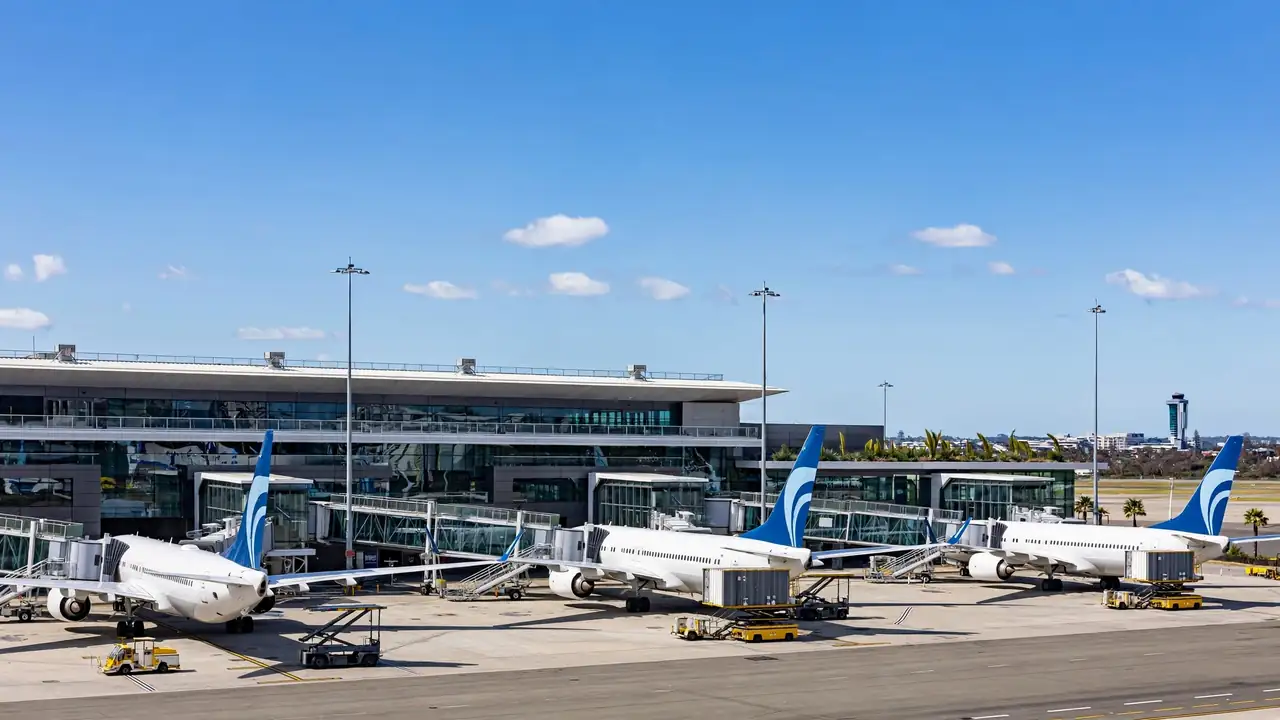
Sydney Airport Guide: Terminals, Transport & Tips
Sydney Airport (SYD) is Australia’s busiest airport, handling over 40 million passengers a year across three terminals. It is also one of the more confusing airports for first-timers: the terminals are not connected airside, the train carries a hefty surcharge, and the domestic terminals are split by airline. This Sydney Airport guide covers terminals, transport options with real 2026 prices, and the tips that make the whole experience smoother.
The Three Terminals
T1 — International
All international flights arrive and depart from T1. It has the full range of duty-free, lounges (Qantas, airline and independent pay-per-visit), and the most dining options. Allow extra time here — international check-in, customs and security take longer, and the terminal is large.
T2 — Domestic (Virgin, Jetstar, Rex and regionals)
T2 serves Virgin Australia, Jetstar, Rex and most regional carriers. It is a busy, no-frills terminal — functional but crowded at peak times.
T3 — Domestic (Qantas)
T3 is Qantas’s domestic terminal, with Qantas lounges and a generally calmer feel than T2.
Critical: T1 is physically separated from T2/T3 — you cannot walk between them airside or landside in a few minutes. Transferring between international and domestic requires the T-Bus shuttle, the train (one stop), or a taxi/rideshare. Allow at least 30-45 minutes for the transfer plus check-in time. Miss this and you miss your connection.
Getting To and From the Airport
Train (fastest)
The T8 Airport & South Line runs from Central Station to the airport in about 13 minutes, with trains every 10 minutes or so. There are two airport stations: International (T1) and Domestic (T2/T3).
The catch is the station access fee: Sydney Airport stations are privately operated and charge a surcharge on top of the normal Opal fare — about $18.61 for adults (2026, via Opal or contactless). An adult one-way trip between Central and the airport costs roughly $21.64 off-peak or $22.94 peak. A separate paper “gate pass” costs more, so always use Opal or contactless.
Budget hack: the train stops at Mascot, one station before the airport, with no access fee. From Mascot, the 420 bus reaches the terminals in 10-15 minutes. It adds hassle but saves ~$18 — worth it for the budget-conscious with light luggage.
Bus
Several public bus routes serve the airport, including the 420 (to Mascot and beyond) and routes to Bondi Junction and the eastern suburbs. Cheaper than the train if you are not going to the CBD, but slower.
Taxi and rideshare
Taxis queue outside each terminal; a trip to the CBD typically costs $45-$60 depending on traffic. Uber and other rideshares pick up from designated zones — usually similar or slightly cheaper than taxis outside surge periods. For groups of 3-4 with luggage, a taxi often beats the train on price.
Driving and parking
Sydney Airport parking is expensive — pre-booking online is significantly cheaper than drive-up rates. For pickups, use the free waiting areas and time your arrival; the terminals have strict time limits at the kerb. If someone is picking you up, the international arrivals hall has clear meeting points — agree on one in advance.
Security, Customs and the Curfew
Domestic security
Arrive 60-90 minutes before domestic flights. Sydney’s domestic security queues blow out during the 6-8am and 4-6pm peaks — the early morning business rush is the worst. Have laptops out and liquids ready to keep the line moving.
International departures
Arrive 3 hours before international flights. After check-in you will clear outbound customs and security — usually efficient, but allow buffer. Duty-free shopping is extensive in T1; prices are genuinely competitive on perfume, alcohol and cosmetics.
International arrivals
Inbound customs uses SmartGates for eligible passports (including Australian). Declare all food, plant and animal products — the fines for non-declaration start in the hundreds and the sniffer dogs are excellent. Biosecurity is strict for good reason.
The 11pm-6am curfew
Sydney Airport has a legislated curfew: no scheduled flights between 11pm and 6am (with very limited exceptions). This means no red-eye departures in the middle of the night — and if your evening flight is badly delayed, it may be cancelled rather than depart during curfew hours. Plan connections accordingly.
Tips for a Smooth Experience
- Check which terminal: Qantas domestic = T3, everyone else domestic = T2, international = T1. Getting this wrong costs you 30+ minutes.
- Terminal transfers: use the train (one stop, but you pay the access fee) or the free-ish T-Bus shuttle. Walking is not realistic with luggage.
- Food: T1 international has the best options; T2 domestic is overpriced and crowded — eat before you arrive if you can.
- Lounges: Qantas, Virgin and independent lounges are all available — see our lounge access guide for entry options.
- Wifi: free wifi is available throughout, but it is slow at peak times. Download entertainment before you arrive.
- Delays: Sydney’s weather and curfew cause cascading delays. If your flight is cancelled, know your rights — our Australian flight cancellation guide walks through refunds and rebooking.
For official airport information, check the airport’s own site, and for travel advisories see smartraveller.gov.au. Flying from Melbourne instead? Our Melbourne Airport guide covers Tullamarine in the same detail.
Shopping and Duty-Free at Sydney Airport
T1’s duty-free shopping is among the best in Australia for cosmetics, perfume and spirits — prices are genuinely competitive with city retailers on major brands. The trick: know the Australian retail price before you fly, so you recognise a real saving. Alcohol allowances matter: Australia’s duty-free concession is 2.25 litres of alcohol per adult. Exceed it and you pay duty and GST on the lot — the bargain evaporates. For domestic terminals, skip the shopping: T2 and T3 retail is convenience-priced and rarely a deal.
Airport Hotels: When to Stay Over
Several hotels sit on or near the airport precinct — worth it for early departures (before 7am), late arrivals, or long international-domestic connections. The maths: a $200 hotel room versus a 4am alarm, a $60 taxi and the risk of missing the flight. For connections over 6 hours, a day room (many airport hotels sell them) buys a shower and a bed for half the overnight price. Book directly with the hotel for the best day-room rates.
Art, Views and Layover Ideas
Sydney Airport has invested in art installations and Aboriginal art displays, particularly in T1 — worth a wander on a long layover. The observation deck (where accessible) offers plane-spotting with runway views. For layovers over 5 hours, the train to the city is viable: 13 minutes to Central puts the Opera House within an hour round trip. Store bags at the left-luggage facility in T1, keep your boarding pass and passport on you, and be back 2 hours before an international departure (90 minutes domestic).
T2 vs T3: Choosing Your Domestic Terminal Experience
Your airline chooses your terminal, but it is worth knowing the difference. T2 (Virgin, Jetstar, Rex) handles more passengers and feels it — longer security queues at peak, busier food courts, more chaos. Arrive earlier for T2 morning flights. T3 (Qantas) is calmer, with better lounges and shorter walks. If you have a choice of airline for the same route and price, the T3 experience is a genuine tiebreaker for early morning flights. Both terminals have the same train station (Domestic), so transport is identical.
Getting to the Cruise Terminal
Sydney is Australia’s cruise capital, and many travellers connect from airport to ship. The Overseas Passenger Terminal at Circular Quay is ~25 minutes by train+walk or taxi from the airport; White Bay terminal is similar. For same-day cruise connections, allow 4+ hours between landing and sailing — international arrivals (customs, baggage) plus transfer plus cruise check-in (which closes well before sailing). Better: arrive the night before and stay near the Quay. Missing a cruise departure is catastrophically expensive — the ship will not wait, and catching up at the next port is on you.
Quiet Spaces, Prayer Rooms and Smoking Areas
Sydney Airport provides multi-faith prayer rooms in T1 (and quiet rooms in domestic terminals) — ask at information desks for locations, as signage is modest. Smoking areas are outside the terminals only; there are no airside smoking facilities, so long-haul smokers should plan accordingly. For genuine quiet, the T1 observation areas and the far ends of domestic piers are calmer than the central food courts. Noise-cancelling headphones remain the most reliable quiet space in any terminal.
Arrivals: Meeting Points and Pickup Tips
Sydney’s international arrivals hall is busy and confusing for greeters. The practical system: the driver waits in the free waiting area (not circling — rangers fine double-parked cars aggressively), the arriving passenger messages when landside with bags, and they meet at the designated pickup zones. For domestic arrivals, the pickup kerbs have strict time limits — if your party is delayed at baggage claim, the driver should loop or wait off-airport. Rideshare pickups are in signed zones a short walk from each terminal; follow the signs rather than the app’s pin, which is often slightly off. And for international arrivals needing a taxi: the rank is well-managed, but at peak times the queue can be 20+ minutes — pre-booked transfers skip it entirely.
Check-In Deadlines by Terminal
Cutting it fine is Sydney’s most expensive hobby. Domestic (T2/T3): check-in closes 30 minutes before departure for most airlines (earlier for bags — typically 45-60 minutes). International (T1): check-in closes 60-90 minutes before departure depending on airline. These are hard closes — the system locks and staff cannot reopen it. Add Sydney’s specific risks: the T1-T2/T3 transfer (30-45 minutes), morning security queues, and the train’s 13-minute ride that becomes 25 with a missed connection. The rule: be at the terminal 90 minutes before domestic, 3 hours before international, and never plan to “just make it”.
Staying Connected: Wifi, Charging and SIMs
Sydney Airport has free wifi throughout, but it is slow and time-limited at peak — do not rely on it for anything urgent. Charging points are contested territory in T2; T1 and T3 are better served. Bring a power bank as standard kit. For international arrivals needing immediate connectivity, SIM card vending machines and telco kiosks sit in the T1 arrivals hall — convenient but priced at tourist premiums. A better move for most visitors: arrange an Australian eSIM before departure (buy online, activate on landing) or grab a prepaid SIM at any city convenience store for half the airport price. If you only need maps and messaging, the airport wifi plus offline downloads will carry you into the city.
Sydney Airport rewards preparation and punishes winging it. Know your terminal, know the train surcharge, allow time for the T1-T2/T3 transfer, and the whole experience is smooth. Get any of those wrong and you will pay in money, time or missed flights. Bookmark this guide before your next trip through SYD.
Frequently Asked Questions
Which terminal do I need at Sydney Airport?
T1 is for all international flights. T2 serves Virgin Australia, Jetstar, Rex and regional carriers (domestic). T3 is Qantas domestic. The terminals are not connected airside — allow 30-45 minutes to transfer between T1 and T2/T3.
How much is the train from Sydney Airport to the city?
About $21.64 off-peak or $22.94 peak for an adult one-way between Central and the airport (2026 prices), including the ~$18.61 station access fee. The ride takes about 13 minutes. Use Opal or contactless — paper tickets cost more.
How do I transfer between terminals at Sydney Airport?
Use the T-Bus shuttle, the train (one stop between International and Domestic stations), or a taxi/rideshare. Allow 30-45 minutes. Walking between T1 and T2/T3 with luggage is not realistic.
Does Sydney Airport have a curfew?
Yes — a legislated curfew bans scheduled flights between 11pm and 6am, with very limited exceptions. Badly delayed evening flights may be cancelled rather than depart during curfew hours.
How early should I arrive at Sydney Airport?
60-90 minutes for domestic flights (longer in the 6-8am peak), 3 hours for international. Add buffer for terminal transfers if connecting between international and domestic.