
Two weeks is the classic first trip to Australia — long enough to see the country’s three headline acts, short enough to fit into annual leave. This Australia itinerary 2 weeks route does exactly that: five days in Sydney, five days in Cairns and Port Douglas, and four days in Melbourne and the Great Ocean Road, with flights between each base and no wasted days on heroic drives. It is built for travellers who want the harbour, the reef and the southern coast in a single trip, at a pace that leaves room to actually enjoy each place rather than ticking it off.
The day ranges below match our Australia itinerary planner exactly — put 14 days, Standard pace, Sydney, Cairns–Port Douglas and Melbourne into the tool and you will get this same split: Sydney 5, Cairns 5, Melbourne 4. That is not a coincidence; the route and the tool were designed together, so you can adjust the split in the planner and watch the trade-offs before you book. When to travel matters as much as where: our best time to visit Australia guide explains why April to May and September to October are the kindest months for a multi-zone trip like this one.
Who this route suits — and who should slow down
This route suits first-time visitors who want the greatest-hits version of Australia and are comfortable flying between bases. It is not a slow-travel itinerary, and it is not trying to be: fourteen days cannot cover a continent the size of Australia, so it deliberately skips the Red Centre, Western Australia and Tasmania rather than squeezing them in badly. If you have three weeks or more, add Uluru (see the variants below) or slow the whole route down by a day in each base. If you have only ten days, cut one base — Sydney and Cairns, or Sydney and Melbourne — instead of rushing all three. A two-base trip done properly beats a three-base trip done at a sprint, every time.
Fitness and mobility matter less than most people expect: every leg of this route works on public transport and tours, and none of it requires a hire car except the Great Ocean Road day, where a guided tour is a perfectly good substitute. Families with primary-school children will find the pace comfortable; families with toddlers may want to add a rest day in Port Douglas and drop the Great Ocean Road day trip.
Route at a glance
| Days | Base | What it unlocks |
|---|---|---|
| Day 1–5 | Sydney | Harbour icons, Bondi and the coastal walk, the Rocks, a Blue Mountains day trip |
| Day 6–10 | Cairns and Port Douglas | Great Barrier Reef, Daintree Rainforest, Mossman Gorge, Kuranda |
| Day 11–14 | Melbourne and the Great Ocean Road | Laneways and food, the Twelve Apostles, Phillip Island option |
Flights connect the bases: Sydney to Cairns in about three hours, Cairns to Melbourne in about three and a half. Book the first flight of the day where you can — it protects the rest of the day if anything runs late, and it usually costs less than the mid-morning departures.
Days 1–5: Sydney — the harbour city, properly
Start with the icons, because they earn their fame. Day 1 is the harbour itself: the Opera House from the water on a ferry to Manly, the walk across the Harbour Bridge, and the Rocks at golden hour. Day 2 is Bondi to Coogee, the coastal walk that is genuinely one of the world’s great urban walks, with a swim at Bronte or Tamarama if the surf suits. Day 3 is the city proper — the Art Gallery of New South Wales, the Botanic Garden, the Queen Victoria Building — and an evening in Surry Hills or Newtown for the food scene that makes Sydney one of the world’s better eating cities.
Day 4 is the Blue Mountains: a day trip by train to Katoomba, the Three Sisters, and a bushwalk at Wentworth Falls or in the Jamison Valley. It is the easiest possible escape from the city and the best introduction to Australian bushland on this route. Day 5 is your flex day — Taronga Zoo by ferry, a second beach morning, the harbour kayak, or simply a slow breakfast in Balmain before the flight north. Our Sydney travel guide covers this five-day block in full detail, including where to stay by budget and how to use the Opal fare cap.
Days 6–10: Cairns and Port Douglas — the reef and the rainforest
Fly to Cairns and base yourself in Port Douglas, an hour north — it is quieter, prettier and closer to both the reef and the Daintree than Cairns city. Day 6 is arrival and recovery: the Port Douglas markets if it is a Sunday, Four Mile Beach at low tide, and an early night, because reef days start early. Day 7 is the reef itself: a full-day pontoon or outer-reef tour from Port Douglas, with snorkelling over coral gardens and, in season, a whale sighting on the way out. Choose a smaller operator over a mega-pontoon if you can — the reef experience is dramatically better in a small group, and the price difference is usually modest.
Day 8 is the Daintree: Mossman Gorge for a swim in the rainforest creek, a guided walk through the world’s oldest rainforest, and Cape Tribulation, where the rainforest literally meets the reef. Day 9 is Kuranda by the scenic railway up and the Skyrail back down, or a second reef day if the first was weather-affected — this is why the route holds five days in the north instead of four, because a spare day turns a rained-out reef trip from a disaster into a reschedule. Day 10 is a slow morning in Port Douglas — the Sunday markets, a long breakfast, a final swim — before the flight to Melbourne.
The Queensland travel guide covers the practical side of this block: stinger season dates, what to wear on the reef, and how to pick a reef operator. One safety note that belongs in every north Queensland itinerary: swim only in netted enclosures or with a stinger suit during stinger season, roughly October to May.
Days 11–14: Melbourne and the Great Ocean Road
Melbourne rewards a different pace after the north: laneways, coffee, galleries and markets rather than big-ticket sights. Day 11 is the city centre — Hosier Lane, the State Library, the Queen Victoria Market, and the laneway restaurants that make Melbourne Australia’s food capital. Day 12 is the neighbourhoods: Fitzroy and Collingwood for street art and vintage, St Kilda for the beach and the penguins at the pier at dusk, and the Royal Botanic Gardens if the weather is kind.
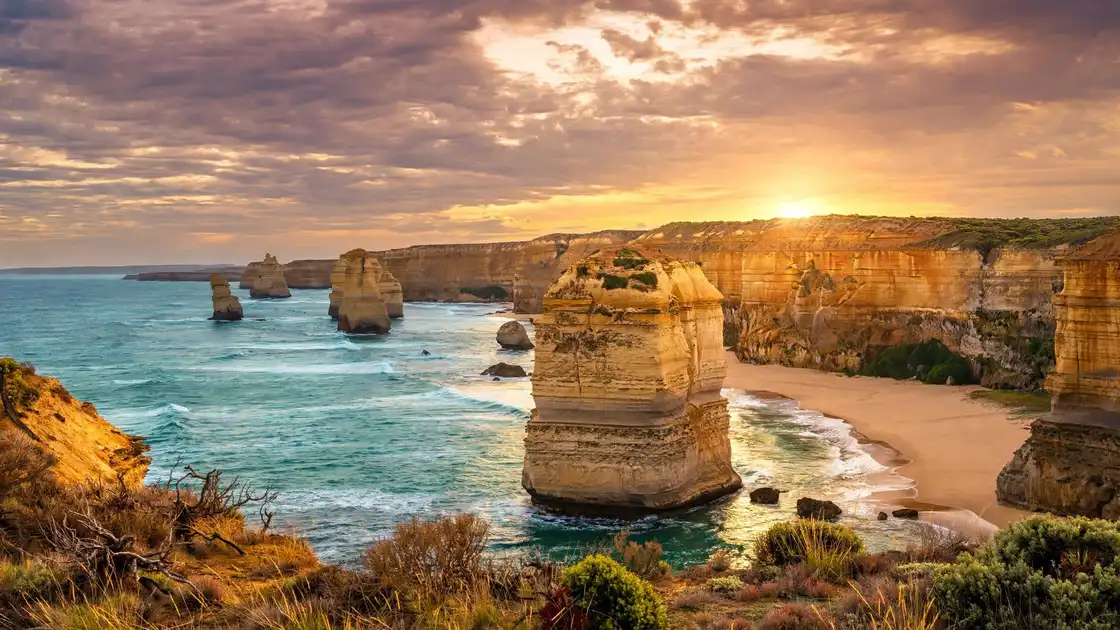
Day 13 is the Great Ocean Road, and it is a long day — leave early. The route runs from Torquay through Lorne and Apollo Bay to the Twelve Apostles and Loch Ard Gorge, and it is one of the great coastal drives on earth. A guided tour removes the driving stress and the parking hunt at the Apostles; a hire car gives you the freedom to stop at the smaller lookouts and to stay for sunset, which is when the Apostles are at their best. Day 14 is your flex day: Phillip Island for the Penguin Parade if you did not do St Kilda’s penguins, the Yarra Valley for wine if the weather turns, or a final slow Melbourne morning before flying home. The New South Wales travel guide and our Melbourne coverage in the Victoria hub will help you extend either end of this block.
Australia itinerary 2 weeks variants: add Uluru, or go east-coast only
Add Uluru (needs 3 extra weeks or a swap): the honest way to add the Red Centre is to extend the trip to 17 days and take 3 days from somewhere else — usually by cutting Melbourne to 2 days and Cairns to 4, then flying Melbourne to Ayers Rock for Uluru and Kings Canyon. Do not try to add Uluru to a 14-day version of this route without cutting a base; the planner’s refusal panel will show you exactly why, and the math does not lie.
East-coast only (no Melbourne): if the southern coast does not appeal, spend the last four days driving from Cairns down to Brisbane via the Whitsundays and Fraser Island, or add them to Sydney and the Blue Mountains. The east-coast variant suits travellers who would rather have a second reef stop than a city break, and it keeps every leg within Queensland and New South Wales.
Slower version (21 days): add two days to each base. Sydney gains the Hunter Valley, Cairns gains the Atherton Tablelands, and Melbourne gains the Grampians or the Mornington Peninsula. The route’s structure does not change — only the depth — which is why the planner’s pace settings exist: try Relaxed pace on the same 14 days and watch Sydney stretch while Melbourne shrinks.
What this Australia itinerary 2 weeks costs
Costs swing by season and travel style, so this Australia itinerary 2 weeks route does not quote a single total — that would be false precision. Instead, price it honestly with our Australia trip budget calculator: put in 5 days in New South Wales, 5 days in Queensland and 4 days in Victoria at your travel style, and the calculator gives you per-day, trip-total and per-person figures from its live band table. As a rough anchor, a mid-range pair travelling this route should budget around A$450–500 per day for two people sharing on the ground (accommodation, food, transport and activities, excluding flights to Australia and the domestic flights between bases), with the reef and Great Ocean Road days running higher and the city days lower. The calculator’s own worked examples — a 7-day New South Wales mid-range pair at $489 a day — will let you sanity-check any figure a tour operator quotes you.
Flights between bases are the other real cost: budget for three domestic sectors (home to Sydney, Sydney to Cairns, Cairns to Melbourne, Melbourne home — the last two are the internal ones) and book them early, because Australian domestic fares rise steeply in the last month before departure. Accommodation is the lever that moves the total most: a serviced apartment with a kitchen in each base can cut food costs enough to pay for the reef tour.
When to go on an Australia itinerary 2 weeks trip
April to May and September to October are the kindest months for this exact route: the north is dry or drying out, the south is mild, and the crowds are manageable. June to August works well too — the north is at its best and the south is cool but clear — while December to February brings the north’s wet season and the south’s peak prices. Our best time to visit Australia guide breaks the month-by-month picture down by zone, and the Bureau of Meteorology’s capital-city climate averages let you check the numbers for your exact towns.
Frequently asked questions
Is 2 weeks enough for Australia?
Enough for one strong route — Sydney, Cairns and Melbourne, or Sydney, Melbourne and the Great Ocean Road — but not enough for the whole country. That is the honest premise of any Australia itinerary 2 weeks plan: Australia is roughly the size of the continental United States, and the honest 2-week trip picks one triangle and does it properly rather than racing between five cities.
Should I hire a car for this itinerary?
Only for the Great Ocean Road day, and even there a guided tour is a fine substitute. Sydney, Cairns, Port Douglas and Melbourne all work on public transport and tours, and the three intercity legs are flights. Hiring a car for the full two weeks would add cost and parking stress without adding freedom.
How much does a 2-week Australia trip cost?
For a mid-range pair, roughly A$450–500 per day on the ground for two people sharing, plus domestic flights and your international fare. Price your exact dates and style with our trip budget calculator — it uses live band tables by state and tier rather than a single guessed total.
Can I do this route in reverse?
Yes, and in the southern summer it can even be better: start in Melbourne, fly to Cairns, finish in Sydney, so the trip ends with the harbour city. The day split stays the same — 4 days Melbourne, 5 days Cairns, 5 days Sydney — and the flight logic is identical.
What should I book first?
International flights, then the reef tour, then accommodation in Port Douglas — in that order. Reef tours and Port Douglas stays sell out first in the dry season, while Sydney and Melbourne accommodation has enough depth to book later without penalty.