
Darwin Travel Guide: Gateway to the Top End
This Darwin travel guide covers Australia’s tropical capital — a small, steamy, endlessly likeable city that feels closer to Southeast Asia than to Sydney. Darwin is the launch pad for the Top End’s big-ticket nature: Kakadu, Litchfield and Nitmiluk (Katherine) gorges, the Tiwi Islands and the crocodile country of the Adelaide River. But the city itself deserves two or three days: sunset markets, WWII history, waterfront lagoons and a food scene shaped by 60+ nationalities.
Darwin is unlike anywhere else in Australia. The harbour sunsets are enormous, the markets are legendary, and the city’s multicultural makeup — shaped by its proximity to Indonesia and Timor-Leste and its large Aboriginal population — shows up on every plate. The climate dictates everything: the dry season (May to October) is glorious, the wet season (November to April) is dramatic. Time your visit right and Darwin is magic.
Best Time to Visit Darwin: Dry vs Wet Season
Dry season (May to October) is the time to visit: sunny days around 30–32°C, low humidity, cool nights, and all national parks fully accessible. This is peak season — book accommodation and tours ahead, especially June–August.
Wet season (November to April) brings build-up humidity, spectacular afternoon storms, and the possibility of cyclones. Many Top End roads and attractions close, but the waterfalls are at their most powerful, the landscape is electric green, and prices drop sharply. The shoulder months (April–May, October–November) can be excellent value if you handle heat.
Things to Do in Darwin
Mindil Beach Sunset Markets
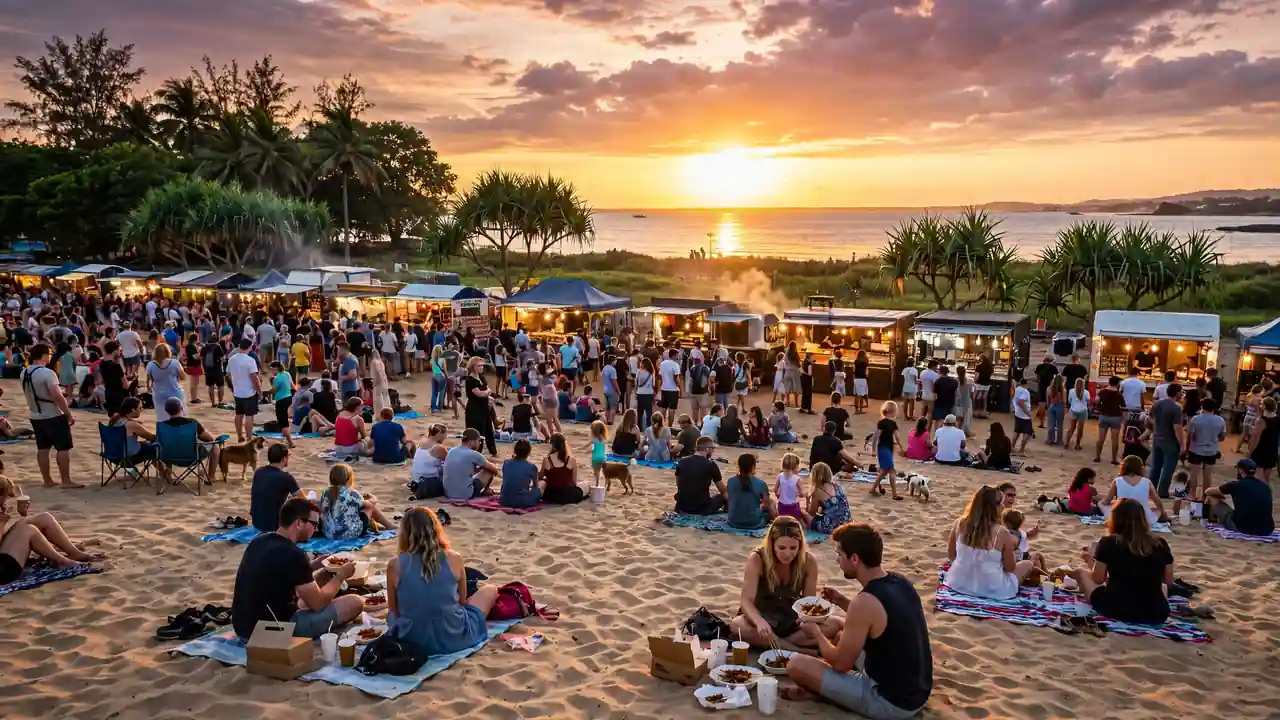
Darwin’s most famous experience: every Thursday and Sunday evening in the dry season, thousands gather on Mindil Beach for 200+ food, craft and art stalls, then watch the sun sink into the Timor Sea. Arrive by 5 pm, eat your way through laksa, satay, dumplings and tropical desserts, and stay for the sunset. It is free to enter and utterly essential.
Darwin Waterfront
The Waterfront Precinct is the city’s swimming solution — the harbour has crocodiles and box jellyfish, so locals swim at the Wave Lagoon (a patrolled wave pool) and the Recreation Lagoon (a safe swimming beach with a seawall). Both are free or cheap, with cafés and green lawns around them.
WWII History
Darwin was bombed by Japanese forces on 19 February 1942 — the largest single attack on Australia. The Defence of Darwin Experience at East Point and the WWII Oil Storage Tunnels under the city tell the story well. The Museum and Art Gallery of the Northern Territory (MAGNT) is free and houses the moving Cyclone Tracy exhibit plus superb Aboriginal art.
Crocodiles
You cannot visit the Top End without meeting a saltwater crocodile. Crocosaurus Cove in the city centre offers the Cage of Death — a perspex cage lowered into a 5-metre croc’s enclosure (around A$170 per person, approximately). The Jumping Crocodile Cruise on the Adelaide River (an hour from Darwin, around A$55 per adult) is the classic Top End experience. And Crocodylus Park covers crocs plus the rest of the region’s wildlife.
George Brown Darwin Botanic Gardens
A lush 42-hectare tropical garden, free to enter, with an excellent rainforest gully, orchid displays and the preserved ruins of the 19th-century Wesleyan church. Best in the early morning before the heat builds.
Where to Eat in Darwin
Darwin’s food reflects its position on Asia’s doorstep: laksa is practically the city dish, and the multicultural markets are the cheapest great eating in town.
- Mindil Beach Markets: the essential food experience — laksa, satay, Thai, Filipino, Greek.
- Parap Village Markets (Saturday): the locals’ market — laksa, tropical fruit, coffee.
- Mitchell Street: the backpacker strip — pubs, live music, late-night eats.
- Stokes Hill Wharf: waterfront seafood restaurants with harbour views.
- Laksa: try Mary Chung’s, Chok’s Place or the Parap markets — Darwin’s laksa rivalry is serious.
Budget A$18–28 for market and café meals, A$35–55 per person for a good restaurant dinner. The wet-season mango season (October–December) is a local obsession — try everything mango.
Day Trip: Litchfield National Park
Litchfield, 90 minutes south of Darwin, is the Top End’s swimming-hole paradise — and the easiest national park day trip from the city. The sealed road loop links Wangi Falls, Florence Falls (a stunning double waterfall with a plunge pool), Buley Rockhole (cascading rock pools), and the Magnetic Termite Mounds (2-metre-high mounds aligned north-south).
Unlike Kakadu, Litchfield’s main swimming spots are croc-managed and generally safe — always check the signs, as conditions change. Day tours from Darwin run from around A$170 per person; self-driving is easy on sealed roads. Start early to swim before the tour buses arrive.
The Big One: Kakadu National Park
Kakadu is Australia’s largest national park and a dual UNESCO World Heritage listing (natural and cultural) — 20,000 km² of escarpments, wetlands, waterfalls and Aboriginal rock art up to 40,000 years old. From Darwin it is 3 hours to the park entrance at Jabiru; most visitors spend 2–3 days.
Highlights: Ubirr rock art at sunset, the Yellow Water (Ngurrungurrudjba) Billabong sunrise cruise (book ahead — it sells out), Nourlangie (Burrungkuy) art galleries, Jim Jim Falls and Twin Falls (dry season, 4WD only). A 7-day park pass costs A$40 per adult in the dry season (A$25 in the tropical summer); see our Kakadu National Park travel guide for the full breakdown.
Nitmiluk (Katherine) Gorge
Three hours south of Darwin, Nitmiluk National Park centres on a 13-gorge system carved by the Katherine River. The classic experience is the Nitmiluk gorge cruise (2-hour cruises from around A$130 per person), but the adventurous options — canoe hire, multi-day hikes, helicopter flights — are superb. Katherine town also offers the Cutta Cutta Caves and outback heritage. It pairs naturally with a Kakadu loop.
Where to Stay in Darwin
The CBD and Waterfront put you near restaurants, the lagoon and tour pickups. Cullen Bay and Fannie Bay offer marina-side apartments with sunset views. Parap is the character suburb — markets, cafés, tropical gardens. Expect A$170–280 per night for a mid-range hotel in the dry season; wet-season rates can drop 30–40%.
Getting Around
Central Darwin is walkable, and buses cover the suburbs. For Litchfield, Kakadu and Katherine you need a hire car or a tour — there is no public transport to the national parks. The Stuart Highway south is sealed and straightforward; Kakadu’s sealed roads suit 2WD, but Jim Jim/Twin Falls need high-clearance 4WD. Book hire cars early in the dry season.
Practical Tips: Crocodile Safety
- Be Crocwise: never swim in rivers, billabongs or beaches unless signed as safe. Saltwater crocodiles inhabit waterways across the Top End.
- Stingers: box jellyfish are present October–May — swim only in patrolled or netted areas.
- Heat: carry 2+ litres of water per person for any walk; start hikes early.
- Fuel: fill up in Darwin, Jabiru and Katherine — distances are long and roadhouses are sparse.
- Respect: much of Kakadu and Arnhem Land is Aboriginal land — follow signage, don’t enter restricted areas, and consider an Aboriginal-guided tour for the richest experience.
Darwin is the Top End’s front door. For the main event, read our Kakadu National Park travel guide, and for the Red Centre, our Uluru travel guide. Heading to Queensland’s tropics instead? See our Cairns and Port Douglas guide.
For official trip ideas, park access reports and events, see northernterritory.com, the official site of Tourism NT.
Darwin’s Markets Beyond Mindil
Mindil gets the fame, but Darwin’s market culture runs deeper:
- Parap Village Markets (Saturday): the locals’ market — the laksa rivalry (Mary Chung’s vs the market stalls), tropical fruit, Vietnamese iced coffee, and secondhand treasures. Arrive before 9 am.
- Nightcliff Markets (Sunday): the foreshore market — food stalls, local crafts, and the Nightcliff jetty sunset afterwards.
- Rapid Creek Markets (Saturday–Sunday): the Asian-grocery market — the fresh produce, live seafood, and ingredients you won’t find elsewhere in Australia.
- Malak Marketplace (Saturday): the community market in the northern suburbs — multicultural food, plants, local art.
Day Trip: Tiwi Islands
The Tiwi Islands (Bathurst and Melville Islands), 80 km north of Darwin, are one of Australia’s great Indigenous cultural experiences — but you can’t visit independently (permit required; access is through organised tours only). SeaLink NT day tours (around A$350–450 per person, approximately, including the 2.5-hour ferry each way) visit Wurrumiyanga (Bathurst Island): the Tiwi art centres (the famous Tiwi Designs textiles and Munupi Arts), the Patakijiyali Museum, the historic Catholic mission church, and a traditional smoking ceremony with Tiwi guides. The Tiwi Grand Final (March, Australian Rules) is the cultural event of the year — tour operators run special trips.
Darwin’s Best Free Experiences
Darwin is kind to budgets: the Museum and Art Gallery of the NT (free, including the Cyclone Tracy exhibit), the George Brown Botanic Gardens (free), the Waterfront lagoons (free/cheap), the East Point Reserve (WWII history, wallabies, Lake Alexander — the safe swimming lake), the Nightcliff foreshore walk, and sunset at East Point or Dripstone Cliffs. The Deckchair Cinema (dry season, under the stars) is cheap and magical.
Darwin to Alice Springs: The Road Trip Option
With a week, the Stuart Highway from Darwin to Alice Springs (1,500 km) is the classic outback drive: Katherine (Nitmiluk Gorge), Mataranka (the thermal springs — Bitter Springs and Mataranka Thermal Pool, both free and magical), Daly Waters Pub (the outback icon, 1930s pub with bras on the wall), Tennant Creek (the Nyinkka Nyunyu art centre), the Devils Marbles (Karlu Karlu) (the famous balanced boulders — camp here for sunset), and Alice Springs. Allow 4–5 days minimum; the road is sealed but remote — carry water, fuel up at every roadhouse, and never drive at night (cattle, camels, kangaroos).
Darwin’s Sunset Spots Ranked
Darwin’s sunsets are enormous — the dry-season sky goes orange → pink → purple over the Timor Sea. The ranking:
- 1. Mindil Beach: the icon — the sunset market (Thursday/Sunday, dry season), the food stalls, the thousands on the sand. Arrive by 5 pm.
- 2. East Point: the locals’ spot — the clifftop, the WWII guns, Lake Alexander (the swim before sunset). Quieter than Mindil.
- 3. Nightcliff Jetty: the northern suburbs jetty — the foreshore walk, the café, the sun dropping into the Beagle Gulf.
- 4. Cullen Bay: the marina — sunset drinks at the waterfront bars, the yachts silhouetted.
- 5. Dripstone Cliffs: the red cliffs — the ochre glows at golden hour. 20 minutes from the CBD.
- 6. Stokes Hill Wharf: the city option — the harbour sunset, the seafood restaurants.
- 7. Charles Darwin National Park: the bush sunset — the mangrove boardwalks, the WWII bunkers, no crowds.
Top End Road Distances from Darwin
- Litchfield National Park: 120 km, 1.5 hours (sealed).
- Kakadu (Jabiru): 250 km, 3 hours (sealed).
- Katherine (Nitmiluk): 320 km, 3.5 hours (sealed Stuart Highway).
- Adelaide River (jumping crocs): 110 km, 1 hour.
- Mataranka Thermal Pool: 420 km, 4.5 hours.
- Alice Springs: 1,500 km, 16+ hours (2 days minimum).
Fuel up at every roadhouse, carry water, and never drive at night (cattle, buffalo, kangaroos).
Darwin Travel FAQs
How many days do you need in Darwin?
Two to three days for Darwin itself (Mindil Beach markets, waterfront, WWII history, crocodiles). Add one day for Litchfield, two to three for Kakadu, and one to two for Nitmiluk/Katherine — a full Top End trip is seven to ten days.
What is the best month to visit Darwin?
May to October (dry season) is best — sunny, low humidity, all parks open. June to August is peak season. November to April (wet season) is cheaper with dramatic storms but many attractions close.
Can you swim in Darwin?
Not in the harbour or most beaches — saltwater crocodiles and box jellyfish (October to May) make open water dangerous. Swim at the patrolled Darwin Waterfront lagoons, hotel pools, or designated safe swimming holes in Litchfield.
Is Darwin worth visiting?
Yes — Darwin’s sunset markets, multicultural food scene, WWII history and crocodile experiences are unique in Australia, and it is the essential gateway to Kakadu, Litchfield and the Top End’s national parks.
Do I need a 4WD for Kakadu from Darwin?
No for the main sealed-road attractions (Ubirr, Nourlangie, Yellow Water, Jabiru). You need a high-clearance 4WD only for Jim Jim Falls and Twin Falls in the dry season. Litchfield’s main loop is fully sealed.