
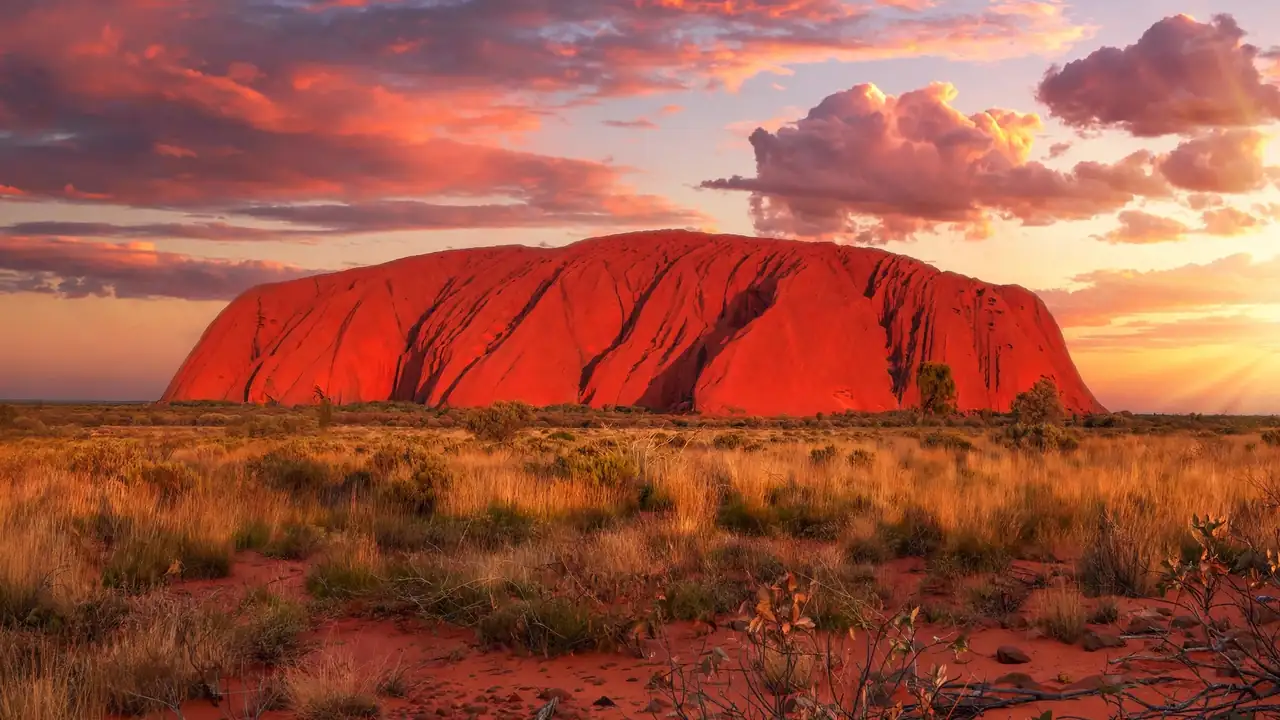
Uluru Travel Guide: Everything First-Timers Must Know
This Uluru travel guide is written for first-time visitors to Australia’s spiritual heart — the great red monolith rising from the Central Australian desert. Nothing prepares you for the first sight of Uluru: 348 metres of ancient sandstone, older than the dinosaurs’ extinction, glowing red at dawn and dusk, holding 30,000+ years of Anangu culture in its caves and waterholes. This guide covers the practicalities first-timers get wrong: park passes, where to stay, which walks to do, sunrise vs sunset, costs, and — most importantly — how to visit respectfully.
Uluru-Kata Tjuta National Park is jointly managed by Parks Australia and the Anangu traditional owners, and it is dual World Heritage-listed for nature and culture. The park centres on two great formations: Uluru itself and Kata Tjuta (the Olgas), 40 km west — 36 domes of conglomerate rock, equally spectacular and far less crowded. Most visitors base at Yulara (Ayers Rock Resort), 20 minutes from the park. Two to three days is the sweet spot.
First Things First: Cultural Respect
Uluru is sacred to the Anangu people, and visiting respectfully is the single most important part of your trip:
- Do not climb Uluru. The climb has been closed since 26 October 2019 at the request of the traditional owners. Respect the closure completely.
- Photography restrictions: do not photograph certain sacred sites — they are clearly signposted. When in doubt, don’t shoot.
- Stay on marked tracks and do not remove rocks, sand or plants — everything in the park is protected.
- Learn the Tjukurpa (creation law/stories) at the Cultural Centre before walking — it transforms the experience from sightseeing to understanding.
- Consider an Anangu-guided tour (e.g. with SEIT Outback Australia or Anangu Tours) — hearing the stories from traditional owners is the deepest experience the park offers.
Park Passes and Entry (2026 Prices)
Every visitor needs a park pass: A$38 per adult in 2026, valid for 3 consecutive days, covering both Uluru and Kata Tjuta. Children under 18 enter free. Buy online before arrival for the fastest entry (use the left lane at the entry station). Note that a Northern Territory parks pass does not cover Uluru — it is federally managed by Parks Australia and needs its own pass. Pass revenue is reinvested in park management and Anangu community programs.
Best Time to Visit Uluru
May to September is the ideal window: daytime maximums of 20–30°C, cold desert nights (below freezing in June–July — pack accordingly), and walks that stay open all day. October to April is brutally hot — 35–40°C+ days — and walks close when temperatures exceed 36°C (the Mala Walk and parts of the base walk shut first). Sunrise and sunset are spectacular year-round; winter adds the possibility of desert wildflowers after rain.
The Walks: What to Do
Uluru Base Walk (10.6 km)
The essential walk: a full circuit of the rock, 3–4 hours, passing waterholes (Mutitjulu), caves with rock art, and the Kantju Gorge. Start at sunrise — the light on the eastern face is extraordinary and you’ll finish before the heat. Water stations are spaced around the track; carry 2+ litres per person. Hire bikes at the Cultural Centre if you’d rather cycle it.
Mala Walk (2 km return)
The best short walk: from the Mala carpark to Kantju Gorge, guided by free ranger talks (9 am daily in season, approximately — check the program). The gorge’s waterhole and rock art, with a ranger explaining Tjukurpa, is many visitors’ highlight.
Kuniya Walk to Mutitjulu Waterhole (1 km return)
An easy, shaded walk to a permanent waterhole with rock art — beautiful in the late afternoon light. Wheelchair accessible.
Valley of the Winds, Kata Tjuta (7.4 km)
At Kata Tjuta, the Valley of the Winds walk threads between the great domes — the full circuit to the second lookout takes 3–4 hours and feels like walking through a lost world. The shorter Walpa Gorge walk (2.6 km return) is an easier alternative. Kata Tjuta is at its best in the morning light; note the trail closes beyond the first lookout when temperatures exceed 36°C.
Sunrise vs Sunset: Where to Go
Sunset: the Uluru sunset viewing area (signposted off the park road) is the classic — the rock shifts through orange, red and purple as the sun drops. Bring a picnic and arrive 45 minutes early for a good spot. The dedicated bus sunset tour with sparkling wine is popular but the self-drive viewing area is just as good.
Sunrise: the sunrise viewing area faces the eastern flank — the rock ignites as the sun hits it. Alternatively, start the base walk at dawn and watch the light change as you walk. Kata Tjuta at sunrise (the dune viewing area) is quieter and, some argue, more beautiful.
Where to Stay: Yulara
Every bed near the park is at Yulara (Ayers Rock Resort), 20 minutes from Uluru. Options span the Ayers Rock Campground (powered/unpowered sites from around A$45–70 per site), the Outback Pioneer Hotel (mid-range), the Desert Gardens Hotel, and the luxury Sails in the Desert and Longitude 131° (the ultra-luxury tented camp with rock views, from around A$3,000+ per night). Book months ahead for May–September — Yulara sells out.
The resort has a supermarket (prices 20–40% above city prices — stock up in Alice Springs if self-driving), restaurants, a pool, and free resort shuttle buses. The Town Square hosts free nightly Indigenous dance and didgeridoo performances.
Signature Experiences
- Field of Light (Tili Wiru Tjuta Nyakutjaku): Bruce Munro’s installation of 50,000 solar-lit stems covering the desert — walk it after dark or at dawn. Tickets from around A$45 per adult (approximately); book ahead.
- SEIT Patji tour: an Anangu-led tour to a restricted-access area south of Uluru — art, tools, bush foods, and stories you won’t hear elsewhere. Around A$165 per adult (approximately).
- Sunrise camel tour: a dawn camel ride with Uluru views and damper breakfast.
- Helicopter/scenic flights: 15-minute to multi-hour flights over Uluru and Kata Tjuta (from around A$150 per person for short flights).
- Sounds of Silence dinner: the famous outback dining-under-the-stars experience (from around A$250+ per person) — didgeridoo, bush-tucker-inspired menu, astronomer talk.
What It Costs
Uluru is expensive — Yulara’s remoteness shows in every price. A realistic budget: park pass A$38; accommodation A$150–400+ per night; meals A$25–40 (café) to A$50–80 (restaurant); car hire A$80–150 per day plus fuel (petrol at Yulara is among Australia’s priciest). A 3-day trip for two typically runs A$1,500–2,500+ excluding flights. Self-catering from the supermarket and free walks keep costs down; the splurge experiences (Field of Light, Sounds of Silence, flights) push them up.
Getting There
Fly: Ayers Rock Airport (AYQ) has direct flights from Sydney, Melbourne, Brisbane, Cairns and Alice Springs (Jetstar, Qantas, Virgin). A free shuttle meets flights to Yulara. Drive: Alice Springs is 450 km (4.5 hours) north-east on sealed road — the classic Red Centre road trip. Tours: day tours from Alice Springs exist but make for an 18-hour day; 2–3 day camping/coach tours from Alice are better value.
Practical Tips
- Flies: buy a fly net in Yulara — in warmer months the flies are relentless.
- Water: carry far more than you think; the desert dehydrates fast.
- Heat: walks close above 36°C — start every walk at or before sunrise in warm months.
- Fuel: fill up at every opportunity; distances are vast.
- Drones: banned in the national park.
- Night skies: the desert sky is among the darkest on earth — walk out of the resort lights after dinner.
Uluru pairs naturally with the Top End: our Kakadu guide and Darwin guide cover the tropical north, and our Tasmania road trip is the green counterpoint. For official park information, passes and alerts, see parksaustralia.gov.au/uluru.
Add-On: Kings Canyon (Watarrka)
With a 4th day, add Kings Canyon — 300 km north-east of Yulara (3.5 hours) or 450 km south-west of Alice Springs. The Rim Walk (6 km, 3–4 hours) is one of Australia’s great day walks: the Garden of Eden (a permanent waterhole in the gorge), the Amphitheatre, and the North and South Walls with views across the desert. Start at sunrise — the light on the red sandstone is extraordinary and the heat builds fast. The shorter Kings Creek Walk (2.6 km return) suits families. Stay at the Kings Canyon Resort (the night before the walk) or do it as a long day trip from Yulara (tours available, or self-drive with an early start). The Light Towers installation (by Bruce Munro, of Field of Light fame) illuminates the desert after dark.
Uluru Photography Tips
- Sunset: the dedicated sunset viewing area — arrive 45 minutes early. The rock goes through orange → red → purple as the sun drops; keep shooting after the sun sets (the afterglow is often the best colour).
- Sunrise: the sunrise viewing area faces the eastern flank — the rock ignites. Alternatively, photograph Kata Tjuta at the dune viewing area (quieter, equally spectacular).
- Night: the desert sky is among the world’s darkest — Milky Way shots from the Field of Light area (the installation provides foreground interest). No tripod? The Sounds of Silence dinner includes an astronomer talk.
- Respect: no photography at signposted sacred sites — the restrictions are clearly marked. Drones are banned in the national park.
- Gear: a wide-angle for the rock’s scale, a telephoto for the texture details (the rock’s surface is extraordinary up close). Dust is constant — bring lens cloths.
Yulara: Making the Most of the Resort
Yulara is more than a bed base. The Town Square hosts free nightly performances — Indigenous dance, didgeridoo, and bush tucker talks. The Desert Gardens Hotel‘s Mangata Bistro and the Outback Pioneer‘s barbecue (cook your own on the communal grills) are the dining highlights. The supermarket (open daily) covers self-catering — prices are 20–40% above city prices, so stock up in Alice Springs if driving. The resort pools are essential in the heat. The free shuttle buses loop the resort — but walking (the resort is compact) is pleasant at dawn/dusk.
Anangu Culture: A Visitor’s Primer
Uluru is Anangu land — and understanding the culture transforms the visit. The essentials:
- Tjukurpa: the creation law — the stories of the ancestral beings (the Mala (rufous hare-wallaby), the Kuniya (woma python), the Liru (poisonous snake)) that shaped Uluru. The Cultural Centre introduces the Tjukurpa — visit first.
- The Mala Walk: the ranger-guided walk (the Mala story) — the best cultural introduction (free, daily in season).
- Anangu Tours: the Anangu-owned operator — the dot-painting workshops, the bush food experiences, the guided walks. Book ahead.
- SEIT Patji: the Anangu-led tour to the restricted southern side — art, tools, stories (around A$165 per adult, approximately).
- Language: Pitjantjatjara/Yankunytjatjara — “Palya!” (hello/welcome), “Tjukurpa” (creation law). The Cultural Centre has language displays.
- Respect: don’t climb (closed 2019), don’t photograph sacred sites (signposted), stay on tracks, don’t remove anything. The Anangu ask visitors to learn — the Cultural Centre is the start.
Uluru Travel FAQs
How much does it cost to visit Uluru?
The park pass is A$38 per adult (2026), valid 3 consecutive days, with under-18s free. A 3-day trip for two typically costs A$1,500–2,500+ excluding flights, covering Yulara accommodation, meals, car hire and fuel.
How many days do you need at Uluru?
Two to three days is ideal: one for the Uluru base walk and sunset, one for Kata Tjuta (Valley of the Winds) and the Cultural Centre, and a third for Field of Light, a guided cultural tour or Kings Canyon. The park pass covers three consecutive days.
Can you still climb Uluru?
No — the climb has been permanently closed since 26 October 2019 at the request of the Anangu traditional owners. Climbing is disrespectful to Anangu culture; the base walk, Mala Walk and cultural tours are the recommended experiences.
What is the best month to visit Uluru?
May to September offers ideal walking weather (20–30°C days, cold nights). October to April is extremely hot (35–40°C+) with walk closures above 36°C. Book accommodation months ahead for the May–September peak.
Do I need a car at Uluru?
A car (or tour) is highly recommended — Yulara is 20 minutes from the park and Kata Tjuta is 40 km from Uluru. Free resort shuttles cover Yulara, and hop-on hop-off shuttles serve the park, but a hire car gives you sunrise/sunset flexibility.