
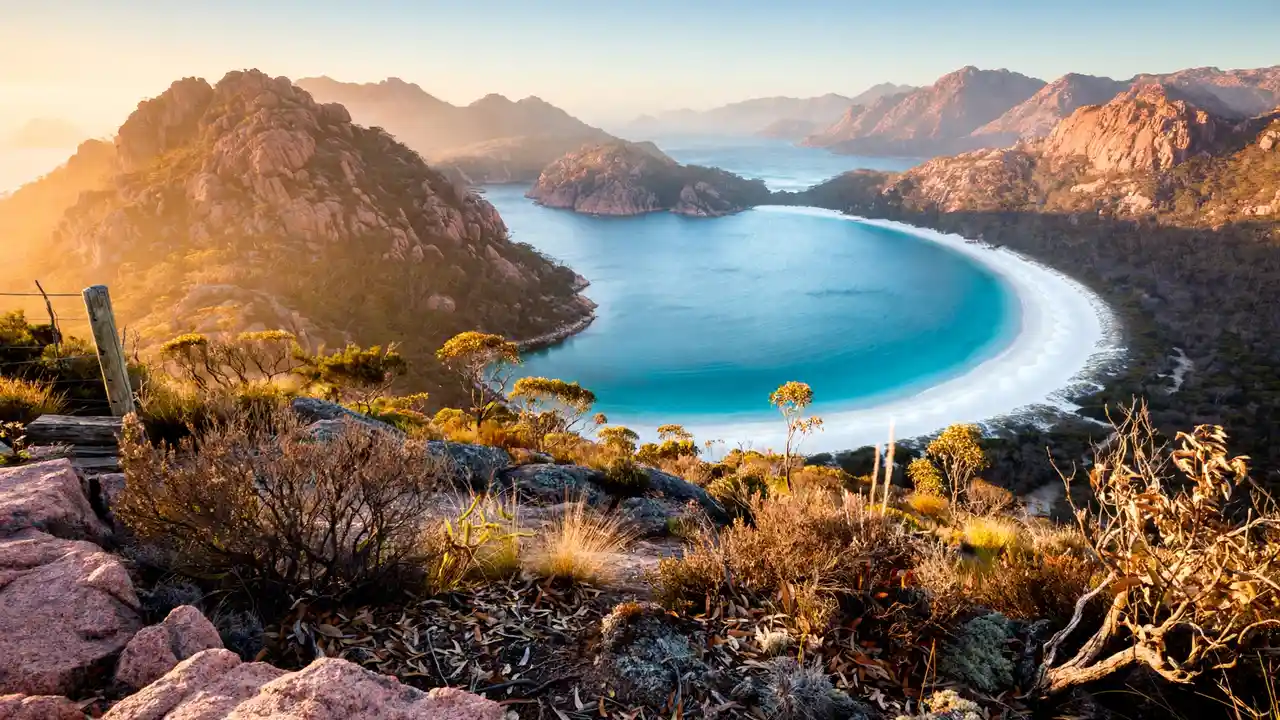
This Tasmania road trip itinerary squeezes the island’s greatest hits into one perfect week: Hobart’s waterfront and MONA, the white sands of Wineglass Bay, Launceston’s Cataract Gorge, the alpine drama of Cradle Mountain, and the wild west coast at Strahan. Seven days is the minimum for a proper Tasmanian circuit — enough to see the highlights without living in the car, with driving days kept under 3.5 hours.
Tasmania is Australia’s best road-trip state, full stop. The distances are short (the whole island is smaller than Ireland), the roads are scenic, the produce is extraordinary, and every day delivers a contrast — beach to mountain to rainforest to historic town. This itinerary runs clockwise from Hobart, which suits the prevailing weather and puts the west coast’s wildest scenery in the second half. Hire cars are available at Hobart and Launceston airports; book ahead in summer.
Before You Go: Tasmania Driving Essentials
- Distances are short, roads are slow: Tasmanian roads are winding — allow more time than the kilometres suggest. A 150-km leg takes 2–2.5 hours.
- Wildlife: dusk and dawn driving is hazardous — wallabies, wombats and possums are everywhere. Avoid driving in the dark in rural areas.
- Fuel: fill up in major towns; petrol stations are sparse on the west coast.
- Weather: pack for four seasons — even in summer, Cradle Mountain can be 10°C and raining while Hobart is 25°C.
- National Parks Pass: a Holiday Vehicle Pass (around A$80–90 for 8 weeks, approximately) covers all park entries — essential for this itinerary.
- Book ahead: summer (Dec–Feb) accommodation in Freycinet, Cradle Mountain and Strahan sells out; book 3–6 months ahead.
Day 1: Hobart
Fly into Hobart, collect your car, and settle in. Spend the afternoon on the waterfront: Salamanca Place, Battery Point (via Kelly’s Steps), and the Tasmanian Museum and Art Gallery (free). If it’s Saturday, the Salamanca Market is unmissable. Drive or walk up to the Mount Nelson Signal Station for sunset over the Derwent.
Dinner on the waterfront or in Salamanca — try the local seafood and a Tasmanian pinot noir. See our Hobart travel guide for the full city breakdown. Overnight: Hobart.
Day 2: Hobart → Port Arthur → Hobart (or Eaglehawk Neck)
Option A: MONA day — ferry from Brooke Street Pier, 3–5 hours in the museum, lunch at the Moorilla winery. Option B: Port Arthur Historic Site (90 minutes south-east) — Australia’s premier convict site, with guided tours and a harbour cruise; allow 4–5 hours. The Tasman Peninsula also offers the Tessellated Pavement, Tasman Arch, Devil’s Kitchen and the Port Arthur Lavender Farm.
Overnight: Hobart (or Eaglehawk Neck if you want a head start east).
Day 3: Hobart → Freycinet (via the East Coast)
Drive the east coast north: Hobart to Coles Bay is about 2.5 hours direct, but take the scenic route via Orford, Triabunna, Swansea (stop at Kate’s Berry Farm for berries and chocolate) and Bicheno (the blowhole, evening penguin tours). The Spiky Bridge and Spiky Beach are quirky roadside stops.
Arrive at Coles Bay by mid-afternoon. Walk the Cape Tourville Lighthouse circuit (20 minutes, stunning coastal views) for a warm-up. Overnight: Coles Bay. Driving: ~200 km, 3 hours with stops.
Day 4: Freycinet National Park
Freycinet day. The essential walk: the Wineglass Bay Lookout (1.5 hours return, 600+ steps) — the postcard view. The fit and keen continue down to the beach (2.5 hours return total) for a swim in famously clear (cold) water. Alternatives: the Hazards Beach circuit (11 km), Sleepy Bay, and the Friendly Beaches north of the park.
Afternoon: oyster farm tours at Coles Bay, sea kayaking, or a Wineglass Bay cruise from Coles Bay (around A$150–180 per person, approximately) — the cruise shows you the bay’s scale from the water with a seafood lunch. See our Freycinet and Wineglass Bay guide for the detail. Overnight: Coles Bay.
Day 5: Freycinet → Launceston (via the Midlands)
Drive west to Launceston via Campbell Town (the convict brick trail, the Lost Fudge Shop), Ross (the exquisite 1836 Ross Bridge with its Celtic carvings, the Tasmanian Wool Centre), and Oatlands (Australia’s largest collection of Georgian sandstone buildings, the Callington Mill whisky distillery).
Afternoon in Launceston: the Cataract Gorge — a dramatic river gorge 15 minutes’ walk from the city centre, with the world’s longest single-span chairlift, peacocks, and swimming at the First Basin. Dinner in the Seaport precinct or Brisbane Street’s restaurant strip. Overnight: Launceston. Driving: ~200 km, 2.5–3 hours.
Day 6: Launceston → Cradle Mountain
Drive south-west to Cradle Mountain-Lake St Clair National Park (2.5 hours via Sheffield — the town of murals, worth a stop). Tasmania’s alpine heart: jagged dolerite peaks, glacial lakes, ancient pencil pines, and wombats grazing at dusk.
Afternoon walks: the Enchanted Walk (20 minutes, wombats and platypus), the Dove Lake circuit (2–3 hours, the classic — Cradle Mountain reflected in the lake), or the Marion’s Lookout track for the fit. The Cradle Mountain shuttle bus runs from the visitor centre (included with park entry). At dusk, walk the Ronny Creek boardwalk for wombats. Overnight: Cradle Mountain (book well ahead — limited beds). Driving: ~150 km, 2.5 hours.
Day 7: Cradle Mountain → Strahan → Hobart (or Queenstown)
The big driving day. Option A (full circuit): drive to Strahan via Rosebery and Zeehan (3.5 hours) for the Gordon River cruise (a half-day wilderness cruise through World Heritage rainforest, around A$150–180 per person) — then the long return to Hobart via Queenstown (4+ hours). This is too much for one day; better to add a night.
Option B (recommended for 7 days): drive Cradle Mountain to Queenstown (2 hours) — the moonscape mining town with its famous bare hills and the West Coast Wilderness Railway (a steam-rack railway through rainforest, from around A$150 per person) — then continue to Hobart via Lake St Clair and the Derwent Valley (4 hours). It is a long day (6+ hours driving) but spectacular. Alternatively, drop the car in Launceston and fly out — the itinerary works as a loop or a one-way.
Extending to 10 Days
With 10 days, add: Bruny Island (day trip from Hobart), Port Arthur properly, Bay of Fires (north of Bicheno — orange-lichen boulders, white sand), the Tarkine wilderness, and Stanley/The Nut in the far north-west. Tasmania rewards slow travel — the 7-day version is the highlights reel; 10 days is the real trip.
What It Costs
Approximate per-person costs for 7 days (2026): hire car A$500–800/week; accommodation A$150–280/night (mid-range); National Parks Holiday Pass ~A$85; fuel ~A$250–350; food A$80–120/day; activities (cruises, MONA, railway) A$300–500 total. Budget roughly A$2,500–3,500 per person for the week excluding flights — less with hostels and self-catering, more with the luxury lodges.
Practical Tips
- Book the triangle: Freycinet, Cradle Mountain and Strahan accommodation first — everything else is flexible.
- One-way fees: dropping the car in Launceston instead of Hobart often incurs a one-way fee (around A$150–300) — compare with the fuel/time of looping back.
- Devils: Devils@Cradle and the Tasmanian Devil Unzoo (Taranna) offer after-dark devil feedings — book ahead.
- Produce stops: the itinerary is studded with farm gates — berry farms, cheese makers, whisky distilleries, oyster leases. Stop often.
- Phone coverage: patchy on the west coast and in national parks — download offline maps.
For the city bookends, see our Hobart travel guide and Freycinet guide. For the desert contrast after Tasmania’s green, our Uluru travel guide covers the Red Centre. For official road-trip tools and passes, see discovertasmania.com.au.
Packing List for a Tasmania Road Trip
- Layers: a warm fleece, a rain jacket, and a beanie — even in summer, Cradle Mountain can be 10°C and raining.
- Hiking boots: waterproof, broken in — the tracks are rocky and often muddy.
- Swimmers and a towel: the east-coast beaches are swimmable in summer; the hot springs (Hastings Caves) are year-round.
- Fly net: for the west coast in summer (the march flies are fierce).
- Cooler bag: for the farm-gate produce — cheese, berries, oysters, wine. You’ll buy more than you plan.
- Offline maps: download Tasmania in Google Maps — coverage is patchy on the west coast.
- National Parks Pass: buy the Holiday Vehicle Pass online before you go.
- Headlamp: for the penguin tours (Bicheno), glow worms (Mole Creek), and wombat-spotting at dusk.
Tasmania’s Best Photo Stops
- Wineglass Bay Lookout: the classic — morning light (the bay faces east).
- Dove Lake, Cradle Mountain: the mountain reflection — dawn for still water.
- Bay of Fires: the orange-lichen boulders — sunrise for the glow.
- Russell Falls: the waterfall in Mt Field National Park — overcast days for the even light.
- Stanley and The Nut: the volcanic plug rising from the Bass Strait — sunset from the summit.
- Bruny Island Neck: the isthmus from the Truganini Lookout — late afternoon.
- Cataract Gorge: the chairlift view — morning for the light on the cliffs.
Tasmania’s Wildlife Calendar
- Platypus: dawn/dusk at Lake St Clair, Cradle Mountain (Enchanted Walk), and the Burnie platypus pools — year-round.
- Wombats: dusk at Cradle Mountain (Ronny Creek), Maria Island, and Narawntapu National Park — year-round.
- Tasmanian devils: after-dark tours at Devils@Cradle and the Unzoo — year-round (book ahead).
- Penguins: Bicheno evening tours (September–March peak).
- Whales: humpback and southern right whales — May–November, best from Eaglehawk Neck and Bruny Island.
- Glow worms: Mole Creek Caves and Hastings Caves — year-round, best in the dark.
Tasmania’s Best Roadside Stops: The Produce Trail
The Tasmania road trip is studded with farm gates — stop often:
- Kate’s Berry Farm (Swansea): the berries, the chocolate, the ice cream — the east-coast institution.
- Pyengana Dairy (north-east): the cheese factory — the cloth-bound cheddar (the tastings), the Holy Cow Café (the milkshakes).
- Ashgrove Cheese (Elizabeth Town): the cheese centre — the tastings, the factory viewing, the ice cream.
- Christmas Hills Raspberry Farm (Elizabeth Town): the raspberries (summer), the jams, the desserts.
- Spreyton Cider Co (Devonport): the cider — the tastings, the orchard.
- Hill Street Grocer (various): the Tasmanian grocer — stock up on local produce (the cheese, the salmon, the wine).
- The Truffle Farm (Deloraine): the winter truffle hunts (June–August) — book ahead.
- Wursthaus Kitchen (Latrobe): the German smallgoods — the platypus spotting at the Mersey River (dawn/dusk).
Tasmania’s Best Short Walks (Under 2 Hours)
- Cape Tourville (Freycinet): 20 minutes — the boardwalk, the lighthouse, the Hazards views.
- Wineglass Bay Lookout (Freycinet): 1.5 hours return — the postcard.
- Enchanted Walk (Cradle Mountain): 20 minutes — the wombats, the platypus.
- Russell Falls (Mt Field): 1 hour return — the waterfall, the swamp gums.
- Cataract Gorge (Launceston): 1 hour — the chairlift, the First Basin swim.
- Tessellated Pavement (Eaglehawk Neck): 30 minutes — the mosaic rock platform.
- The Nut (Stanley): 1 hour return (or the chairlift) — the volcanic plug, the Bass Strait views.
Tasmania Road Trip FAQs
Is 7 days enough for Tasmania?
Yes — seven days covers Tasmania’s highlights: Hobart, MONA or Port Arthur, Freycinet/Wineglass Bay, Launceston, Cradle Mountain and the west coast. Driving days stay under 3.5 hours. Ten days allows a slower pace with Bruny Island, Bay of Fires and the Tarkine.
What is the best direction to drive around Tasmania?
Clockwise from Hobart (east coast first, west coast second) is the most popular: it puts the gentler east-coast driving first and saves the wild west for the second half. The itinerary works equally well counter-clockwise.
Do I need a national parks pass for Tasmania?
Yes — the Holiday Vehicle Pass (around A$80–90 for 8 weeks) covers entry to all Tasmanian national parks including Freycinet and Cradle Mountain. Buy online before you go.
When is the best time for a Tasmania road trip?
December to February offers the warmest weather and longest days but peak prices and crowds. March to May and October to November give mild weather, autumn colour and fewer crowds. Winter (June–August) is cold with possible snow at Cradle Mountain.
Is it safe to drive in Tasmania at night?
Avoid it where possible — wallabies, wombats and possums are active at dusk and dawn and collisions are common. Plan to arrive at each overnight stop before dark, especially on rural roads.