
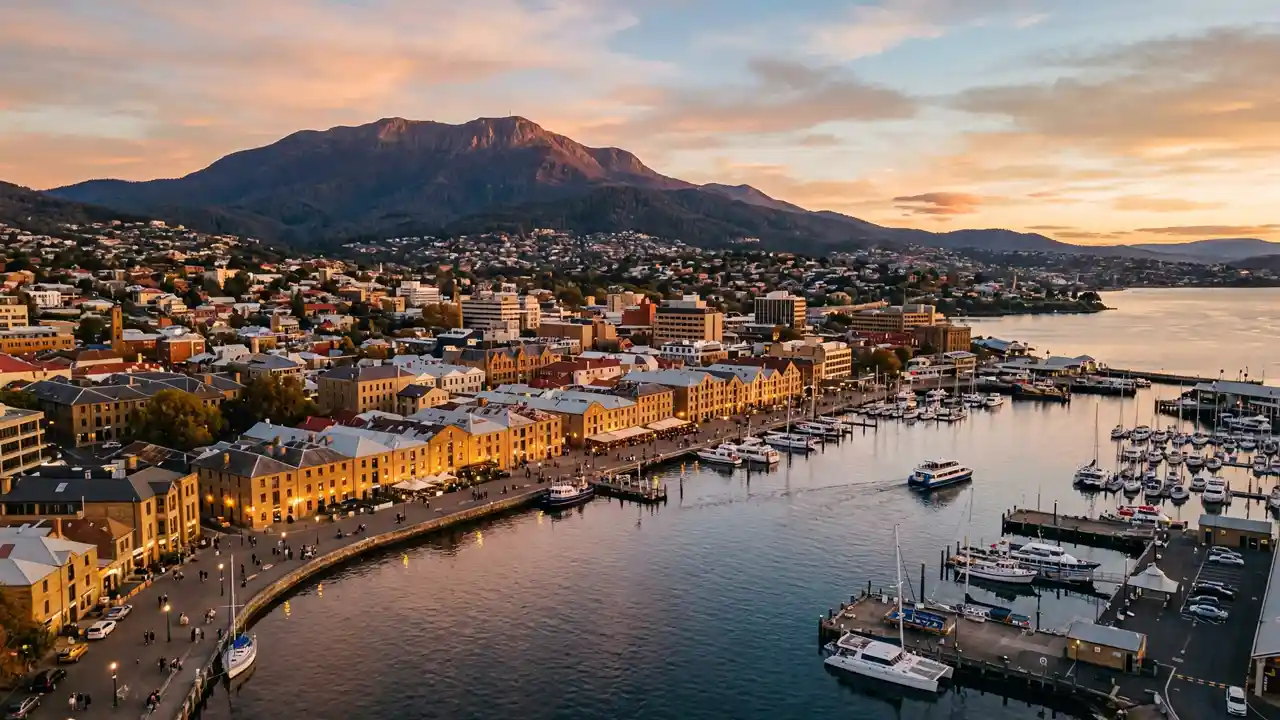
Hobart Travel Guide: MONA, Salamanca & Beyond
This Hobart travel guide covers Australia’s southernmost capital — a waterfront city of sandstone warehouses, mountain views and one of the world’s most talked-about museums. Hobart is compact enough to explore on foot, pretty enough to photograph at every turn, and positioned as the gateway to Tasmania’s wilderness, whisky, wine and wildlife. Most visitors come for MONA; they stay for Salamanca, the mountain, and the food.
Hobart’s setting does half the work: the Derwent River on one side, kunanyi/Mount Wellington rising 1,271 metres on the other. The city’s Georgian and Victorian streetscapes survived where other Australian cities demolished theirs, so Battery Point and Salamanca Place feel genuinely historic rather than reconstructed. And the produce — Tasmanian seafood, cheese, whisky, wine, apples — makes Hobart one of the country’s great eating cities. This guide covers MONA, Salamanca, the mountain, and where to go beyond the city.
Best Time to Visit Hobart
December to February is peak season: long daylight (sunset after 8:30 pm), warm days (21–23°C), the Taste of Summer festival and the Sydney Hobart Yacht Race finish. It is also the busiest and priciest time — book accommodation well ahead.
June brings Dark Mofo, MONA’s midwinter festival of art, music and feasts — many travellers now plan their whole Tasmania trip around it. Shoulder seasons (March–May, September–November) offer mild weather, autumn colours, and thinner crowds. Winter is cold (9–12°C days) but atmospheric, with snow on kunanyi and open fires in the pubs.
MONA: The Museum of Old and New Art
MONA is the reason half of Hobart’s visitors come — David Walsh’s subterranean museum of “old and new art”, carved into a peninsula at Berriedale, 12 km upriver. It is confronting, funny, brilliant and unlike any museum in Australia. Allow 3–5 hours; the building itself (designed by Nonda Katsalidis) is as much the exhibit as the art.
Getting There: Ferry vs Driving
Take the MONA ferry from Brooke Street Pier — the camouflage-painted catamarans (MR-1 and MR-2) are part of the experience, with sheep sculptures to sit on and a 25-minute cruise up the Derwent. A return ticket costs about A$30 per adult (approximately; Posh Pit upgrades with drinks and canapés cost more). Driving takes 15–20 minutes and parking is free, but you miss the river arrival — and the driver misses the Moorilla wine tasting.
Tickets and Tips
Entry is about A$39 per adult for non-Tasmanians in 2026 (Tasmanians enter free); book ferry and museum tickets online in advance as timed entry slots sell out, especially on weekends. Download “The O” — MONA’s digital guide device/app — and wear comfortable shoes: the museum descends through tunnels and stairs. The Moorilla winery and Moo Brew brewery on site make lunch here very tempting; the Source Restaurant and the wine bar both overlook the river.
Salamanca Place and Salamanca Market
Salamanca Place is Hobart’s postcard row: 1830s sandstone warehouses turned into galleries, cafés, bars and craft shops along the waterfront. On Saturdays, Salamanca Market takes over — 300+ stalls of Tasmanian produce, crafts, whisky, cheese and street food, running 8:30 am to 3 pm. Arrive before 10 am to beat the cruise-ship crowds.
The surrounding streets reward wandering: Kelly’s Steps up to Battery Point, the Parliament House gardens, and the waterfront walk past the Tasmanian Museum and Art Gallery (free entry, excellent Antarctic and Aboriginal galleries) to Constitution Dock, where the Sydney Hobart yachts berth each December.
Battery Point
Climb Kelly’s Steps into Battery Point, Hobart’s oldest residential neighbourhood — Georgian cottages, village pubs, and Arthur Circus, a perfectly preserved 1840s cottage circle. The Narryna Heritage Museum shows merchant-class colonial life, and the pubs (the Shipwright’s Arms, the Jackman & McRoss bakery) are local institutions. It is Hobart’s prettiest walk, especially in the late-afternoon light.
kunanyi / Mount Wellington
The mountain dominates Hobart’s skyline and its weather. The sealed road to the Pinnacle (1,271 m) takes about 30 minutes from the city; on a clear day the view spans the city, the Derwent estuary, Bruny Island and into the Tasmanian wilderness. On a cloudy day you will be inside a cloud — check the webcam before driving up.
The Organ Pipes (dolerite columns), the Sphinx Rock lookout, and the walks from Fern Tree (the Pipeline Track, Silver Falls) are the highlights. Temperatures at the summit run 8–10°C below the city — bring a jacket even in summer. Guided tours from Hobart run from around A$70 per person if you don’t have a car.
Where to Eat in Hobart
- Franklin: the city’s flagship restaurant — Tasmanian produce, wood-fired, book ahead.
- Dier Makr and Templo: small, inventive, local — Hobart’s dining at its most exciting.
- Constitution Dock: seafood — try the fish and chips or a Tasmanian scallop pie.
- Farm Gate Market (Sunday, Bathurst St): the locals’ market — produce, coffee, breakfast.
- Whisky bars: Tasmania’s whisky scene is world-class; try Lark, Overeem or Sullivan’s Cove pours at the city’s whisky bars.
- Salamanca: Machine Laundry Café and Jackman & McRoss for breakfast institutions.
Hobart punches above its weight for food: budget A$22–30 for lunch, A$45–75 per person for a good dinner. The produce is the point — order the local seafood, cheese and wine wherever you eat.
Where to Stay
The waterfront/Salamanca is the prime location — walk to the market, the docks and Battery Point. The CBD is practical and slightly cheaper. Battery Point has gorgeous B&Bs in heritage cottages. Sandy Bay suits longer stays near the university and Wrest Point. Expect A$180–300 per night for a mid-range hotel in 2026, higher in January and during Dark Mofo.
Beyond Hobart: Day Trips
Bruny Island
The classic Hobart day trip: a 20-minute ferry from Kettering (30 minutes south of Hobart) to an island of cheese, oysters, whisky, fudge and wild coastline. The Neck Lookout (the narrow isthmus between north and south Bruny) is the photo; the Cape Bruny Lighthouse and the Get Shucked oyster farm are the experiences. Day tours from Hobart run from around A$180 per person; self-driving gives you more time.
Richmond and the Coal River Valley
Thirty minutes north-east: Richmond, Australia’s best-preserved Georgian village, with the oldest stone bridge and oldest Catholic church in the country. The surrounding Coal River Valley is a cool-climate wine region — cellar doors at Pooley, Frogmore Creek and Nocton.
Port Arthur
Ninety minutes south-east: the Port Arthur Historic Site, Australia’s most significant convict site and a UNESCO World Heritage property. The guided tours and the harbour cruise are excellent; allow a full day. Entry from around A$45 per adult (approximately).
Huon Valley
South of Hobart: apple country, the Hastings Caves and thermal springs, the Tahune AirWalk (a canopy walkway over the Huon River), and the wood-fired everything of Geeveston. Cideries and roadside produce stalls line the Huon Highway.
Hobart as a Road-Trip Base
Hobart is the natural start (or finish) of a Tasmanian circuit. Our 7-day Tasmania road trip itinerary loops from Hobart through Freycinet, Launceston, Cradle Mountain and Strahan. For the east coast’s star attraction, see our Freycinet and Wineglass Bay guide. And if island wildlife is your thing, compare with our Kangaroo Island guide.
For official events, accommodation and trip ideas, see discovertasmania.com.au, the official site of Tourism Tasmania.
Hobart’s Whisky Trail
Tasmania is the birthplace of Australia’s whisky renaissance, and Hobart is its capital. The island’s 60+ distilleries produce single malts that win global awards — Sullivan’s Cove (the French Oak cask that was named the world’s best single malt), Lark (the pioneer, est. 1992), Overeem, Nant, and 7K. In Hobart:
- Lark Distillery (Davey Street): the cellar door — tastings, the whisky highball bar, distillery tours.
- The Still (Salamanca): the whisky bar with 300+ Tasmanian whiskies.
- Evoke (Elizabeth Street): the late-night whisky and cocktail bar.
- Old Kempton Distillery: 30 minutes north — the Dysart House Georgian mansion distillery, tastings in the stables.
- Callington Mill (Oatlands): 1 hour north — whisky distilled in the historic 1837 windmill precinct.
The Tasmanian Whisky Week (August) is the pilgrimage event — distillery dinners, masterclasses, and the famous long-table dinners. Budget A$15–25 per tasting flight; the bottles (A$150–300+) are the souvenirs.
Day Trip Deep Dive: The Tasman Peninsula
The Tasman Peninsula deserves more than a Port Arthur fly-by. Beyond the Port Arthur Historic Site (allow 4–5 hours: the guided tour, the harbour cruise, the Isle of the Dead cemetery tour):
- Tasman Arch and Devil’s Kitchen: the collapsed sea arch and the roaring chasm — 10 minutes from Port Arthur, free.
- Tessellated Pavement: the famous mosaic-patterned rock platform at Eaglehawk Neck — go at low tide.
- Waterfall Bay and the Paterson’s Arch: the clifftop walk from Waterfall Bay — spectacular and quiet.
- Remarkable Cave: the sea cave with the keyhole ocean view — short walk from the carpark.
- Port Arthur Lavender Farm: the purple fields (December–January flowering), lavender ice cream, and the distillery.
- Three Capes Track: the 4-day/3-night hut walk (46 km) along the peninsula’s dolerite cliffs — Cape Pillar, Cape Hauy (the Totem Pole sea stack), Cape Raoul. Book through the Tasmanian Parks service months ahead — it’s one of Australia’s great multi-day walks.
Hobart’s Best Free Experiences
Hobart is generous with free experiences: the Salamanca Market (Saturday), the Tasmanian Museum and Art Gallery, the Royal Tasmanian Botanical Gardens, the Battery Point walk, the kunanyi/Mount Wellington summit (self-drive), the Waterworks Reserve trails, and the Constitution Dock yacht-watching. The Farm Gate Market (Sunday, Bathurst Street) is free to browse and the tastings are the breakfast.
Hobart with Kids: The Family Guide
- MONA: the ferry (the sheep sculptures!), the Moorilla grounds (the space to run), the Moo Brew playground — kids love the weirdness (the explicit rooms are signposted — steer around them). Under-12s are free.
- BONORONG Wildlife Sanctuary: 30 minutes north — the after-dark devil feeding, the kangaroo walk (the free-ranging mob), the wombat encounters. The best wildlife experience near Hobart.
- Tasmanian Museum and Art Gallery: the free museum — the Islands to Ice (Antarctic) gallery, the dinosaur skeletons, the Discovery Space (the kids’ zone).
- Richmond: the Georgian village — the old bridge (the duck feeding), the maze (the Richmond Maze), the lolly shop.
- Zoodoo Zoo: 30 minutes north — the safari bus (the lions!), the native precinct, the playground.
- Kunanyi/Mount Wellington: the snow (winter — the snow play at the Springs), the Organ Pipes (the climbing), the Sphinx Rock (the easy lookout).
- Derby: 1.5 hours north-east — the mountain biking capital (the Blue Derby trails — kids’ pump tracks, family green trails).
Hobart’s Best Viewpoints Ranked
- 1. Mount Nelson Signal Station: the Derwent panorama — the city, the river, the mountain. Sunset spot, café on site.
- 2. kunanyi/Mount Wellington Pinnacle: the 1,271-m summit — Hobart, the Derwent estuary, Bruny Island. Check the webcam (the cloud ruins it).
- 3. Rosny Hill Lookout: the eastern shore — the city across the river, the Tasman Bridge. Sunrise spot.
- 4. Kelly’s Steps (Battery Point): the waterfront — Salamanca, the docks, the mountain behind.
- 5. Truganini Memorial (Bruny Island): the Neck isthmus — the day-trip viewpoint.
Hobart Travel FAQs
How many days do you need in Hobart?
Three days covers Hobart well: one for MONA, one for Salamanca Market, Battery Point and the waterfront, and one for kunanyi/Mount Wellington plus a day trip (Bruny Island, Richmond or Port Arthur). Add days for the wider Tasmania road trip.
Is MONA worth visiting?
Yes — MONA is one of Australia’s most distinctive cultural experiences, combining provocative art, extraordinary subterranean architecture, a winery and brewery. Entry is about A$39 for non-Tasmanians; take the ferry from Brooke Street Pier for the full experience.
What is the best month to visit Hobart?
December to February offers long days and festivals but peak prices. June brings Dark Mofo. March to May and September to November give mild weather, autumn colour and fewer crowds.
Can you do Hobart without a car?
The city itself is walkable and the MONA ferry, kunanyi shuttle tours and Bruny Island/Port Arthur day tours cover the main sights without a car. But a car (or multi-day tour) is essential for a wider Tasmania road trip.
What day is Salamanca Market on?
Salamanca Market runs every Saturday from 8:30 am to 3 pm at Salamanca Place on the Hobart waterfront, with 300+ stalls. Arrive before 10 am to beat the crowds.