
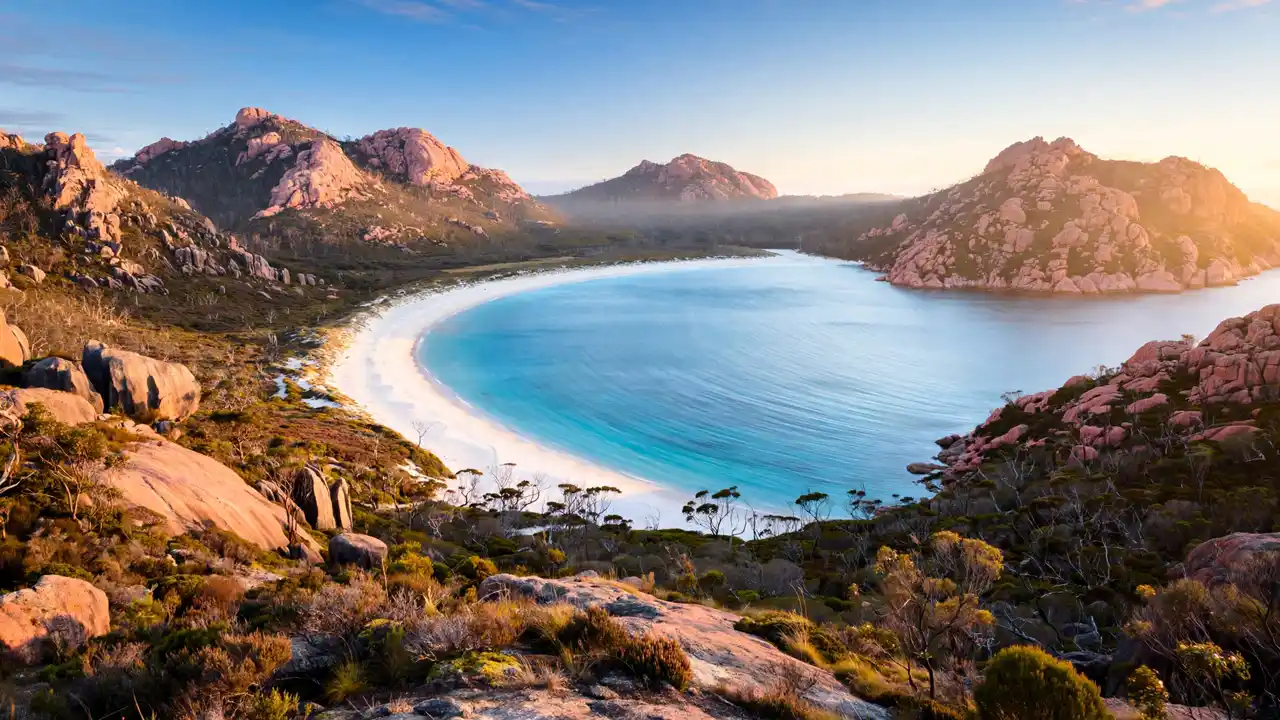
This Freycinet Wineglass Bay guide covers Tasmania’s most photographed place — the perfect crescent of white sand and turquoise water wrapped by the pink-granite Hazards mountains. Wineglass Bay is consistently voted among the world’s best beaches, and it earns it: the view from the lookout is genuinely jaw-dropping, the water is absurdly clear, and the surrounding Freycinet National Park offers coastal walks, wildlife and some of Tasmania’s finest produce (oysters, wine, cheese) at its doorstep in Coles Bay. This guide covers the lookout walk, the beaches, cruises, where to stay and eat, and how to fit Freycinet into a Tasmania trip.
Freycinet sits on Tasmania’s east coast, 2.5 hours north of Hobart and 2 hours south-east of Launceston. The park centres on the Hazards (the pink-granite mountain range), Wineglass Bay, Hazards Beach, and the Friendly Beaches to the north. Allow 1–2 days: one full day for the park’s walks, an optional second for a cruise, kayaking or the oyster farms. A Tasmanian National Parks Pass is required (the Holiday Vehicle Pass, around A$80–90 for 8 weeks, covers it).
Best Time to Visit Freycinet
December to February is peak: warmest weather (21–23°C), best swimming, longest days — and the biggest crowds and highest prices. March–April and October–November are the sweet spots: mild weather, fewer people, lower prices, and the water is still swimmable for the brave. Winter (June–August) is quiet and moody — the walks are spectacular in storm light, but swimming is for the hardy and some tour operators reduce schedules. Book Coles Bay accommodation 3–6 months ahead for summer.
The Wineglass Bay Lookout Walk
The essential Freycinet experience: the Wineglass Bay Lookout track — 1.5 hours return, 3 km, with 600+ steps up to the saddle between Mount Amos and Mount Mayson. The view that greets you is the postcard: the perfect white crescent, the turquoise water, the Hazards behind.
Tips: go early (by 9 am) to beat the crowds and get the best light — the bay faces east and glows in the morning. The steps are steep but the track is well-formed; allow 45 minutes up, 30 down. Continue to the beach (another 1 hour down, 2.5 hours return total) for the full experience — the sand squeaks, the water is crystal clear (and cold — around 16–18°C even in summer). There are no facilities at the beach: carry water and take rubbish out.
Mount Amos Climb
For the adventurous: the Mount Amos scramble (3 hours return, steep, exposed rock slabs) gives the elevated Wineglass Bay panorama — the shot you see on Tourism Tasmania’s posters. It is a genuine scramble with exposure; don’t attempt it in wet or windy conditions, and wear grippy shoes.
Hazards Beach Circuit
The park’s best full-day walk: Wineglass Bay Lookout → Wineglass Beach → Hazards Beach → carpark (11 km, 4–5 hours). After descending to Wineglass Beach, follow the isthmus track to Hazards Beach on the ocean side — a wild, empty surf beach backed by dunes — then return via the Hazards Beach track. You’ll see wallabies, echidnas and sea eagles, and likely have Hazards Beach to yourself. Carry 2–3 litres of water; there are no refills.
Other Park Highlights
- Cape Tourville Lighthouse: the easy win — a 20-minute boardwalk circuit with stunning views of the Tasman Sea, Schouten Island and the Hazards. Wheelchair accessible. Do it at sunset.
- Sleepy Bay: a tiny, sheltered cove near Cape Tourville — rock pools, orange lichen, calm water. The locals’ swim spot.
- Friendly Beaches: north of the park — 6 km of white sand backed by dunes, accessible by a short walk from the carpark. Often deserted; excellent for beach walks.
- Honeymoon Bay: the calm, sheltered bay near the visitor centre — the easiest swim in the park, great for families.
- Schouten Island: the offshore island — sea kayaking tours and the Schouten Passage offer dolphin and seal encounters.
Wineglass Bay Cruises
Seeing the bay from the water reveals its scale. Wineglass Bay Cruises from Coles Bay (around A$150–180 per person, approximately, 4–4.5 hours) cruise past the Hazards, Schouten Island, and into Wineglass Bay itself, with a seafood lunch (oysters, salmon, abalone) served on board. Morning cruises have the calmest conditions; afternoon cruises catch the golden light. Sea kayaking tours (half and full day, from around A$130) paddle the coastline with guides — the intimate way to see the park.
Coles Bay: Where to Eat
- Oyster farms: Freycinet Marine Farm — the famous waterfront oyster farm: buy oysters, mussels, abalone and scallops fresh, or join the oyster farm tour (around A$50, approximately — shuck your own). The Lease 65 floating restaurant is the premium option.
- Tombolo Freycinet: the vineyard restaurant — pinot noir with water views.
- Geographe Restaurant (Freycinet Lodge): the park’s fine dining — Tasmanian produce, book ahead.
- Iluka Tavern: the casual option — pizzas, local beers, sunset views.
- Devil’s Corner: 20 minutes south — the spectacular cellar door with the lookout tower over Moulting Lagoon: wine, oysters, wood-fired pizza.
- Kate’s Berry Farm (Swansea, 30 minutes south): berries, chocolate, ice cream — the road-trip stop.
Where to Stay
Coles Bay is the base — everything is here. Options: Freycinet Lodge (inside the park — cabins with wallabies on the lawn, from around A$350+/night); Saffire Freycinet (the luxury icon — from A$2,000+/night, all-inclusive); holiday apartments and cabins (A$200–350/night); the Coles Bay caravan park and Friendly Beaches campground (budget). Bicheno (30 minutes north) offers cheaper beds and the evening penguin tours. Book 3–6 months ahead for summer — Coles Bay sells out.
Wildlife
Freycinet is rich in wildlife: Bennett’s wallabies and pademelons graze around Coles Bay at dusk; echidnas shuffle along the tracks; white-bellied sea eagles soar over the Hazards; dolphins cruise the bay. The East Coast Natureworld (near Bicheno) offers Tasmanian devil feedings. Drive carefully at dawn/dusk — wildlife on the roads is constant.
Sample 2-Day Itinerary
- Day 1: Arrive Coles Bay → Cape Tourville + Sleepy Bay → Wineglass Bay Lookout walk (afternoon light) → sunset at Cape Tourville → dinner at Geographe or Iluka.
- Day 2: Hazards Beach circuit (full morning) → Freycinet Marine Farm oyster tour + lunch → Wineglass Bay cruise (afternoon) → sunset drinks at Devil’s Corner.
Practical Tips
- National Parks Pass required — buy the Holiday Vehicle Pass online before you go.
- Water: carry more than you think — no refills on the tracks, and the Tasmanian sun is deceptive.
- Weather: the east coast is Tasmania’s driest, but fronts still sweep through — pack a rain jacket.
- Swimming: the water is cold (16–18°C in summer) — the sheltered bays (Honeymoon, Sleepy, Tea Tree) are warmest.
- Phone coverage: patchy in the park — download maps offline.
- Leave No Trace: the park’s popularity pressures its ecology — stay on tracks, take rubbish out.
Freycinet is the east coast’s star — see our 7-day Tasmania road trip for the full circuit and our Hobart guide for the southern bookend. For island wildlife comparisons, see our Kangaroo Island guide. For official trip ideas, see discovertasmania.com.au.
Add-On: The Bay of Fires
90 minutes north of Freycinet, the Bay of Fires is Tasmania’s other great coastal wilderness — 50 km of white sand, turquoise water, and boulders covered in brilliant orange lichen. The Bay of Fires Conservation Area (from Binalong Bay to Eddystone Point) offers:
- Binalong Bay: the southern gateway — the lichen-covered boulders start here. Swim, snorkel, kayak.
- The Gardens: the iconic boulder fields — the orange lichen against the white sand and blue sea. Sunrise is the photographer’s hour.
- Cosy Corner: the sheltered beaches — swimming, picnics, camping.
- Eddystone Point Lighthouse: the 1889 granite lighthouse — the northern end, remote, wild.
- Bay of Fires Lodge Walk: the 4-day/3-night guided walk (the Tasmanian Walking Company) — beach walking, kayaking, lodge accommodation. From around A$3,000+ per person (approximately) — the luxury option.
St Helens (the nearby town) offers accommodation, dining, and the St Helens oyster farms. The Bay of Fires pairs with Freycinet for the ultimate east-coast trip — allow 2 days here.
Freycinet Stargazing and Night Skies
Freycinet’s dark skies (the east coast has minimal light pollution) make it a stargazing destination. The Milky Way over Wineglass Bay (from the lookout — the night walk is unmarked; go with a guide or headlamp), the Southern Cross over the Hazards, and the aurora australis (the southern lights — rare, but photographed from the east coast during solar storms). Coles Bay‘s after-dark is quiet — walk to the beach, turn off the torch, and look up. Winter (June–August) offers the longest nights and the clearest skies.
Freycinet’s Best Kept Secrets
- Bluestone Bay: the hidden cove — south of Wineglass Bay, accessible by boat or the long walk. Granite boulders, clear water, no crowds.
- Graham’s Lookout: the alternative viewpoint — the Wineglass Bay panorama from the south. Quieter than the main lookout.
- Richardsons Beach: the Coles Bay beach — calm, family-friendly, pelicans. The sunset spot.
- Moulting Lagoon: the wetland behind Coles Bay — black swans, pelicans, sea eagles. The Devil’s Corner cellar door overlooks it.
- Schouten Island: the offshore island — sea kayaking (the guided tours), dolphins, seals. The wilderness experience.
Freycinet’s Wine and Produce Trail
The east coast is a food destination — the trail from Sorell to Bicheno:
- Devil’s Corner (Apslawn): the cellar door — the lookout tower (the Moulting Lagoon panorama), the wood-fired pizzas, the oysters (the Moulting Lagoon leases).
- Freycinet Marine Farm (Coles Bay): the oyster farm — the tours (around A$50, approximately — shuck your own), the seafood (the mussels, the abalone, the scallops).
- Tombolo Freycinet (Coles Bay): the vineyard restaurant — the pinot noir (the east-coast style — elegant, cool-climate).
- Gala Estate (Cranbrook): the boutique winery — the pinot noir, the chardonnay, the cellar door.
- Kate’s Berry Farm (Swansea): the berries (summer), the chocolate, the ice cream — the road-trip stop.
- Spring Vale Vineyard (Cranbrook): the family winery — the pinot, the views.
- Bicheno: the lobster — the Lobster Shack (the fresh crayfish), the evening penguin tours.
Freycinet’s Best Swimming Spots
- Honeymoon Bay: the calmest — the sheltered bay, family-friendly, 5 minutes from the visitor centre.
- Sleepy Bay: the prettiest — the cove, the orange lichen, the calm water.
- Wineglass Bay: the iconic — the clear water (but cold — 16–18°C).
- Richardsons Beach (Coles Bay): the convenient — the town beach, pelicans, sunset.
- Friendly Beaches: the wild — the surf, the dunes, often deserted.
Freycinet & Wineglass Bay FAQs
How long is the Wineglass Bay lookout walk?
The Wineglass Bay Lookout track is 3 km return, taking about 1.5 hours with 600+ steps up to the saddle. Continuing down to Wineglass Beach makes it 2.5 hours return. Go early (by 9 am) for the best light and fewest crowds.
How many days do you need in Freycinet?
One full day covers the Wineglass Bay lookout, a beach visit and Cape Tourville. Two days allows the Hazards Beach circuit, a Wineglass Bay cruise or sea kayaking, and the oyster farms. A Tasmanian National Parks Pass is required.
Can you swim at Wineglass Bay?
Yes — the water is crystal clear but cold (16–18°C even in summer). There are no facilities or lifeguards at the beach. Sheltered Honeymoon Bay and Sleepy Bay near Coles Bay are warmer and easier options.
Where should I stay to visit Wineglass Bay?
Coles Bay is the base — Freycinet Lodge (in the park), Saffire Freycinet (luxury), apartments and the caravan park. Bicheno (30 minutes north) is cheaper with penguin tours. Book 3–6 months ahead for summer.
Is the Wineglass Bay cruise worth it?
Yes — the cruise shows the bay’s scale from the water, visits Schouten Island and the Hazards coastline, and includes a Tasmanian seafood lunch. Around A$150–180 per person for 4–4.5 hours. Morning cruises have the calmest conditions.