
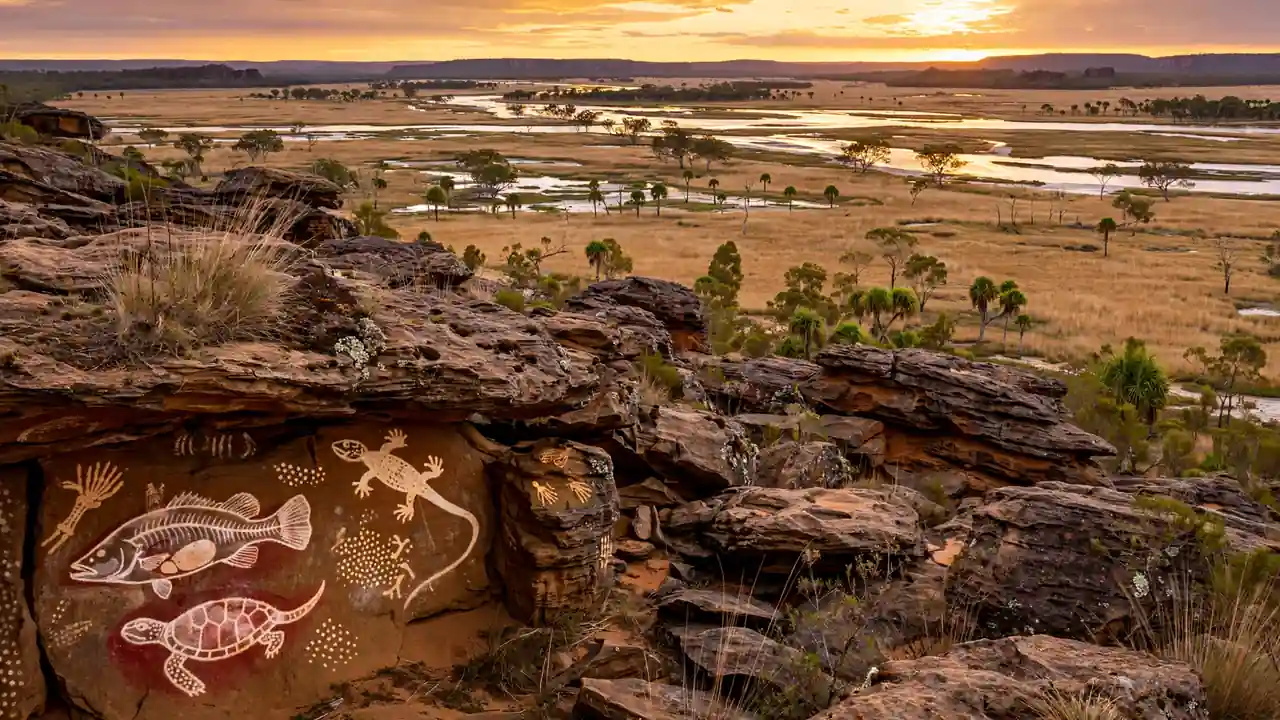
Kakadu National Park Travel Guide
This Kakadu National Park travel guide covers Australia’s largest national park — 20,000 km² of escarpment, wetland, waterfall and rock art, dual World Heritage-listed for nature and culture. Kakadu holds Aboriginal rock art up to 40,000 years old, a third of Australia’s bird species, and landscapes that shift from monsoon forest to stone country. It is jointly managed by Parks Australia and the Bininj/Mungguy traditional owners, and visiting with cultural respect transforms the trip. This guide covers park passes, the essential sights, walks, cruises, where to stay, costs and safety for 2026.
Kakadu sits 3 hours south-east of Darwin via the Arnhem Highway. The park is vast — the main sights cluster in three areas: Jabiru (the park town, east), Cooinda/Yellow Water (south), and Ubirr (north-east, near the East Alligator River). Allow 3–4 days minimum; the park pass covers 7 days, so slow down.
Park Passes (2026 Prices)
Every visitor needs a Kakadu park pass, valid for 7 days. In 2026, prices are seasonal: dry season (15 May – 31 October): A$40 per adult; tropical summer (1 November – 14 May): A$25 per adult. Children (5–15) are $20/$12.50; family passes $100/$65. Buy online before you go. Note: passes for travel between 1 July and 31 October 2026 are charged at the lower wet-season rates per Parks Australia’s current advice — check the official passes page when booking. This pass is separate from the Uluru pass and NT park passes.
Best Time to Visit Kakadu
Dry season (May–October) is the time: all roads and attractions open, waterfalls still flowing early in the season, comfortable days (30–33°C), cool nights. June–August is peak — book accommodation and the Yellow Water cruise ahead. Wet season (November–April): dramatic storms, electric-green landscapes, powerful waterfalls — but many roads close, Jim Jim/Twin Falls become inaccessible, and some areas flood. The shoulder months (May, October) offer the best balance.
The Essential Sights
Ubirr (Obiri Rock)
Kakadu’s most famous rock art site: a cluster of outcrops with 40,000 years of paintings — the Namarrgarn Sisters, the thylacine (Tasmanian tiger) paintings, the rainbow serpent. The 1-km circumnavigation walk passes the main galleries; then climb to the Ubirr lookout for sunset over the Nadab floodplain — one of Australia’s great sunsets. Arrive 90 minutes before sunset. Free ranger talks run in the dry season.
Yellow Water (Ngurrungurrudjba) Billabong
The sunrise Yellow Water cruise is Kakadu’s signature experience: 2 hours gliding past sea eagles, jabirus, jacanas, wild horses, buffalo and saltwater crocodiles as the mist lifts. Book the first departure (around 6:45 am in the dry season) — it sells out weeks ahead in peak season. Around A$130–150 per adult (approximately). The sunset cruise is the alternative; the Warradjan Aboriginal Cultural Centre nearby is worth an hour.
Nourlangie (Burrungkuy)
The second great art site: the Anbangbang Gallery (the famous Namarrkon the Lightning Man paintings), the Nanguluwurr gallery (quieter, with contact-period art including a steamship), and the Nawurlandja lookout for sunset over the escarpment. The 1.5-km Burrungkuy walk links the main galleries.
Jim Jim Falls and Twin Falls
The park’s most dramatic waterfalls — but dry season only (June–November, approximately), 4WD only (high clearance required; the Jim Jim track is rough), and a long day from Jabiru/Cooinda. Jim Jim Falls: a 200-m plunge into a deep plunge pool (1-km walk from the carpark, rock-hopping). Twin Falls: reached by boat shuttle + boardwalk through the gorge. Check the Kakadu access report before attempting — both can close with little notice.
Gunlom Falls
The infinity pool made famous by Crocodile Dundee: a natural rock pool on the escarpment edge with views across the southern hills. The climb is steep (15–20 minutes) but the reward is extraordinary. Check croc-safety signage — swimming status changes with conditions.
Maguk (Barramundi Gorge)
A pristine plunge pool at the base of the escarpment — 1-km walk through monsoon forest, excellent swimming (when signed safe). Quieter than Gunlom.
Walks and Hikes
- Bardedjilidji (Savannah Way): sandstone pillars and art sites — 2.5-km loop near the East Alligator River.
- Mamukala Wetlands: the birdwatching boardwalk — tens of thousands of magpie geese in the dry season. Dawn is best.
- Nawurlandja: short climb for the escarpment sunset view.
- Barrk Sandstone Bushwalk: the multi-day option — 12 km through savanna woodland and art sites (Nourlangie area).
- Yurmikmik walks: the southern hills — Boulder Creek and Motor Car Falls (dry season swim).
Aboriginal Culture: Going Deeper
Kakadu’s art and stories belong to the Bininj (west) and Mungguy (east) people. To go beyond the signs:
- Arnhem Land tours: Arnhemland Barramundi Lodge and Davidson’s Arnhemland Safaris run small-group tours into western Arnhem Land (permit required — tours handle it) — rock art, billabongs, and Indigenous guides.
- Warradjan Cultural Centre (Cooinda): the park’s best cultural displays — allow an hour.
- Bowali Visitor Centre (Jabiru): park information, the crocodile-shaped building, and excellent interpretive displays.
- Ranger programs: free guided walks and talks run May–October — check the program at Bowali.
Where to Stay
Jabiru: the park town — Cooinda Lodge-style accommodation, the Mercure Kakadu Crocodile Hotel (the crocodile-shaped icon), caravan park, supermarket, fuel. Cooinda: near Yellow Water — Cooinda Lodge, campground, the cruise departure point. Camping: park campgrounds (around A$15–25 per person, approximately) at Mardukal, Jim Jim, Malabanjbanjdju and others — book ahead in the dry season. Outside the park: Pine Creek and Adelaide River on the highway offer cheaper beds.
What It Costs
Approximate per-person for 4 days (2026): park pass A$40; accommodation A$150–250/night (Jabiru/Cooinda) or A$25/night camping; car hire A$100–150/day + fuel (long distances); Yellow Water cruise ~A$140; food A$60–100/day (limited options — self-cater where possible). Budget roughly A$1,200–1,800 per person for 4 days excluding Darwin travel.
Safety: Crocs, Heat, Water
- Be Crocwise: assume every waterway has saltwater crocodiles. Swim ONLY where signs explicitly say it’s safe — and re-check, as status changes. Never clean fish near the water’s edge. Camp at least 50 m from water.
- Heat: carry 3–4 litres of water per person for day walks; start before 8 am.
- Roads: the Arnhem and Kakadu Highways are sealed; Jim Jim/Twin Falls need high-clearance 4WD. Check the daily access report every morning.
- Fuel: fill up at Jabiru and Cooinda — distances are long.
- Respect: much of the park is living Aboriginal culture — don’t enter restricted areas, don’t remove anything, and ask before photographing people.
Kakadu is the Top End’s crown — pair it with our Darwin travel guide. For the desert contrast, see our Uluru guide, and for Queensland’s rainforest, our Daintree guide. For official passes and access reports, see kakadu.gov.au.
Kakadu’s Birdwatching: A World-Class Destination
Kakadu is one of Australia’s great birdwatching destinations — 280+ species, a third of Australia’s birds. The dry season (May–October) concentrates the birds at the shrinking wetlands:
- Mamukala Wetlands: the boardwalk hide — tens of thousands of magpie geese, egrets, jabirus (black-necked storks). Dawn is best (the geese lift off in waves).
- Yellow Water: the cruise — sea eagles (the white-bellied and whistling kites), jacanas (the “Jesus birds” walking on lilies), kingfishers (the azure and forest), brolgas (the dancing cranes).
- Nourlangie (Burrungkuy): the escarpment — chestnut-quilled rock pigeons (the white-banded birds of the stone country), sandstone shrike-thrushes.
- South Alligator floodplain: the Mamukala and Muirella Park areas — comb-crested jacanas, plumed whistling-ducks, radjah shelducks.
Bring binoculars — the Bowali Visitor Centre has bird lists. The Yellow Water dawn cruise is the single best birding experience in the park.
Arnhem Land: Beyond the Park Boundary
Western Arnhem Land — the Aboriginal reserve east of Kakadu — is restricted access (permit required), but organised tours open it up. Davidson’s Arnhemland Safaris (the Mount Borradaile lodge) and Arnhemland Barramundi Lodge run multi-day tours (from around A$2,000+ per person, approximately) visiting rock art galleries (the Mt Borradaile art is 40,000 years old), billabongs (barramundi fishing), and wetlands with Indigenous guides. The Injalak Arts Centre (Gunbalanya/Oenpelli) — the art centre famous for bark paintings — runs day tours from Jabiru in the dry season (around A$300+ per person, approximately, including the East Alligator River crossing). Book months ahead — numbers are strictly limited.
Kakadu’s Waterfalls: The Seasonal Guide
- Early dry (May–June): all waterfalls flowing — Jim Jim, Twin Falls, Gunlom, Maguk at their peak. 4WD tracks open (check the access report).
- Mid-dry (July–August): Jim Jim and Twin Falls slowing — the plunge pools remain. Gunlom and Maguk still swimmable.
- Late dry (September–October): Jim Jim may be dry — the plunge pool remains (the walk is still worth it). Motor Car Falls (the 4WD-only falls) is the late-dry secret.
- Wet (November–April): spectacular but inaccessible — the falls thunder, the roads close. Scenic flights (from Jabiru) show the wet-season falls from the air.
Kakadu’s Best Swimming Holes (When Signed Safe)
Swimming in Kakadu is conditional — only where signs explicitly say safe, and status changes. The usual safe spots (dry season, check signage):
- Gunlom Falls: the infinity pool — the escarpment edge, the views. The climb is steep (15–20 minutes). Check the croc signs — status varies.
- Maguk (Barramundi Gorge): the plunge pool — the 1-km walk through monsoon forest. Usually safe (dry season).
- Jim Jim plunge pool: the 200-m falls — the 1-km rock-hop from the carpark. 4WD access, dry season only.
- Motor Car Falls: the late-dry secret — the 4WD track, the secluded pool. Check the access report.
- Moline Rockhole: the southern rockhole — the easy access, the family swim.
Never swim in the Yellow Water billabong, the Alligator Rivers, or any waterway without explicit safe-swimming signage. Saltwater crocodiles are present throughout the park.
Kakadu’s Best Sunrise and Sunset Spots
- Ubirr lookout (sunset): the icon — the Nadab floodplain, the escarpment glowing. Arrive 90 minutes early.
- Yellow Water (sunrise): the cruise — the mist, the birds, the crocodiles. Book the first departure.
- Nawurlandja lookout (sunset): the alternative — the Nourlangie escarpment, fewer crowds than Ubirr.
- Mamukala Wetlands (sunrise): the boardwalk — the magpie geese lifting off in waves.
- Cahills Crossing (sunrise/sunset): the East Alligator River — the crocodiles hunting (the tidal change). View from the platform — never enter the water.
- Gunlom Falls (sunset): the infinity pool — the southern hills glowing. Check access.
Kakadu Packing Checklist
Pack for Kakadu: 3–4 litres water capacity per person (the heat), wide-brimmed hat, high-SPF sunscreen, sturdy walking shoes (the rock is rough), swimmers and towel (the designated swimming holes), binoculars (the birds), fly net (the dry-season flies), headlamp (the campgrounds), and offline maps (the coverage is patchy).
Kakadu Travel FAQs
How much is the Kakadu park pass?
In 2026, the 7-day Kakadu park pass costs A$40 per adult in the dry season (15 May–31 October) and A$25 in the tropical summer (1 November–14 May). Children 5–15 are $20/$12.50; family passes $100/$65. Buy online before you go.
How many days do you need in Kakadu?
Three to four days minimum: one for Ubirr and the northern art sites, one for Yellow Water and Nourlangie, one for waterfalls (Gunlom, Maguk, or Jim Jim/Twin Falls with 4WD). The park pass covers 7 days, so longer stays cost nothing extra.
What is the best month to visit Kakadu?
May to October (dry season) — all roads open, comfortable weather, waterfalls flowing early in the season. June–August is peak: book accommodation and the Yellow Water cruise ahead. November–April (wet season) brings closures and dramatic storms.
Is it safe to swim in Kakadu?
Only where signs explicitly say so — saltwater crocodiles inhabit waterways across the park. Designated swimming spots (Gunlom, Maguk, Jim Jim plunge pool) are croc-managed but status changes with conditions: always check current signage.
Do I need a 4WD for Kakadu?
No for the main sealed-road sights (Ubirr, Nourlangie, Yellow Water, Jabiru, Gunlom). You need a high-clearance 4WD only for Jim Jim Falls and Twin Falls in the dry season. Check the daily access report before any unsealed-road travel.