
Canberra Travel Guide: Beyond the Museums
This Canberra travel guide starts with a confession: yes, the museums are excellent — the Australian War Memorial alone justifies the trip. But Canberra in 2026 is far more than a school-excursion destination. It is a designed city of lake, mountain and bushland with a genuinely exciting food scene, cool-climate wineries 20 minutes from the CBD, and outdoor adventures that surprise everyone who bothers to look past the Parliamentary Triangle.
Canberra rewards the curious. Lake Burley Griffin’s 35-km shoreline is made for cycling. Mount Ainslie and Black Mountain offer city lookouts and bush walks. The inner suburbs — Braddon, Kingston, New Acton — have the cafés, bars and restaurants that locals brag about. And the surrounding region delivers the Snowy Mountains, the South Coast beaches and the Southern Highlands within day-trip range. Give Canberra two or three days and it will quietly become one of your favourite Australian cities.
Best Time to Visit Canberra
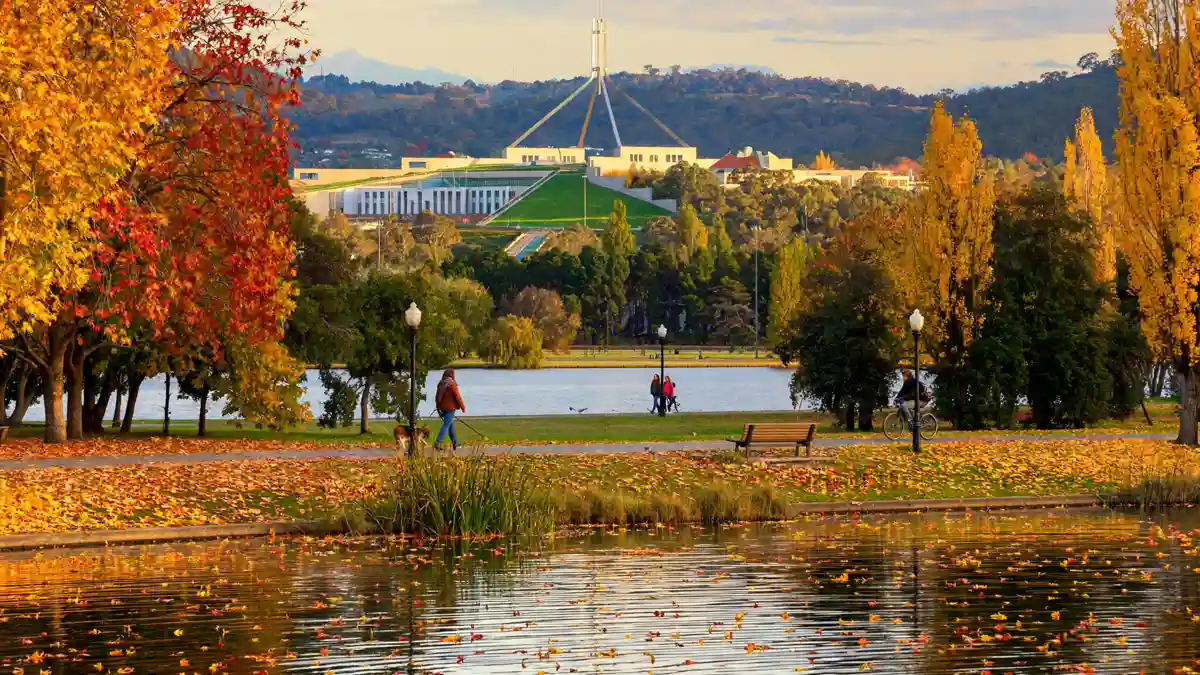
March to May is Canberra’s golden season: crisp days, spectacular autumn colour (the city’s 800,000+ trees turn gold and red), and the Enlighten Festival (February–March) lighting up the national institutions. September to November brings Floriade (Australia’s biggest flower festival, September–October) and spring blossoms.
Summer (December–February) is warm and dry — perfect for the lake — while winter (June–August) is cold (frosty mornings, occasional snow on the Brindabellas) but brilliant for cosy fireside dining and day trips to the Snowy Mountains ski fields. Canberra’s four distinct seasons are part of its charm.
The Big Institutions (Done Right)
Let’s get the famous ones out of the way — because they are genuinely world-class:
- Australian War Memorial: Australia’s most moving museum. The galleries, the Roll of Honour, and the daily Last Post Ceremony at closing (arrive 30 minutes early) are unforgettable. Free entry; allow 3–4 hours minimum.
- National Gallery of Australia: the Southern Hemisphere’s finest collection — Aboriginal and Torres Strait Islander art, the Blue Poles, and the Sculpture Garden on the lake. Free for the permanent collection.
- National Museum of Australia: the story of the nation, from Dreamtime to the present, in a striking building on the Acton Peninsula. Free entry.
- Parliament House: free guided tours of the working parliament, the Great Hall, and the grassed roof with its flagpole and city views. Book ahead when parliament sits.
- Questacon: the national science centre — brilliant for kids, secretly fun for adults.
All the national institutions are free to enter (special exhibitions ticketed). The trick is pacing: do one major institution per half-day, not three in a row.
Lake Burley Griffin: The City’s Playground
The lake is Canberra’s soul. The Central Basin loop (5 km) and the full 35-km shoreline circuit are made for cycling — hire a bike from the city or Commonwealth Place and ride the whole thing. Highlights along the way: the Captain Cook Memorial Jet (shoots water 147 m high), the National Carillon on Aspen Island (free recitals), and the Yarralumla shoreline with its cafés.
Get on the water: stand-up paddleboards and kayaks hire from the Yarralumla and Kingston foreshores, and hot air balloon flights at dawn drift over the lake and Parliament House (around A$250–300 per person, approximately) — one of Australia’s great ballooning experiences.
Lookouts and Bush Walks
Canberra is a bush capital — nature reserves thread through the suburbs:
- Mount Ainslie Lookout: the classic view — straight down Anzac Parade to the lake and Parliament House. Drive up or walk the 2-km trail from the War Memorial. Best at sunrise.
- Black Mountain / Telstra Tower: 360-degree views from the tower lookout (small entry fee, approximately A$7–8), plus walking trails through the Australian National Botanic Gardens at its base — the world’s largest collection of Australian native plants.
- Red Hill Lookout: sunset views over the Woden Valley and the Brindabellas.
- Mt Majura and Mt Taylor: suburban summits with kangaroo-spotting on the trails — dawn and dusk are best.
Where to Eat in Canberra
Canberra’s food scene has quietly become one of Australia’s best — the public-service salaries support serious dining:
- Braddon: the city’s coolest strip — Lonsdale Street’s cafés, bars, the Origin Market food hall.
- Kingston Foreshore: waterfront restaurants and bars on the lake’s south-eastern shore.
- New Acton: the precinct around the Nishi building — Monster Kitchen, wine bars, cinema.
- Old Bus Depot Markets (Sunday, Kingston): the city’s best Sunday market — food, crafts, flowers.
- Wine bars: Canberra’s cool-climate wines shine in the city’s wine bars — try local Shiraz Viognier and Riesling.
Budget A$22–30 for a café lunch, A$40–65 per person for dinner. The Canberra wine region (Murrumbateman, 25 minutes north) has 40+ wineries — Clonakilla’s Shiraz Viognier is world-famous. Cellar doors are an easy half-day trip.
Day Trips from Canberra
Tidbinbilla Nature Reserve
Forty minutes south-west: a beautiful valley reserve with free-ranging kangaroos, emus, koalas (in the sanctuary), platypus in the wetlands, and the Deep Space Communication Complex (NASA’s Canberra tracking station — free visitor centre). The Biral Biral and Turkey Hill walks suit families; the Gibraltar Peak trail is the challenge.
Namadgi National Park
Canberra’s own alpine national park — 46% of the ACT. Yankee Hat Aboriginal rock art, the Booroomba Rocks climb, and snow in winter. The Centenary Trail (145 km) circles the whole city for multi-day hikers.
The Snowy Mountains
Thredbo and Perisher are 2–2.5 hours away — very doable as a winter day trip for skiing, or a summer trip for alpine wildflowers, the Kosciuszko walk to Australia’s highest peak (13 km return from Thredbo, chairlift-assisted), and mountain biking.
The South Coast
Batemans Bay, Murramarang and Jervis Bay are 2–2.5 hours east — white-sand beaches, dolphin cruises, and the famous Hyams Beach (reputedly the whitest sand in the world). An easy overnight from Canberra.
Where to Stay
Civic (the CBD) is the practical base — central, well-connected, with the best hotel choice. Braddon suits food-and-bar lovers (noisier on weekends). Kingston/Manuka offer village charm on the south side. Yarralumla has leafy B&Bs near the lake and the embassies. Expect A$150–240 per night for a mid-range hotel in 2026 — excellent value by capital-city standards.
Getting Around
Canberra is a driving city by design — the light rail covers the Gungahlin–Civic corridor, buses cover the rest, but a car makes everything easier. The city is famously easy to drive: wide roads, minimal traffic, abundant parking. Cycling is superb — 300+ km of paths. For day trips (Tidbinbilla, Namadgi, wineries, coast, snow), a car is essential.
Practical Tips
- Parliament sittings: check the parliamentary calendar — Question Time in the House of Representatives is free public theatre.
- Floriade: September–October; book accommodation early as it draws 500,000+ visitors.
- Winter mornings: frost is common June–August — hire cars may need de-icing; the Brindabellas get snow.
- Roundabouts: Canberra has hundreds. Give way to the right, signal your exit, and you’ll be fine.
- Free stuff: the institutions, the lake, the lookouts, the botanic gardens — Canberra’s best experiences are mostly free.
Canberra pairs well with its neighbours: Sydney is 3 hours north (or a 55-minute flight), Melbourne is 7 hours south-west, and the Blue Mountains make a natural stop on the Sydney drive. For official events and trip ideas, see visitcanberra.com.au, the official visitor site.
Canberra’s Craft Beer and Gin Scene
Canberra’s drinking scene has quietly become excellent. The craft breweries: BentSpoke Brewing Co (Braddon — the city’s best brewery, the Crankshaft IPA is the local icon), Capital Brewing Co (Fyshwick — the big taproom), Zierholz (Fyshwick — the pioneer). The gin distilleries: The Canberra Distillery (Mitchell — the Royal Australian Navy-strength gin), Underground Spirits. The wine bars: Bar Rochford (Canberra’s best wine bar — natural wines, Melbourne Lane), Mana Bar, Highball Express (the whisky bar). The Old Canberra Inn (Lyneham, est. 1857) is the historic pub — the beer garden under the gum trees is a Canberra institution.
Enlighten and Floriade: The Big Events
- Enlighten Festival (February–March): Canberra’s festival of light — the national institutions (Parliament House, National Gallery, Questacon, the National Library) become projection canvases after dark, with the Enlighten Night Noodle Markets in the parliamentary triangle. Free to wander; the projections run 8–11 pm.
- Floriade (September–October): Australia’s biggest flower festival — 1 million+ blooms in Commonwealth Park, plus Floriade NightFest (the after-dark program with light installations). Free entry; book accommodation early — it draws 500,000+ visitors.
- Canberra Balloon Spectacular (March): hot air balloons rising over the lake at dawn during Enlighten — the Patrick White Lawns launch site is the viewpoint.
Canberra’s Hidden Gems
- National Arboretum Canberra: 250 hectares of rare and endangered trees — the Village Centre, the Bonsai Collection, and the Dairy Farmers Hill lookout (the city’s best sunset viewpoint).
- Cockington Green: the miniature English village — oddly delightful, especially with kids.
- Canberra Glassworks: the Kingston power-station-turned-glass-studio — glassblowing demonstrations and the gallery.
- Jerrabomberra Wetlands: the urban wetlands — platypus at dawn, 70+ bird species, 5 minutes from the CBD.
- Mount Stromlo Observatory: the fire-ravaged observatory (2003 bushfires) — the ruins, the visitor centre, and the dark-sky stargazing (book the night tours).
- Lanyon Homestead: the 1850s homestead in the Tharwa valley — colonial history, the Nolan Gallery (Sidney Nolan’s Ned Kelly works).
Canberra’s Museums Ranked: Beyond the Big Five
Everyone knows the War Memorial and the National Gallery — but Canberra’s second tier is excellent:
- National Film and Sound Archive: the art-deco building (the old Institute of Anatomy) — the Arc cinema (the retrospectives), the exhibitions (the Australian screen history). Free exhibitions.
- National Portrait Gallery: the King Edward Terrace gallery — the Australian faces (the Archibald-adjacent portraits). Free.
- Old Parliament House / Museum of Australian Democracy: the 1927 building — the Prime Minister’s office (the time capsule), the House of Representatives chamber, the democracy exhibitions. Free.
- Royal Australian Mint: the Deakin mint — the coin production (the robot!), the National Coin Collection, mint your own $1 coin. Free.
- Canberra Museum and Gallery: the Civic museum — the Canberra story (the local history), the Sidney Nolan works. Free.
- National Dinosaur Museum: the Gold Creek museum — the skeletons, the animatronics, the garden (the dinosaur trail). Kids’ favourite (small entry fee).
- Australian War Memorial’s Treloar Technology Centre (Mitchell): the large technology objects — the tanks, the aircraft. Open days only (check the AWM website).
Canberra’s Best Lookouts
- Mount Ainslie: the classic — Anzac Parade to the lake to Parliament House. Sunrise spot (the 2-km walk from the War Memorial).
- Black Mountain (Telstra Tower): the 360° panorama — small entry fee (approximately A$7–8), the botanic gardens at the base.
- Dairy Farmers Hill (Arboretum): the sunset viewpoint — the city, the Brindabellas, the Village Centre below.
- Red Hill: the Woden Valley sunset — the lookout off Hindmarsh Drive.
- Mount Majura: the suburban summit — kangaroos on the trails (dawn/dusk).
- Parliament House roof: the grassed roof — the flagpole, the city laid out below. Free.
Canberra Travel FAQs
Is Canberra worth visiting?
Yes — Canberra offers world-class free museums (War Memorial, National Gallery), a beautiful lake and bush setting, an excellent food scene, cool-climate wineries, and easy day trips to the Snowy Mountains and South Coast beaches.
How many days do you need in Canberra?
Two to three days covers the highlights: the War Memorial, Parliament House, the national institutions, Lake Burley Griffin and a lookout or two. Add days for Tidbinbilla, the wineries, or day trips to the Snowies or South Coast.
What is the best month to visit Canberra?
March to May brings autumn colour and the Enlighten Festival; September to October brings Floriade and spring blossoms. Summer is warm and dry; winter is cold but great for fireside dining and Snowy Mountains day trips.
Do I need a car in Canberra?
A car makes Canberra much easier — the city is designed for driving, and day trips to Tidbinbilla, Namadgi, the wineries and the coast all require one. The light rail and buses cover the Civic corridor and main sights.
Are Canberra’s museums free?
Yes — the Australian War Memorial, National Gallery, National Museum, Parliament House and most national institutions are free to enter. Special exhibitions are usually ticketed.