
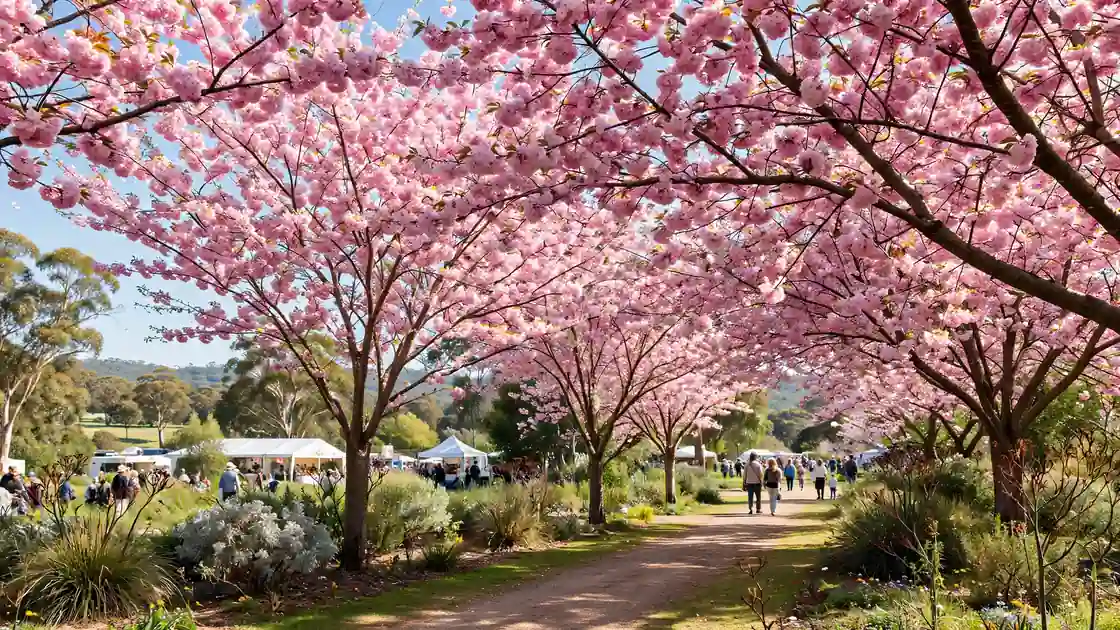
Cherry Blossom & Spring Festivals in Australia
Spring in Australia — September to November — is festival season, and cherry blossom is its prettiest headline act. From Sydney’s dedicated blossom festival to Cowra’s Japanese garden, the cherry blossom Australia spring festivals mark the moment the country shakes off winter. Here’s where to see the blossom, which festivals are worth your time, and how to plan the perfect spring getaway.
Timing note: cherry blossom season in Australia runs roughly late August to early October, varying by region and variety — Sydney’s blossoms peak first (August–September), cooler regions follow (September–October). Blossom is weather-dependent; a warm winter brings it early, a cold one delays it. And the season is short — two to three weeks of peak bloom per location — so timing your visit matters more than almost anything else in this guide. Follow the bloom watches.
Cherry Blossom: The Best Spots
1. Sydney Cherry Blossom Festival, Auburn Botanic Gardens
Sydney’s official cherry blossom festival runs for about two weeks in August at the Auburn Botanic Gardens — the largest Japanese garden in the Southern Hemisphere. Thousands of cherry trees, traditional tea ceremonies, taiko drumming, cosplay days and night illuminations. It’s enormously popular: book tickets online ahead, go on a weekday if you can, and arrive early. The gardens’ Japanese precinct (with its lake, bridges and bonsai) is beautiful even outside blossom season.
2. Cowra Japanese Garden and Cultural Centre, NSW
Cowra’s Japanese garden — created as a gesture of reconciliation after WWII — holds one of Australia’s finest cherry blossom displays each September–October. The strolling garden (designed in the Edo style), the bonsai house, and the cultural centre make it a full day. Cowra is 4 hours from Sydney; combine with the region’s wine and the POW camp history for a meaningful weekend. The autumn colours here are superb too — Cowra does both shoulder seasons well.
3. Cherry Blossom Festival, Cowra (Sakura Matsuri)
Cowra’s dedicated sakura festival each September celebrates the blossom with Japanese cultural performances, market stalls and garden tours. It’s smaller and more contemplative than Sydney’s — and the setting, in a garden built for peace, gives it a depth the bigger festivals can’t match.
4. The Dandenong Ranges, Victoria
Melbourne’s mountain backyard does blossom beautifully — the National Rhododendron Gardens at Olinda (peak October–November for rhododendrons, with cherry blossoms earlier), the Alfred Nicholas Gardens, and the village streets of Olinda and Sassafras. The Tesselaar Tulip Festival (September–October) at Silvan runs on the blossom season’s coattails with spectacular tulip fields.
5. Adelaide’s Japanese Gardens
The Himeji Garden in the Adelaide parklands (a gift from Adelaide’s sister city) offers intimate cherry blossom viewing each September, while the Mount Lofty Botanic Garden’s spring displays are superb. Smaller scale, but free and uncrowded.
6. Canberra’s Spring Blossoms
The national capital does spring with gusto: Commonwealth Park’s blossoms, the National Arboretum’s forests, and Floriade (September–October) — Australia’s biggest spring flower festival, with a million+ blooms. Floriade’s night program (after-dark illuminations) is a highlight.
Spring Festivals Worth Travelling For
Floriade, Canberra (Sep–Oct)
Australia’s premier spring festival — over a million flowers in Commonwealth Park, plus NightFest illuminations, entertainment and food. Free entry. Combine with Canberra’s galleries and the Arboretum for a top spring weekend.
Tesselaar Tulip Festival, Silvan VIC (Sep–Oct)
Over a million tulips in the Dandenong Ranges foothills, with themed weekends, live music and food stalls. One of Victoria’s most photographed spring events.
Toowoomba Carnival of Flowers, QLD (Sep)
Queensland’s grandest spring celebration — 75+ years of flower displays, the Grand Central Floral Parade, garden competitions and food events across the Garden City. September in Toowoomba is glorious.
Wildflower Season, Western Australia (Aug–Oct)
Not a single festival but a statewide phenomenon — WA’s wildflower season is one of the world’s great floral displays, with over 12,000 species. The Everlasting Kings Park Festival in Perth (September) is the urban centrepiece; the real magic is on the wildflower touring routes north of Perth (see our WA national parks guide for the key parks).
Orange Wine Festival / Regional Food Festivals (Oct)
Spring is eating season in the regions — new-season produce, wine festivals and farmers’ markets. Orange (NSW), the Yarra Valley and the Adelaide Hills all run spring food and wine events.
Jacarda and Blossom Trails, Young NSW (Sep–Oct)
The cherry capital of NSW — Young district’s cherry orchards blossom in September–October, and the National Cherry Festival (early December) celebrates the harvest. The blossom trail drives through the orchard country are lovely.
Planning Your Blossom Trip
Timing is everything
Blossom season is short (2–3 weeks per location) and weather-dependent. Follow the festivals’ social media for bloom updates — most post regular “bloom watch” reports. Sydney peaks earliest (August); Cowra and the Dandenongs follow (September); cooler spots run into October.
Beat the crowds
Blossom festivals are hugely popular — Sydney’s sells out weekends. Go on weekdays, arrive at opening time, and book tickets online in advance. Photography is best in the soft light of early morning or late afternoon.
What to bring
A picnic (many gardens allow them in designated areas), a camera, sun protection (spring UV is strong), and layers — spring weather swings from warm to chilly in a day.
Spring Beyond the Blossom
Spring is arguably Australia’s best travel season overall: wildflowers in the west, mild weather nationwide, baby animals (spring lambs, joeys emerging — see our wildlife spotting guide), and comfortable conditions for hiking and road trips before the summer heat. The blossom is the excuse; the season is the reward.
Spring Wildflowers by State
Blossom is just the start — spring wildflowers are Australia’s other floral headline. Western Australia (Aug–Oct): the world-famous wildflower season — everlastings, orchids and 12,000+ species, best on the northern sandplains and in parks like Kalbarri and Fitzgerald River (see our WA parks guide). Victoria (Sep–Nov): the Grampians and Brisbane Ranges erupt in colour — over 600 species in the Brisbane Ranges alone. NSW (Sep–Nov): the Blue Mountains’ heathlands, Royal National Park’s wildflower walks, and the Warrumbungles. Tasmania (Oct–Dec): alpine wildflowers in the high country as the snow melts. Spring wildflower touring pairs beautifully with blossom festivals — do both.
Blossom Photography Tips
Cherry blossom is made for photography — but the crowds aren’t. Go at opening time on a weekday for empty paths. Overcast days give soft, even light that flatters pink blossoms; backlit blossom in late-afternoon sun glows. Get low and shoot upward for blossom-against-sky compositions; include people for scale in festival shots. A macro or close-focus lens captures individual blossoms. And the classic: blossom reflected in water — Auburn’s lake, Cowra’s ponds. Drones are banned in most botanic gardens — check rules before flying.
Spring Road Trips
Spring is prime road trip season — mild weather, wildflowers, and festivals as waypoints. The blossom trail (NSW, 3–4 days): Sydney → Cowra (Japanese garden, sakura festival) → Young (cherry orchards in blossom) → Canberra (Floriade) → back via the Southern Highlands. Victoria’s spring gardens (3 days): Melbourne → Dandenong Ranges (Tesselaar Tulips, rhododendron gardens) → Daylesford (spring gardens, spa country) → the Macedon Ranges. WA’s wildflower route (7+ days): Perth → Kings Park Festival → the northern wildflower country. Spring rewards the traveller who plans around what’s blooming — see our best road trips in Australia for more routes.
Canola Season: Australia’s Golden Spring
Cherry blossom gets the fame, but canola season is Australia’s most spectacular spring display — vast fields of brilliant yellow flowering across the wheatbelts of NSW, Victoria, SA and WA from August to October. The NSW central west (Cowra, Canowindra, Grenfell), Victoria’s Wimmera, and WA’s wheatbelt (the famous canola fields around York and Northam, an hour from Perth) are the hotspots. The season is short (3–4 weeks per area) and weather-dependent — follow local bloom reports. Respect the farmers: stay on roads and verges, never trample crops, and don’t fly drones over private land without permission. The yellow fields against blue spring skies — with the blossom towns nearby — make September–October the prettiest month in rural Australia.
Spring Gardens in the Cities
The cities do spring beautifully. Melbourne’s Royal Botanic Gardens and Fitzroy Gardens erupt in spring bulbs and blossom; the Sydney Royal Botanic Garden’s spring walks (the rose garden, the succulent garden) are superb; Canberra’s Floriade is the national headline; Perth’s Kings Park wildflower festival celebrates the state’s botanical riches; Adelaide’s Botanic Garden and Mount Lofty’s spring displays are lovely; Hobart’s Royal Tasmanian Botanical Gardens offer cool-climate spring at its best. All are free or cheap, all are at their best September–November, and all pair with the cities’ spring café culture. You don’t need a festival ticket to enjoy spring — just a garden and a free morning.
Spring in the Outback: Wildflowers After Rain
Spring in the outback is a gamble that sometimes pays off spectacularly. After good winter rains, the desert blooms — Sturt’s desert peas (Australia’s most famous wildflower, brilliant red with black bosses), desert daisies, and eremophilas carpeting the red sand. The Flinders Ranges, the Broken Hill region, and western Queensland are the places to watch; local visitor centres and wildflower hotlines report conditions. It’s unpredictable — the desert might bloom gloriously one year and stay brown the next — but a desert in flower, with dark skies above and wildlife everywhere, is one of the great Australian experiences. Time it with the outback road trips for the ultimate spring expedition.
Spring Whale Watching: The Southern Migration
Spring is whale season’s second act — and in some ways the best. From September to November, humpback mothers and calves migrate south along both coasts, resting in sheltered bays: Hervey Bay (Queensland) is the famous one — the whales stop to rest and play, with famously close encounters; Geographe Bay (WA) hosts mothers and calves in calm water; Eden and the Sapphire Coast (NSW) see the migration streaming past the headlands. The calves are curious and playful, the mothers are relaxed, and the spring weather makes for pleasant days on the water. See our whale watching guide for the full seasonal calendar — spring is the perfect time to combine blossom festivals with whale watching on the NSW south coast.
Planning Your Spring Festival Trip
A few practical notes for blossom and spring festival travel. Book early: the popular festivals (Sydney’s cherry blossom, Floriade weekends, the Tesselaar Tulips) sell out time slots — book online as soon as dates are announced. Go midweek: weekends are packed; a Tuesday morning at the blossom gardens is a different, better experience. Combine festivals: Sydney’s blossom (August) → the Dandenongs’ tulips (September) → Floriade (late September–October) makes a superb spring touring arc down the east coast. Check bloom watches: every major festival posts bloom updates — a cold snap can delay peak by two weeks. And pack for four seasons: spring weather swings from 28°C afternoons to 8°C mornings, sometimes in the same day.
Frequently Asked Questions
When is cherry blossom season in Australia?
Cherry blossom season in Australia runs roughly late August to early October. Sydney’s blossoms peak first (August–September at the Auburn Botanic Gardens festival); cooler regions like Cowra and the Dandenong Ranges follow in September–October.
Where is the best cherry blossom in Australia?
The Sydney Cherry Blossom Festival at Auburn Botanic Gardens is the biggest; Cowra’s Japanese Garden offers the most culturally significant setting; and the Dandenong Ranges provide beautiful blossom-plus-gardens touring. All three are excellent — pick by location and timing.
What is Floriade?
Floriade is Australia’s biggest spring flower festival, held September–October in Canberra’s Commonwealth Park, with over a million blooms, free entry, entertainment and the NightFest after-dark program.
When is wildflower season in Western Australia?
WA’s wildflower season runs roughly August to October, moving from north to south. The Everlasting Kings Park Festival in Perth (September) is the urban highlight; the northern sandplains and parks like Kalbarri and Fitzgerald River are the wild heart of it.
Check festival dates and bloom updates at Destination NSW and the individual festival websites before travelling.