
Best National Parks in Western Australia
Western Australia is enormous — a third of the continent — and its national parks are on a different scale to the rest of the country. Ancient gorges, the world’s best wildflower displays, a fringing reef you can snorkel from the beach, and outback ranges older than almost anything on Earth. These are the best national parks in Western Australia, the 12 that justify the distance.
1. Karijini National Park
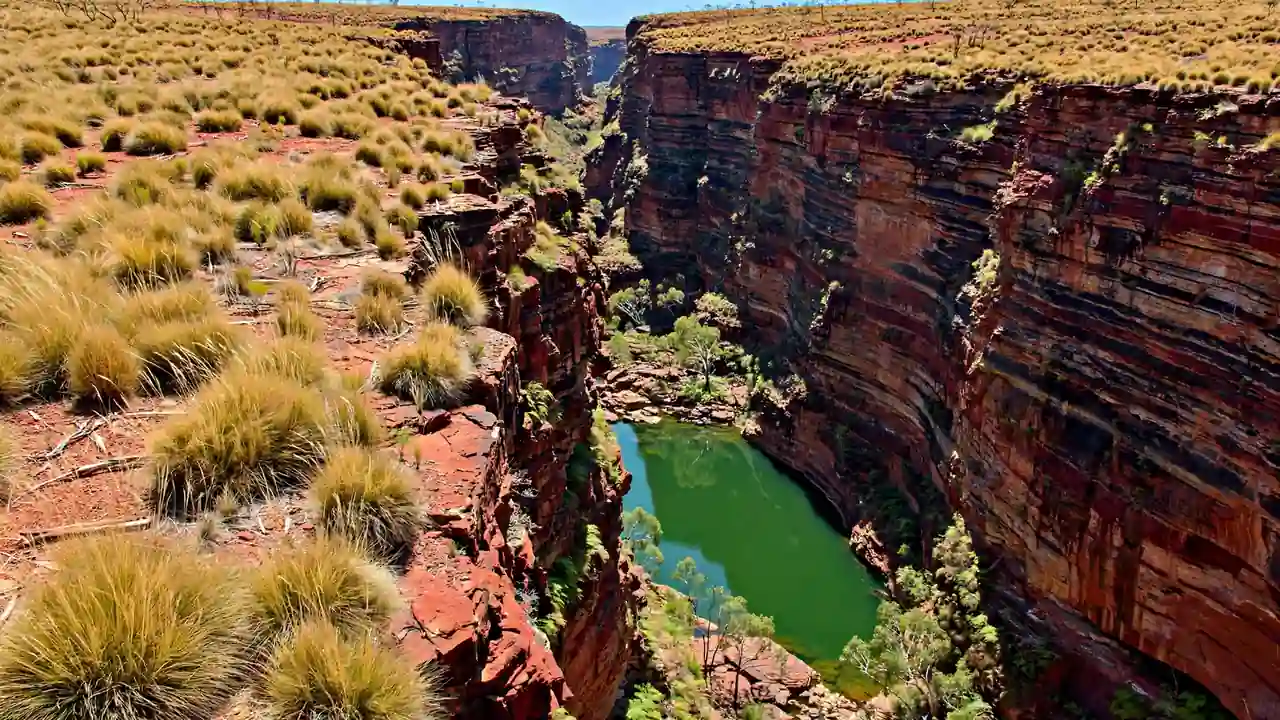
Karijini is WA’s most spectacular inland park — 2.5-billion-year-old banded ironstone gorges slot through the Hamersley Range, with emerald waterholes at the bottom of narrow chasms. The walks into Hancock Gorge (the “spider walk” squeeze), Weano Gorge and Dales Gorge (Fortescue Falls, Circular Pool) are among the great gorge experiences in Australia. It’s remote — a full day’s drive from Perth or Exmouth — and best in the cooler months (April–September). Summer temperatures can exceed 45°C and the gorges flash-flood. Allow three to four days minimum.
2. Purnululu National Park (Bungle Bungles)
The beehive domes of the Bungle Bungles are one of Australia’s most extraordinary landscapes — 350-million-year-old banded sandstone towers striped orange and black. Cathedral Gorge’s acoustics, Echidna Chasm’s narrow slot, and the flight over the range (the only way to grasp the scale) are the highlights. Access is via a rough 53 km 4WD-only track in the dry season (April–November), or by scenic flight from Kununurra. See our Savannah Way guide for how the Bungles fit into a Kimberley trip.
3. Ningaloo: Cape Range National Park
Cape Range protects the land side of Ningaloo Reef — rugged limestone ranges, deep canyons (Yardie Creek, Mandu Mandu Gorge), and beaches where the reef is metres from the sand. Turquoise Bay’s drift snorkel — regularly ranked among the best snorkelling in Australia — is inside the park. Combine gorge walks in the morning with reef snorkelling in the afternoon; few parks on Earth offer that combo. Whale shark season (March–July) is the peak time to visit.
4. Nambung National Park (The Pinnacles)
Two hours north of Perth, thousands of limestone pillars rise from yellow sand — the Pinnacles Desert is one of WA’s most photographed landscapes, especially at sunrise and sunset when the shadows stretch. The loop drive, the lookout, and the excellent discovery centre make it an easy half-day trip, best combined with the coastal towns of Cervantes and Jurien Bay.
5. Kalbarri National Park
Kalbarri pairs two landscapes: the dramatic coastal cliffs (Natural Bridge, Island Rock, the Kalbarri Skywalk’s vertigo-inducing platforms over the Murchison Gorge) and the inland river gorges (Nature’s Window, Z-Bend, the Loop Walk). The skywalk project has transformed the park’s accessibility. Visit in the cooler months; wildflower season (August–October) is superb.
6. Fitzgerald River National Park
A UNESCO Biosphere Reserve near Hopetoun, Fitzgerald River is WA’s botanical treasure — nearly 1,800 plant species, many found nowhere else, in a rugged coastal wilderness of quartzite ranges. East Mount Barren’s summit walk, the coastal lookouts, and spring wildflowers (September–November) are the drawcards. Remote and gloriously uncrowded.
7. Stirling Range National Park
The Stirling Range rises abruptly from the southern wheatbelt — WA’s only true mountain range, with Bluff Knoll (1,099 m) the highest peak in the state’s south-west. One of the few places in WA that sees snow, with extraordinary wildflower displays in spring and the challenging 6.8 km return Bluff Knoll climb — see our best hikes in Australia. Winter brings mist and drama; spring brings colour.
8. Leeuwin-Naturaliste National Park
Protecting the coast between Cape Naturaliste and Cape Leeuwin (the south-western tip of Australia), this park combines limestone caves (Jewel Cave, Lake Cave, Mammoth Cave — all tourable), surf beaches, karri forest and the Cape to Cape Track. The Margaret River wine region sits on its doorstep. Good year-round; winter storms make the coastal lookouts spectacular.
9. Walpole-Nornalup National Park (Valley of the Giants)
Home to the towering red tingle trees — some of the largest trees in the world — and the famous Tree Top Walk, a 600-metre canopy walkway 40 metres up. The Ancient Empire boardwalk at ground level is equally impressive. The surrounding inlets and the Conspicuous Cliff coastline add variety. A must on any south-west road trip.
10. Francois Peron National Park
At the tip of the Peron Peninsula near Denham (Shark Bay World Heritage Area), Francois Peron is red sand, white beaches and turquoise water — with a hot tub artesian bore at Peron Homestead. High-clearance 4WD required (soft sand, tyre pressures down). The contrast of red cliffs against blue water at Cape Peron is pure WA.
11. Millstream Chichester National Park
In the Pilbara between Karratha and Karijini, Millstream’s permanent waterholes and palm-fringed pools are an oasis in the iron-ore country — a perfect stop on the way to Karijini. The Homestead’s history, the Deep Reach pool, and the birdlife make it more than just a rest stop.
12. Torndirrup National Park
On Albany’s doorstep, Torndirrup’s granite coastline is the most dramatic in the south-west: the Gap and Natural Bridge (with the new accessible lookout), the Blowholes, and the wild Southern Ocean crashing against ancient rock. An easy half-day from Albany, spectacular in winter storms.
Planning Your WA Parks Trip
Distances are the challenge
WA’s parks are far apart — Karijini to Purnululu is the best part of 1,000 km. Don’t try to see everything in one trip; pick a region (the south-west, the Coral Coast, the Pilbara, the Kimberley) and do it properly. Our best road trips in Australia groups several of these parks into logical routes.
When to go
The north (Karijini, Purnululu, Millstream): dry season, April–September. The south-west (all the southern parks): year-round, best September–November for wildflowers. Ningaloo: March–July for whale sharks, year-round for reef. Summer in the north is dangerously hot — don’t attempt Karijini or the Kimberley in December–February.
Park passes
WA charges park entry fees (daily or annual passes); camping requires booking and fees. Remote parks have limited water and fuel — carry excess of both.
4-Day Karijini Itinerary
Day 1: Drive in (from Tom Price or via the Great Northern Highway), settle into Dales Campground, afternoon at Fortescue Falls and Fern Pool — the gentle introduction. Day 2: Weano Gorge and the famous Handrail Pool — the trail descends through the gorge with some scrambling; the reward is a swim in a pool walled by 2.5-billion-year-old banded ironstone. Afternoon: Joffre Falls lookout. Day 3: Hancock Gorge and the Spider Walk — Karijini’s signature adventure, squeezing through the narrow chasm to Kermit’s Pool. This is a Class 5 trail: take your time, wear grippy shoes, and don’t attempt it if you’re unsure. Day 4: Hamersley Gorge (a drive west) for the spa-like pools, then depart. Four days is the minimum; five lets you add Mount Bruce (WA’s second-highest peak, 1,234 m) or a rest day.
South-West Road Trip: Perth to Esperance
The ultimate WA parks road trip strings the southern parks together: Perth → Margaret River/Leeuwin-Naturaliste (caves, surf, wine) → Walpole-Nornalup (Valley of the Giants) → Albany/Torndirrup (Granite coast) → Fitzgerald River (wildflowers, East Mount Barren) → Esperance/Cape Le Grand (Lucky Bay’s kangaroos, Hellfire Bay) — see our best beaches in Australia for the Esperance coast. Allow 7–10 days, and time it for wildflower season (September–October) if you can. The best road trips in Australia covers the route in full.
Wildflower Touring: How to Do It
WA’s wildflower season (roughly August–October) deserves its own trip. The classic route: Perth → the Pinnacles → Kalbarri (coastal cliffs + inland gorges in bloom) → Mount Magnet/Mullewa (the northern wheatbelt’s everlastings) → back via the wheatbelt towns. Go with the season: flowers bloom north first (July–August around Kalbarri and the Pilbara) and move south (September–October in the Stirling Range and Fitzgerald River). The WA Wildflower Society and local visitor centres publish bloom reports. Stay on paths — the flowers are fragile and many grow nowhere else on Earth.
Shark Bay: Francois Peron and Beyond
The Shark Bay World Heritage Area deserves a fuller spotlight. Beyond Francois Peron’s red cliffs and hot tub: Shell Beach — 120 kilometres of beach made entirely of tiny white cockle shells, one of only two in the world; Hamelin Pool’s stromatolites — living fossils, 3.5-billion-year-old life forms still growing in the hypersaline water; Monkey Mia’s dolphins — the famous (carefully managed) dolphin encounters; and Dirk Hartog Island — the “Return to 1616” ecological restoration project, now a national park with some of Australia’s most ambitious wildlife reintroductions. Shark Bay is a 2-day drive from Perth or a short flight to Monkey Mia — and utterly unlike anywhere else in the country.
Kennedy Range and Mount Augustus
In WA’s Gascoyne, two underrated giants: the Kennedy Range National Park — a 75-kilometre mesa with gorges, Aboriginal art and some of the best outback camping in the state; and Mount Augustus (Burringurrah) — the world’s largest monocline (rock, not mountain, technically), twice the size of Uluru, rising from the plains with gorges, rock art and 8+ walking trails. Both are remote, best in the cooler months, and gloriously uncrowded. They pair perfectly with a Karijini trip for the ultimate Pilbara–Gascoyne expedition.
The Kimberley Coast: Parks by Sea
Some of WA’s most spectacular parks are accessible only from the water. King George Falls (twin 80-metre falls dropping off the plateau into the ocean), the Horizontal Falls (the tidal phenomenon — see our waterfalls top 20), the Buccaneer Archipelago’s thousand islands, and the Prince Regent National Park (one of Australia’s most pristine wilderness areas, with its own falls and ancient art). Kimberley expedition cruises (from Broome or Darwin, dry season only) are the way in — 7–13 day voyages that rank among the world’s great wilderness cruises. They’re expensive, but the Kimberley coast is one of the last truly wild coastlines on Earth.
The Pilbara Coast: Islands and Iron
The Pilbara’s coast is WA’s industrial-meets-wild frontier. The Dampier Archipelago (42 islands off Karratha/Dampier) — turquoise water, Aboriginal rock art (Murujuga/Murramuga is a vast open-air gallery), and excellent diving. The Montebello Islands — remote, pristine, world-class fishing and diving (and the site of 1950s British nuclear tests — the history is as confronting as the marine life is spectacular). Access is by boat or charter from Dampier/Karratha. It’s a long way from anywhere — but the combination of ancient culture, industrial scale and marine wilderness is unlike anything else in Australia.
Perth’s Backyard Parks
Closer to the city: Yanchep National Park (40 minutes north) — koala boardwalks, limestone caves (Crystal Cave tours), and kangaroos on the lawns; Serpentine National Park — Serpentine Falls and the Kitty’s Gorge walk, a superb half-day; John Forrest National Park — Australia’s oldest conservation area, with the Swan View Tunnel (an old railway tunnel, bring a torch) and waterfall walks in winter; and Rottnest Island (technically a reserve, not a national park) — quokkas, 63 beaches, and car-free cycling. These are the parks Perth locals actually visit weekly — and they’re all under an hour from the CBD.
Frequently Asked Questions
What is the best national park in Western Australia?
Karijini wins for sheer drama — ancient gorges and waterholes on an epic scale. Purnululu (Bungle Bungles) is the most unique landscape; Ningaloo/Cape Range offers the unbeatable gorge-plus-reef combination.
When is the best time to visit Karijini?
April to September — cooler temperatures, safe gorge walking, and flowing waterholes. Summer (November–March) brings extreme heat (45°C+) and flash-flood risk; many gorge walks close.
Can you visit the Bungle Bungles without a 4WD?
By road, no — the 53 km access track is 4WD-only and rough. The alternative is a scenic flight from Kununurra, which many visitors rate as the highlight of their Kimberley trip anyway.
What is wildflower season in Western Australia?
Peak wildflower season runs roughly August to October, starting in the north (Pilbara, Kalbarri) and moving south (Stirling Range, Fitzgerald River). It’s one of the world’s great floral displays — over 12,000 species, most found nowhere else.
Check alerts and book campgrounds at the WA Department of Biodiversity, Conservation and Attractions (Parks and Wildlife Service).