
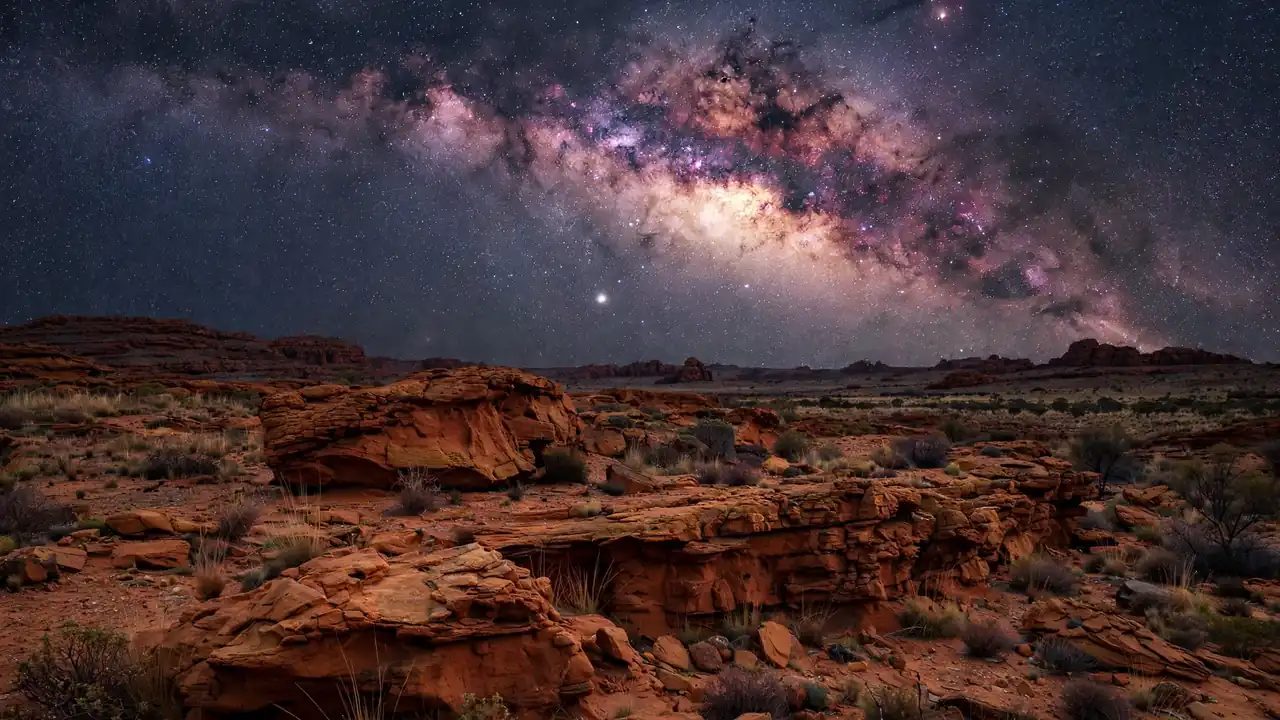
Stargazing in Australia: Dark Sky Parks
Australia has some of the darkest skies on Earth. The vast, empty interior — far from city lights, under dry desert air — offers night skies that most of the world has forgotten exist: the Milky Way bright enough to cast shadows, the Magellanic Clouds, the Southern Cross, and satellites drifting overhead. This stargazing in Australia dark sky parks guide covers the certified Dark Sky Parks, the best outback skies, when to go, and how to photograph it all.
The southern hemisphere sky is the drawcard: northern visitors see constellations they’ve never seen — the Southern Cross, Centaurus, the Coal Sack, Omega Centauri (the finest globular cluster in the sky), and the Large and Small Magellanic Clouds, our neighbouring galaxies, visible to the naked eye.
Australia’s Certified Dark Sky Places
1. Warrumbungle National Park, NSW — Dark Sky Park
Australia’s first certified Dark Sky Park, and still the benchmark. The Warrumbungles’ volcanic spires make a dramatic foreground for the Milky Way, and the Siding Spring Observatory (Australia’s premier optical observatory) sits on the park’s edge — visit during the day, then stargaze at night. The park’s Warrumbungle entry in our NSW parks guide covers the daytime side. Coonabarabran’s motels and the park campground are the bases; winter offers the longest, darkest nights.
2. Arkaroola, South Australia — Dark Sky Sanctuary
In the northern Flinders Ranges, Arkaroola’s wilderness sanctuary holds some of the darkest measured skies in Australia. The observatory runs night sky tours with serious telescopes, and the rugged ranges make spectacular foregrounds. It’s remote — a full day from Adelaide — but the combination of outback geology by day and pristine skies by night is unmatched.
3. Wai-Iti / River Murray, South Australia — Dark Sky Reserve
The River Murray Dark Sky Reserve (around Swan Reach, 90 minutes from Adelaide) is the most accessible certified dark sky in Australia — a genuine dark-sky experience within easy reach of a capital city. The river red gums and cliff faces add foreground interest, and houseboat stargazing is a thing here.
The Outback: The World’s Best Stargazing
Certification aside, the outback’s skies are the main event. Anywhere 100+ km from a town in the interior — the Nullarbor, the Red Centre, the Kimberley, western Queensland — offers staggeringly dark skies. Standouts:
The Nullarbor Plain: pull off at a rest area, lie on the bonnet, and watch the Milky Way arc from horizon to horizon. Our Nullarbor guide covers the practicalities; the night sky is the free bonus. Uluru-Kata Tjuta: the desert sky over the rock is iconic — several operators run “sounds of silence” style astronomy dinners. The Flinders Ranges: Wilpena Pound’s amphitheatre under the stars. Western Queensland: Charleville’s Cosmos Centre runs observatory sessions in some of the darkest skies in the east. The Pilbara and Kimberley: dry air, zero light pollution, and the Milky Way’s galactic core directly overhead in winter.
When to Go Stargazing
Best months
Winter (June–August) offers the longest nights and the galactic core of the Milky Way high overhead in the early evening — the classic Milky Way shot. Summer nights are shorter but bring different constellations and the Magellanic Clouds high. The dry season (May–October) is best for the outback generally — clear skies, no clouds.
Moon phases
The moon is the enemy of dark skies. Plan around the new moon — the week either side of new moon offers the darkest skies. A full moon washes out the Milky Way entirely (though moonlit landscapes have their own beauty). Check a moon phase calendar before booking any stargazing trip.
Weather
Desert air is the key: low humidity means clearer, steadier skies. Coastal areas bring haze and cloud. Always have a backup night — even in the desert, one cloudy night in five is normal.
What You’ll See
With the naked eye under truly dark skies: the Milky Way’s galactic core with visible dark dust lanes, the Southern Cross and Pointers, Scorpius, the Coal Sack dark nebula, the Large and Small Magellanic Clouds, the Eta Carinae nebula region, Omega Centauri (as a fuzzy star — spectacular in binoculars), Jupiter and Saturn (obvious bright “stars” that don’t twinkle), and regular satellites and the occasional ISS pass. With binoculars, everything gets better — the Moon’s craters, Jupiter’s moons, star clusters resolve into hundreds of stars.
Astrophotography Basics
You don’t need expensive gear to start. A modern phone on a tripod (or propped on a rock) with a long-exposure night mode can capture the Milky Way under dark skies. For dedicated cameras: a wide-angle lens (f/2.8 or faster), a sturdy tripod, manual focus set to infinity, ISO 3200–6400, and 15–25 second exposures (the “500 rule”: 500 ÷ focal length = max seconds before stars trail). Shoot in RAW, focus on a bright star using live view zoomed in, and take many shots. The galactic core season (February–October, best June–August) is when the Milky Way is most photogenic. And turn off your headlamp’s white light — red light preserves night vision.
Stargazing Tours and Observatories
Several operators elevate the experience with telescopes and expert guides: Siding Spring Observatory (Warrumbungles) open days and night tours; Arkaroola’s observatory sessions; Charleville Cosmos Centre; the Perth Observatory’s night sky tours; and numerous “astro-tourism” operators in the Flinders Ranges, Uluru and the Blue Mountains. A guided session with a big telescope — seeing Saturn’s rings or a globular cluster resolved into thousands of stars — is worth doing at least once.
Practical Tips
Dress warmer than you think — desert nights drop below freezing in winter even after 25°C days. Bring a reclining chair or swag — neck comfort matters for long sky sessions. Download a star-chart app (they work offline and identify constellations when you point your phone). Give your eyes 20–30 minutes to fully adapt to the dark — and once adapted, avoid white light entirely. And check park rules: some parks restrict after-dark access to certain areas.
Tour of the Southern Sky
Learn these and you’ll never be lost at night in Australia. The Southern Cross (Crux): the famous four-star cross — extend its long axis 4.5 times to find south. The Pointers (Alpha and Beta Centauri): the two bright stars that point to the Cross; Alpha Centauri is the closest star system to our sun. Scorpius: the scorpion’s curved tail with red Antares at its heart — dominant in winter evenings. The Coal Sack: the dark nebula beside the Cross, visible as a black patch in the Milky Way. The Magellanic Clouds: two fuzzy patches (our neighbouring galaxies) high in the south on summer nights. Omega Centauri: the finest globular cluster in the sky — a fuzzy star to the naked eye, 10,000 suns in binoculars. Eta Carinae: a massive unstable star in a glowing nebula, visible as a bright patch in the Milky Way.
Astrophotography Gear Guide
Starting out (phone): a modern phone, a small tripod, and a night-mode app. Under dark skies, this genuinely works — the Milky Way will appear. Enthusiast (DSLR/mirrorless): a wide-angle fast lens (14–24mm, f/2.8 or faster), a sturdy tripod, an intervalometer, and spare batteries (cold kills them). Committed: a star tracker (which rotates your camera with the Earth, allowing minute-long exposures without trails), a fast 50mm for panoramas, and stacking software. Whatever the level, the fundamentals don’t change: focus manually on a bright star, shoot RAW, and take dark frames. And the best upgrade isn’t gear — it’s darker skies. A phone under the Nullarbor sky beats a full-frame camera in the suburbs.
Protecting the Night: Light Pollution
Australia’s dark skies are an asset worth protecting — and they’re under threat from expanding development, mining operations and satellite constellations. What helps: supporting Dark Sky places (your visit is a vote), using warm-coloured, shielded outdoor lighting at home, and advocating for lighting ordinances in your council. The Warrumbungles and Arkaroola prove that dark-sky protection and tourism thrive together. The night sky is the oldest human heritage — and in Australia, it’s still spectacularly intact. Let’s keep it that way.
Aurora Australis: The Southern Lights
The southern hemisphere’s aurora — the Aurora Australis — is visible from Tasmania, southern Victoria and southern WA during strong solar storms. Tasmania is Australia’s aurora capital: the far south (Cockle Creek, the Tasman Peninsula, Bruny Island) offers the best odds, with the aurora dancing over the Southern Ocean. The best chances come around the equinoxes (March–April, September–October) during high solar activity — and we’re currently in a strong part of the solar cycle. Follow the aurora forecast services and the Tasmanian aurora chaser communities for alerts. Photographing it needs the same gear as Milky Way shooting, but pointed south — and patience. When it comes, it’s unforgettable: green and purple curtains rippling over the sea at the end of the world.
Night Sky Tours by State
NSW: Siding Spring Observatory open days, Blue Mountains astro-tours, Byron Bay hinterland sessions. VIC: the Astronomical Society of Victoria’s public nights, High Country astro-tours. QLD: Charleville Cosmos Centre, Atherton Tablelands night sky tours. WA: Perth Observatory, Gravity Discovery Centre (Gingin), Karijini astro-experiences. SA: Arkaroola observatory, River Murray Dark Sky Reserve tours. NT: Uluru astronomy dinners, Alice Springs earth sanctuary tours. TAS: aurora chasing in the far south, Cradle Mountain night walks. A guided session under a big telescope — Saturn’s rings, a globular cluster resolved into stars — is the fastest way to fall in love with the night sky.
Stargazing and the Moon: Lunar Landscapes
The moon isn’t always the enemy — a bright moon transforms the outback into a silver landscape where you can walk without a torch. Full-moon nights at Uluru, the Flinders Ranges or the Bunda Cliffs are magical in their own right: the red rock glowing, shadows sharp, the land readable. Some photographers prefer the “moonlit landscape” to the Milky Way — it needs no stacking, no tracking, just a tripod and a long exposure. And the nights around full moon are perfect for nocturnal wildlife spotting (see our wildlife guide) — owls, nightjars and marsupials are all more active in moonlight. Plan a trip that spans the lunar cycle: new moon for the deep sky, full moon for the landscape.
Dark Skies and Aboriginal Astronomy
Australia’s night sky is the world’s oldest observatory — Aboriginal nations have read the stars for 60,000+ years, with the most developed astronomical traditions on Earth. The Emu in the Sky (the dark constellation formed by the Milky Way’s dust lanes, not stars) marks the emu breeding season; the Seven Sisters (Pleiades) dreaming tracks span the continent; and the heliacal rising of stars marked seasonal calendars for hunting, gathering and ceremony. Several operators now offer Aboriginal astronomy tours — in the Blue Mountains, the Flinders Ranges, Uluru and Kakadu — that share this knowledge with permission. It’s the deepest stargazing experience Australia offers: the sky as story, calendar and law. Seek it out.
Frequently Asked Questions
Where is the best stargazing in Australia?
The Warrumbungle National Park (NSW) is Australia’s first certified Dark Sky Park and the benchmark. For the darkest skies, the remote outback — the Nullarbor, Arkaroola (SA), the Red Centre and the Kimberley — offers some of the darkest skies on Earth.
When is the best time for stargazing in Australia?
Winter (June–August) offers the longest nights and the Milky Way’s galactic core overhead in the evening. Plan around the new moon for the darkest skies, and visit during the dry season (May–October) for the clearest outback weather.
Can you see the Milky Way with the naked eye in Australia?
Yes — under dark outback skies, the Milky Way is bright enough to cast a faint shadow, with clearly visible dark dust lanes. It’s one of the most common “wow” moments for visitors from light-polluted cities.
What is a Dark Sky Park?
A Dark Sky Park is a place certified by DarkSky International for exceptional night-sky quality, lighting management and public outreach. Australia has certified Dark Sky Parks, Sanctuaries and Reserves — the Warrumbungles (NSW) was the first.
Find certified dark sky places worldwide at DarkSky International, the authority behind Dark Sky Park certification.