
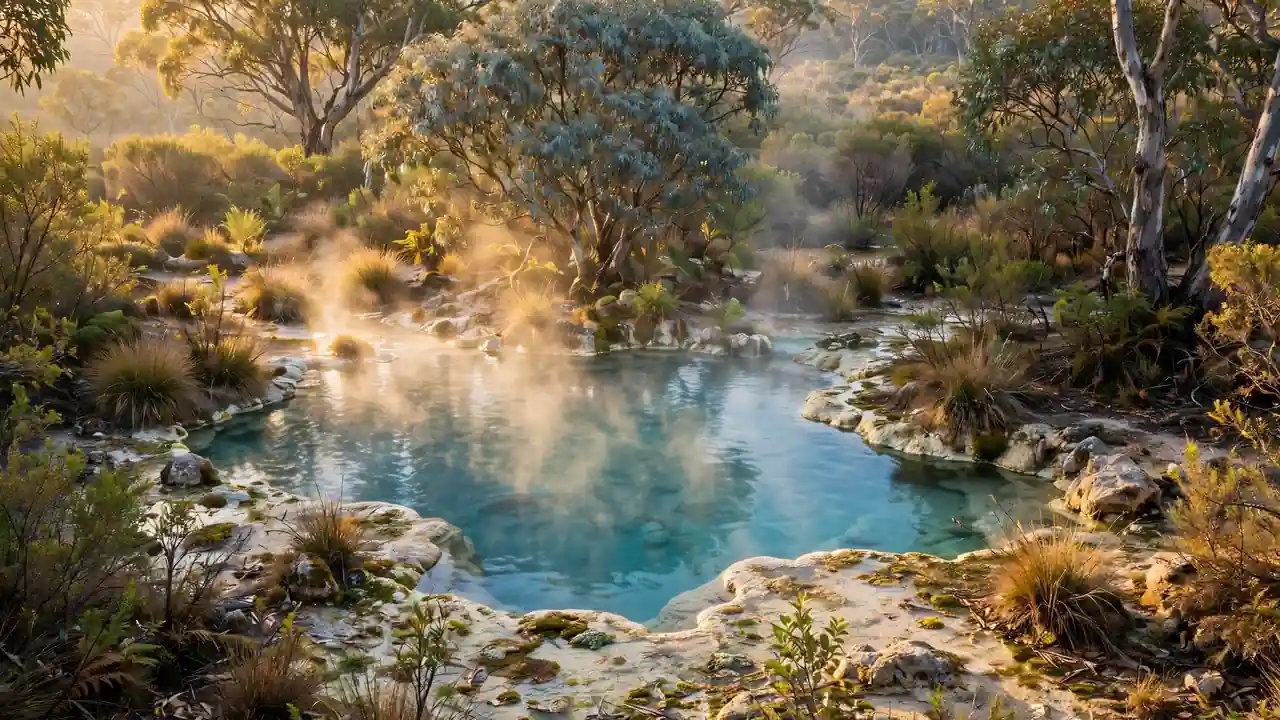
Best Hot Springs in Australia
Australia’s hot springs are wonderfully varied — from luxury bathhouses on the Mornington Peninsula to wild thermal pools in the Northern Territory outback and artesian bores in the Queensland desert. These are the best hot springs in Australia, covering natural springs, developed bathhouses and everything in between.
A note on etiquette that applies everywhere: shower before entering, no glass, keep noise down, and respect the cultural significance of springs to Aboriginal traditional owners — many thermal springs are sacred sites.
Victoria
1. Peninsula Hot Springs, Mornington Peninsula
Australia’s most famous hot springs complex — natural thermal mineral water (around 43–50°C at the source) flowing into 70+ pools across a hillside site, from the social Bath House to the adults-only Spa Dreaming Centre with its hilltop pool overlooking the bush. It’s a full-day or evening experience, 90 minutes from Melbourne. Book ahead — it sells out, especially winter weekends. Winter is the magic season: steaming pools under cold air and stars. Combine with the Mornington Peninsula National Park for the perfect weekend.
2. Hepburn Bathhouse, Daylesford
Australia’s original hot springs experience — bathing in Hepburn’s mineral waters since 1895. The historic bathhouse offers communal and private mineral baths in a beautiful heritage setting, in the heart of “spa country”. The surrounding Hepburn Regional Park has mineral springs walking tracks where you can taste the different waters (an acquired taste). Daylesford’s food and wine scene makes it a top weekend escape from Melbourne.
3. Metung Hot Springs, East Gippsland
On the shores of the Gippsland Lakes, Metung’s cliff-top hot springs offer geothermal bathing with sweeping lake views — a newer, more boutique alternative to the Peninsula. The lakes setting is gorgeous, and the region’s food (lakes Entrance seafood, local wine) is excellent.
Northern Territory
4. Mataranka Thermal Pool, Elsey National Park
The Territory’s most beloved swimming spot — a crystal-clear 34°C thermal pool in a paperbark and palm forest, the setting of the novel We of the Never Never. It’s on the Savannah Way route and the perfect reset after days of outback driving. Go early morning to beat the crowds in the dry season (May–October). The nearby Bitter Springs (a series of thermal pools you can drift down) is the quieter alternative.
5. Talaroo Hot Springs, Gulf Savannah
In Queensland’s Gulf country near Mount Surprise, Talaroo’s hot springs flow through a series of pools in a remote, beautiful setting — with guided tours sharing the Ewamian Aboriginal cultural stories of the springs. It’s genuinely off the beaten track, which is exactly the point.
Queensland
6. Innot Hot Springs, Atherton Tablelands
A classic outback Queensland hot springs — natural thermal pools in a bush setting near Mount Garnet, with camping on site. Rustic, affordable and authentic: the kind of place where you soak under the stars and swap stories with grey nomads. A great stop on an Atherton Tablelands loop.
South Australia
7. Dalhousie Springs (Witjira National Park)
In the far north of SA near the NT border, Dalhousie is a desert oasis — a huge warm artesian spring (around 34–38°C) in the middle of the Simpson Desert fringe, fringed by palms. It’s the traditional endpoint (or start) of the Oodnadatta Track, and swimming here after days of desert driving is one of the great Australian travel moments. Remote: high-clearance vehicle recommended, and check road conditions.
Western Australia
8. Zebedee Springs, El Questro (Kimberley)
A series of warm thermal pools in a living-room-sized patch of Livistona palms in El Questro Wilderness Park — open only in the mornings (to protect the environment), and accessed by a short walk. The Kimberley setting is jaw-dropping. Dry season only (the park closes in the wet).
9. Peron Homestead Hot Tub, Francois Peron National Park
An artesian bore feeding a rustic hot tub at the historic Peron Homestead in Shark Bay — red sand, turquoise water, and a hot soak with a view. High-clearance 4WD required to reach it. See our WA national parks guide for the full park.
Tasmania
10. Hastings Caves Thermal Pool, Far South
After touring the spectacular Hastings Caves (Australia’s largest dolomite cave open to the public), the 28°C thermal pool in the forest is the perfect wind-down. It’s not the hottest spring on this list, but the combination of world-class caves, tall forest and a warm soak in Tasmania’s far south is unique. Book cave tours ahead in summer.
Planning Your Hot Springs Trip
Best time to go
Winter is peak hot springs season in the south — the contrast of hot water and cold air is the whole experience, and the southern bathhouses (Peninsula, Hepburn) are at their most atmospheric. In the north (Mataranka, Talaroo, Dalhousie), the dry season (May–October) is the window — both for access and comfort.
What to bring
Swimmers, a towel, a water bottle (hydrate — hot water dehydrates), and warm clothes for afterwards. Most developed springs provide lockers and towels for hire. Leave the glass and the speaker at home.
Health notes
Hot springs aren’t for everyone: pregnant women, people with heart conditions or high blood pressure, and young children should check guidance and limit soak times. Don’t submerge your head in natural thermal pools (rare amoebic infections are a risk in warm freshwater — the “don’t put your head under” rule at Mataranka and similar pools is serious). Shower before and after.
Hot Springs Etiquette
Many Australian thermal springs are culturally significant to Aboriginal traditional owners — treat them with the respect you’d show a sacred site, because that’s what they are. Follow all signage, don’t use soap or shampoo in natural pools, keep voices low, and take all rubbish with you. At developed bathhouses, the rules are simpler: shower first, swimwear always, and phones away in the bathing areas.
Hot Springs Road Trips
Hot springs anchor great touring routes. Victoria’s spa country loop: Melbourne → Daylesford/Hepburn (bathhouse, mineral springs walks) → the Macedon Ranges → back via the Dandenongs. Two to three days of soaking, gardens and country food. The Savannah Way springs: Mataranka and Bitter Springs (NT) → Talaroo (Queensland Gulf) — thermal pools strung along Australia’s great northern road trip (see our Savannah Way guide). The outback artesian trail: Dalhousie Springs (SA) → the Oodnadatta Track → Marree — desert springs and mound springs in some of the remotest country in the state. Each route pairs the springs with the landscapes around them — the soaking is half the experience.
Onsen Culture Meets Australia
Australia’s developed hot springs increasingly draw on Japanese onsen culture — and the etiquette overlaps. Wash thoroughly before entering the pools. Swimwear is required (unlike Japan) — check each venue’s rules. Keep voices low; the bathhouse is a quiet zone. No phones or cameras in bathing areas. Don’t put your head under the water. And hydrate — the mineral water, the heat and the relaxation combine to dehydrate you faster than you’d expect. The best bathhouses (Peninsula’s Spa Dreaming Centre, Hepburn’s private baths) understand that the ritual matters as much as the water.
What Makes Thermal Water Special
Australia’s thermal waters rise from the Great Artesian Basin and volcanic aquifers, picking up minerals (calcium, magnesium, sulphur, silica) on journeys that take thousands of years. The water at the source can be 50°C+ before cooling to bathing temperature. Different springs have different characters — Hepburn’s mineral waters taste strongly of iron and salts (the “taste the springs” walks are an experience), while Mataranka’s is crystal-clear and odourless. People have sought these waters for health and relaxation for millennia — from Aboriginal traditional owners’ healing springs to the 19th-century spa towns. Whether you believe in the therapeutic claims or just enjoy a hot soak under the stars, the experience is the point.
The Great Artesian Basin: Where the Water Comes From
Many of Australia’s hot springs — Dalhousie, the Queensland artesian bores, the mound springs of the Oodnadatta Track — are fed by the Great Artesian Basin, one of the largest underground freshwater reservoirs in the world, underlying 22% of Australia. Rain falling on the eastern highlands percolates down and travels westward over thousands of years, emerging under pressure where the geology allows — sometimes at 60°C+. The basin’s water sustained Aboriginal nations for millennia and made European settlement of the interior possible. The mound springs (like Blanche Cup and the Bubbler on the Oodnadatta Track) are the basin’s most delicate features — ancient, slow-growing, and home to endemic species found nowhere else. Visit them with the reverence they deserve.
Tasmania’s Thermal Corners
Beyond Hastings Caves: Tasmania’s thermal options are limited but charming. The Hastings thermal pool (28°C) remains the pick — forest setting, post-cave soak, far-south wilderness. Closer to Hobart, the day spa scene (rather than natural springs) fills the gap — floating saunas on the Derwent, wood-fired hot tubs with mountain views. Tasmania’s real thermal story is its wild water: the hot-water bottles of the Overland Track huts after a day in sideways rain. Sometimes the best hot spring is the one you carry.
Mound Springs of the Oodnadatta Track
The Oodnadatta Track’s mound springs are among Australia’s most delicate natural wonders — and several are warm. Blanche Cup, The Bubbler (a spring that gently pulses), and Wabma Kadarbu are ancient artesian springs that have built up mineral mounds over thousands of years, creating desert oases with endemic fish, plants and birds found nowhere else. They’re culturally significant to the Arabana people — stay on the boardwalks, don’t swim in the mound springs themselves (the nearby Coward Springs has a proper swimming bore for that). The mound springs, Dalhousie, and the track’s railway history make the Oodnadatta one of Australia’s great outback drives — see our best road trips in Australia.
Soaking Through the Seasons
Hot springs change character with the seasons. Winter is the classic: steam rising into cold air, the contrast that makes every soak euphoric — the southern bathhouses (Peninsula, Hepburn) are at their absolute best June–August. Spring brings wildflowers to the bush settings (Talaroo, the Grampians’ surrounds) and mild evenings for outdoor pools. Summer is the time for the cooler springs — Mataranka’s 34°C pool is refreshing when the air is 38°C, and the tropical springs are at their most inviting. Autumn offers golden light and smaller crowds at the developed bathhouses. There’s no bad season for a hot spring — just different moods. Match the spring to the season and you’ll never be disappointed.
Hot Springs and Stargazing: The Perfect Combo
Hot springs and dark skies are natural partners — and several springs offer both. Dalhousie Springs sits under some of the darkest skies in South Australia; Talaroo and Mataranka are far from city lights; and the Peninsula Hot Springs runs evening bathing sessions where you can soak under the stars. The ritual is simple: float in hot mineral water, look up. The Milky Way from a thermal pool, with steam rising into the cold air, is one of Australia’s great sensory experiences. See our dark sky parks guide for the astronomy side.
Frequently Asked Questions
What are the best hot springs in Australia?
Peninsula Hot Springs (Victoria) is the most developed and famous; Hepburn Bathhouse (Victoria) is the historic classic; Mataranka Thermal Pool (NT) is the best natural outback spring; and Dalhousie Springs (SA) is the ultimate remote desert oasis.
Are Australia’s hot springs natural?
Many are — Mataranka, Talaroo, Dalhousie, Innot and Zebedee are natural thermal pools. The developed bathhouses (Peninsula, Hepburn, Metung) use natural thermal mineral water in built pools. Both are the real thing; the experience just differs.
When is the best time to visit hot springs in Australia?
Winter (June–August) is best for the southern springs — hot water under cold skies. Northern Territory and outback springs are best in the dry season (May–October) when roads are open and the weather is pleasant.
Are hot springs in Australia safe?
Developed bathhouses are very safe. At natural thermal pools, don’t submerge your head (rare amoebic risk in warm freshwater), check water temperature before entering, and follow all signage. Pregnant women and people with heart conditions should seek medical advice first.
For information on geothermal resources and spring management, visit Geoscience Australia, the national geoscience agency.